Неявні функції

Interactive · 1 question

So far, almost all of the functions that we've seen so far are of the form y=f(x)y=f(x). Examples include y=3xy=3x or y=−x+2y=-\sqrt{x+2}. These are called explicit functions.

On the other hand, implicit functions, like their name suggests, are functions of the form f(x1,x2,…,xn)=0f(x_1,x_2,\ldots,x_n)=0, where x1,x2,…,xnx_1,x_2,\ldots, x_n are different variables. While this general expression may look scary, don't worry! In single-variable calculus, we only deal with implicit functions of the form f(x,y)=0f(x,y)=0.

So, what do these implicit functions look like? One example is xy−1=0.xy-1=0. Of course, for this equation we can solve for yy to get y=1x.y=\frac{1}{x}. By doing so, we changed our initially-implicit function to an explicit function. On the other hand, the implicit function x2+y2−1=0x^2+y^2-1=0 can't be rearranged into one explicit function. The best we can do is solve for yy to get y=±1−x2.y=\pm\sqrt{1-x^2}. The ±\pm must be there because (1−x2)2=(−1−x2)2=1−x2.\left(\sqrt{1-x^2}\right)^2=\left(-\sqrt{1-x^2}\right)^2=1-x^2. So, at best we can rewrite this implicit function as two separate explicit functions. Graphically, the two explicit functions are shown below:

Now that you've seen some examples, which of the following do you think is an implicit function?

Choose one answer

Read · 1 min

Here is some practice for implicit functions. Good luck!

Video · + 2 min read

(Videos) An Introduction to Implicit Differentiation

by PatrickJMT

Here's a video by patrickJMT explaining what an implicit equation is and how you go about solving it.

Before we begin let's look at the difference between an explicit equation and an implicit equation. An explicit equation is one where yy is by itself and xx is on the other side. y=x2y=sin⁡x+xy=x^2\\ y=\sin x+x An implicit equation is where the xx's and yy's are all mixed up on the same side. x2+xy=yxy=x+yx^2+xy=y\\ xy=x+y

Normally when taking a derivative we take it with respect to xx. ddx(x2)=2x\frac{d}{dx}(x^2)=2x Notice that the symbols match up. We have a dxdx and an x2x^2.

But what if we take the derivative with respect to xx of a function that doesn't have an xx? ddx(y2)\frac{d}{dx}(y^2) The symbols don't match up. But we would like them to. What we do is rewrite ddx\frac{d}{dx} as ddydydx\frac{d}{dy}\frac{dy}{dx}. Now our expression becomes: ddydydxy2\frac{d}{dy}\frac{dy}{dx}y^2 We can rearrange this: ddyy2dydx\frac{d}{dy}y^2\frac{dy}{dx} Notice that the symbols match for dydy and y2y^2 now. So we can differentiate. 2ydydx2y\frac{dy}{dx}

This becomes the gist of how we solve these. We take the derivative like normal, when it's respect to xx, and if we have something different, like a yy or zz, we tack on a dydx\frac{dy}{dx} or dzdx\frac{dz}{dx}.

The procedure for solving these is simple.

  1. Take the derivative and add dydx\frac{dy}{dx} where needed.
  2. Get rid of parentheses.
  3. Solve for dydx\frac{dy}{dx}.

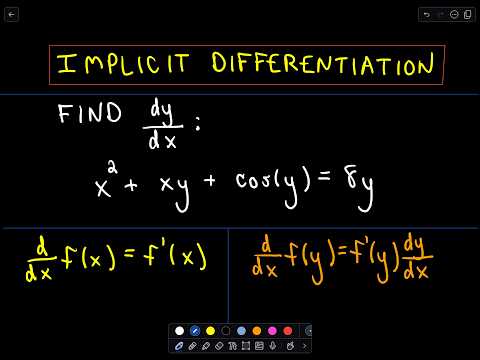
Let's look at an example now. Find dydx\frac{dy}{dx}. x2+xy+cos⁡y=8yx^2+xy+\cos y=8y We start by taking the derivative of each piece. So, the derivative of x2x^2 is just 2x2x. But what about xyxy? This is a product so we need to use the product rule. (x)′(y)+(x)(y)′y+xdydx\color{red}{(x)'}(y)+(x)\color{red}{(y)'}\\ y+x\frac{dy}{dx} For cos⁡y\cos y we need to apply the chain rule. −sin⁡y⋅(y)′−sin⁡ydydx-\sin y\cdot\color{red}{(y)'}\\ -\sin y\frac{dy}{dx} Finally, 8y8y becomes 8dydx8\frac{dy}{dx}.

Putting all these together we get: 2x+(y+xdydx)−sin⁡ydydx=8dydx2x+\left(y+x\frac{dy}{dx}\right)-\sin y\frac{dy}{dx}=8\frac{dy}{dx}

So step 2 tells us to get rid of the parentheses which is easy. 2x+y+xdydx−sin⁡ydydx=8dydx2x+y+x\frac{dy}{dx}-\sin y\frac{dy}{dx}=8\frac{dy}{dx}

So now we have three terms with dydx\frac{dy}{dx} and two terms without. What we want to do is move all the terms with it to one side and all terms without it to the other side. Then we can factor out a dydx\frac{dy}{dx} and solve for it. 2x+y+xdydx−sin⁡ydydx=8dydxxdydx−sin⁡ydydx−8dydx=−2x−ydydx(x−sin⁡y−8)=−2x−ydydx=−2x−yx−sin⁡y−82x+y+x\frac{dy}{dx}-\sin y\frac{dy}{dx}=8\frac{dy}{dx}\\ x\frac{dy}{dx}-\sin y\frac{dy}{dx}-8\frac{dy}{dx}=-2x-y\\ \frac{dy}{dx}(x-\sin y-8)=-2x-y\\ \boxed{\frac{dy}{dx}=\frac{-2x-y}{x-\sin y-8}}

Here's another video by Patrick where he shows you how to find the second derivative of an implicit equation. When finding higher power derivatives for implicit equations you usually end up plugging back in the expression from the previous derivatives.

9x2+y2=918x+2ydydx=02ydydx=−18xdydx=−18x2ydydx=−9xy9x^2+y^2=9\\ 18x+2y\frac{dy}{dx}=0\\ 2y\frac{dy}{dx}=-18x\\ \frac{dy}{dx}=-\frac{18x}{2y}\\ \frac{dy}{dx}=-9\frac{x}y

So there's the first derivative, but now we need to find the second. To do this we need to use the quotient rule. d2ydx2=(−9x)′(y)−(−9x)(y)′y2d2ydx2=−9y+9xdydxy2\frac{d^2y}{dx^2}=\frac{\color{red}{(-9x)'}(y)-(-9x)\color{red}{(y)'}}{y^2}\\ \frac{d^2y}{dx^2}=\frac{-9y+9x\color{red}{\frac{dy}{dx}}}{y^2} So what do we do with this dydx\frac{dy}{dx} in our problem now? Well, we actually have an expression for this since it's just the first derivative. dydx=−9xyd2ydx2=−9y+9x(−9xy)y2d2ydx2=−9y−81x2yy2d2ydx2=−9y2y−81x2yy2d2ydx2=−9y2−81x2yy2d2ydx2=−9y2−81x2y3d2ydx2=−9y2−81x2y3d2ydx2=−9(y2+9x2)y3\color{red}{\frac{dy}{dx}=-9\frac{x}y}\\ \frac{d^2y}{dx^2}=\frac{-9y+9x\color{red}{(\frac{-9x}{y})}}{y^2}\\ \frac{d^2y}{dx^2}=\frac{-9y-\frac{81x^2}{y}}{y^2}\\ \frac{d^2y}{dx^2}=\frac{-\frac{9y^2}{y}-\frac{81x^2}{y}}{y^2}\\ \frac{d^2y}{dx^2}=\frac{\frac{-9y^2-81x^2}{y}}{y^2}\\ \frac{d^2y}{dx^2}=\frac{-9y^2-81x^2}{y^3}\\ \frac{d^2y}{dx^2}=\frac{-9y^2-81x^2}{y^3}\\ \frac{d^2y}{dx^2}=\frac{-9(y^2+9x^2)}{y^3}\\ Now take a look at the expression in the parentheses, y2+9x2y^2+9x^2. This is the same expression that we started with above. x2+y2=9\color{red}{x^2+y^2=9} So we can substitute in 99 for that! d2ydx2=−9(9)y3d2ydx2=−81y3\frac{d^2y}{dx^2}=\frac{-9(\color{red}{9})}{y^3}\\ \boxed{\frac{d^2y}{dx^2}=-\frac{81}{y^3}}

Type a concept, like “slope” or “photosynthesis”.

↑ ↓ to choose · Enter to openSearch explanations and problems