
Illustrated · 2 min
SETI is defined as the "search for extraterrestrial intelligence". But what does that mean?
As when considering what it means for something to be alive when searching for extraterrestrial life more generally, we have to be very careful to not define intelligence in an inappropriate way.
How Many Intelligent Species Are There On Earth?
There are many different definitions of 'intelligence', which involve a wide range of different traits - perception, cognition, self-awareness, pattern recognition, abstract reasoning, problem solving, language skills, tool use.
To illustrate the problem: depending on which definition you use, the number of intelligent species on Earth might be zero, one, or more than dozen or many times larger.
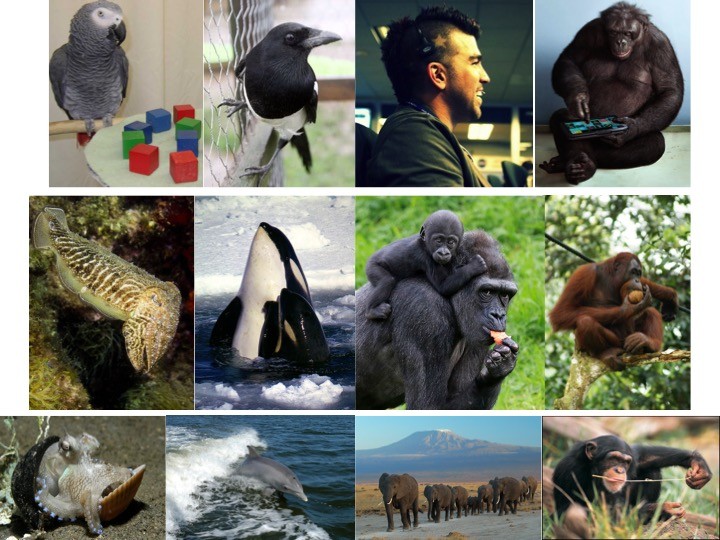
Members of selected intelligent species on Earth, with intelligence assessed by self-awareness, language skills, and/or tool use. Images licensed under Creative Commons / educational use. Collage by M.W. Busch.
Definitions of Intelligence for SETI
The question of how we define intelligence more generally is far outside the purview of astronomy. But we can consider more limited pragmatic definitions.
For example, we could say "Intelligence involved a species that uses tools in a way that could be detected over interstellar distances". This has the advantage of specifying those possible extraterrestrial intelligences that SETI searches would be able to find. But it also excludes many possible varieties of intelligence. e.g. should there be hyperintelligent cuttlefish under the ice shell of a Europa-like moon of an exoplanet, they would not be counted under this definition.
Likewise, humans would only have recently been called intelligent by the pragmatic definitions required for SETI. It has been less than 100 years since we started using high-power radio broadcasting; less than perhaps 300 years that we have made detectable changes to the composition of Earth's atmosphere; a few thousand years since large-scale agriculture and land-use changes would be potentially observable by any alien astronomers who may be watching Earth. That compares to many tens of thousands to millions of years that our ancestors would be intelligent by the more usual anthropological and biological definitions.
Current SETI programs focus on finding potential extraterrestrial intelligence that does things we can observe astronomically, out of necessity. But, again, it's important to recognize the limitation of that definition. And, one final point: We do not expect any extraterrestrial intelligence that SETI may find to be anything like humans - they will have less in common biologically with us than we do with a cuttlefish.