
Illustrated · 3 min
Dark matter. It sounds a little ominous --the stuff of science fiction-- and in a sense, it is. Scientists are not sure exactly what dark matter is. In this particular area of study, the pressure is on to find out what this mysterious stuff is comprised of and how it interacts with other matter.
However, this string of unknowns usually raises an interesting and intuitive question. If we know nothing about dark matter, then why do think it exists in the first place?
There are a myriad of reasons why scientists support this concept, but if we were to make a base case supporting the existence of dark matter, we would start by examining movement and mass, specifically in galaxies.
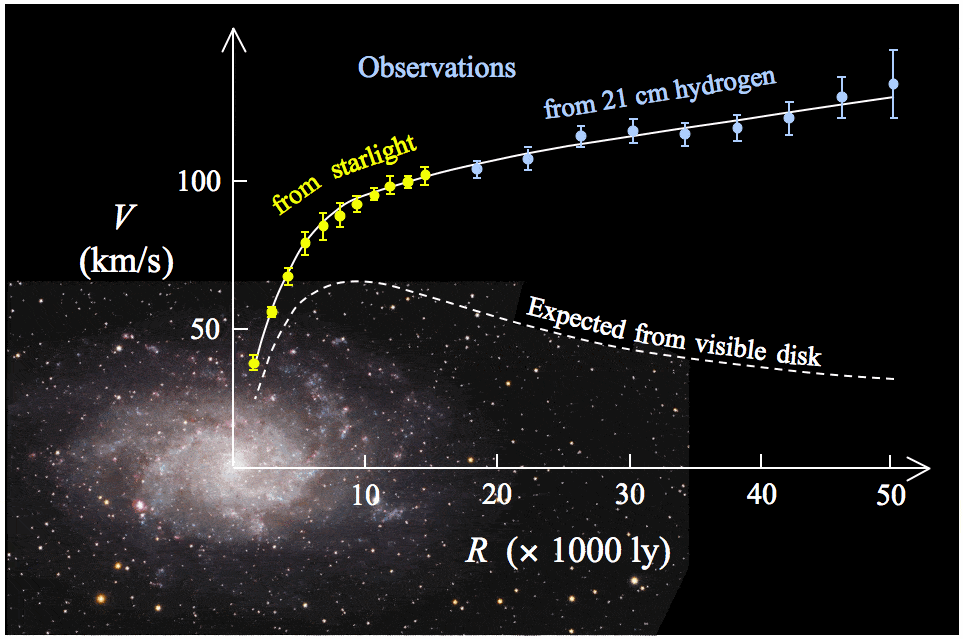
A galactic rotation curve
Movement
Above is a galaxy rotation curve, a diagram of the relative velocity of different parts of a galaxy given by its respective radius from the center. The dotted line that says "Expected from Visible disk" is meant to signify the patter we think a galaxy should follow. As something moves further away from the central bulge of its galactic disk, its speeds should decrease. If this is a confusing concept then consider our solar system. As one travels backwards, starting at Mercury and ending at Pluto (I realize Pluto is not technically a planet, but it will always remain one in my heart) the orbital time around the sun increases, thus its radial velocity has decreased. The same must be true of galaxies, or, at least we thought it must be true. When taking measurements, scientists found that the further our they looked, the faster things were going.
How curious.
Mass
does not exist without . The connection between mass and gravity is fundamental to physics. It's a direct relationship, simply put: more mass, more gravity. However, large astronomical objects exhibit gravitational forces much larger than their predicted masses would allow.
Why though?
Explanations?
Observations were made again and again, but the same results kept coming up. Something was making galaxies move in a way that theoretical science told us was irregular. A few interesting theories came out of the search for an answer. Two of the most notable are MoND and, of course, dark matter. MoND is the shorthand for Modified Newtonian Dynamics that essentially says that our concept of gravitational attraction and motion were not wholly correct. Mordecai Milgrom, the physicist behind MoND, instead proposes a set of equations that boil down to a modified version of Newton's second law:
In a case where , force is equal to the object's mass, , times its acceleration, , squared, divided by a new universal constant .
Unfortunately, many physicists think this description is too vague and designed in such a way it's able too fit too many observations. It lacks specificity. Additionally, MoND doesn't work with clusters, and, in an ironic twist of fate, MoND still requires dark matter to make data fit when dealing with galaxies.
Dark matter, offers a more viable explanation for the accelerated movement in galaxies. While we are not really sure what it is, for the most part, scientists know what dark matter isn't. It's not a big cluster of dark particles (baryons), nor is it antimatter. While some people suspect it could be neutrinos, most believe it is a new particle.
However, whatever it is, it constitutes about 26.8% of the matter in our universe. Unseen and undetectable (for now), it is now believed to be one of the sources of additional mass that threw off scientists' 'gravitational calculations'. The future of dark matter lies in methods of indirect detection. Scientists are looking for a bread crumb trail that might lead them to the identity of this illusive particle.