Що таке диференційне рівняння?

Read · 1 min

A differential equation is simply any equation containing one or more derivatives of any kind.

ddxsin⁡(x)=cos⁡(x)\frac{d}{dx}\sin(x) = \cos(x)

is a differential equation because it contains a derivative on the left-hand side. However, perhaps it will be written as

dsin⁡(x)dx=cos⁡(x)\frac{d\sin(x)}{dx} = \cos(x)

dydx=ex+5\frac{dy}{dx} = e^x + 5

is also a differential equation; the derivative is just written in a different form, the derivative of yy with respect to xx.

Differential equations can be solved to find the function that is differentiated. This typically involves integration (antidifferentiation) combined with a variety of other techniques, but there are a overwhelming number of different ways to solve different types of differential equations.

Illustrated · 1 min

A differential equation is an equation of a function which provides a way to find its derivative. In the real world this usually corresponds to a rate of change.

Knowing the basic rules of differentiation we know that the derivative of this functions y=2x^2 However, if we want to know the tangent point at a specific value of x we must plug that value into the function after differentiating. This can help us locate maximum and minimum values on graphs.

However, sometimes a function has multiple variables. In such a circumstance you must differentiate the function with respect to one variable at a time. For example, if a function's variables are x and y, you would first differentiate it with respect to x while treating y as any other constant, and then do the exact opposite. This is called a partial derivative. ie: dz/dx[(x^2)+4y]=2x dz/dy[(x^2)+4y]=4

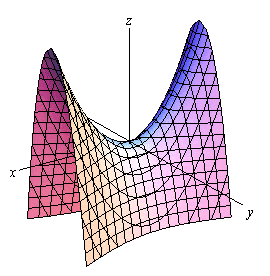
Sometimes you will get a derivative of zero when an equation has multiple variables. Such an instant is called a saddle point for the shape the graph makes at that distinct instant, it is simultaneously a maximum and a minimum, but of different variables respectively.

Here you can see the saddle point is where the x y and axis's intersect, and how for one variable in that given direction it is a maximum, yet for the other variable in the other direction is a minimum..

Illustrated · 1 min

A Differential Equation is just the equation of the graph of the slopes of every point in a given graph. Let the given graph be a function of x say f(x). The differential equation represented by df(x)dx\frac{df\left(x\right)}{dx} gives us the slope of the graph at a given point.

The above graph is that of function x​2x^{​2}+2 When we differentiate the function we get 2x (I'll tell you how I got that in the next section). This is the graph of the slope of the function

Type a concept, like “slope” or “photosynthesis”.

↑ ↓ to choose · Enter to openSearch explanations and problems