Interactive · 10 questions
There are two ways to tell if quadratic functions are identical:
- If their equations, , are equivalent
- If their graphs share 3 points in common
Both of these are pretty straightforward to work with (yay!). We'll look at an example of each below.
Approach 1: Are the equations equivalent?
This will probably require you to mess around with (i.e., rearrange) at least one of the equations to see if you can get it to look like the other.
The equation of a quadratic function in will look like : a quadratic equation in two variables. Let's first review how to tell if two quadratic equations in a single variable are equivalent.
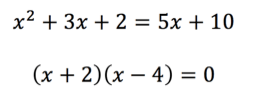
So, are these two quadratic equations equivalent?
The bottom one appears to be in its simplest form, so let's see if we can take the top one and rearrange it to look the same.
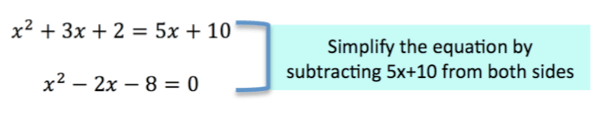
Now, we need to factor the quadratic expression on the left, .

We can see that, once we simply and factor in the second equation, the quadratic expressions on the left are the same.
Here's another example: are these two equations equivalent?
and
Are these two equations equivalent?
and
Approach 2: Do the functions/graphs share 3 points in common?
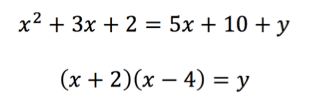
Let's use the same two quadratic expressions as we did before, just so we can show that both approaches can be used to determine if they are identical.
If two quadratic functions are the same, they will share at least 3 distinct points on their graphs. To determine if quadratic expressions share points without actually graphing them, simply pick three values for x and plug them into each expression. If each x produces the same value for y in both expressions, then we can say they are equivalent.
Let's try it out.
We're going to pick values for x that are easy to work with (i.e., small):
x=0 x=1 x=4 (this one makes the second expression equal to 0)
Plug in the first test point (x=0) into the first quadratic equation:
What is the value of y?
Plug in the first test point (x=0) into the second quadratic equation: What is the value of y?
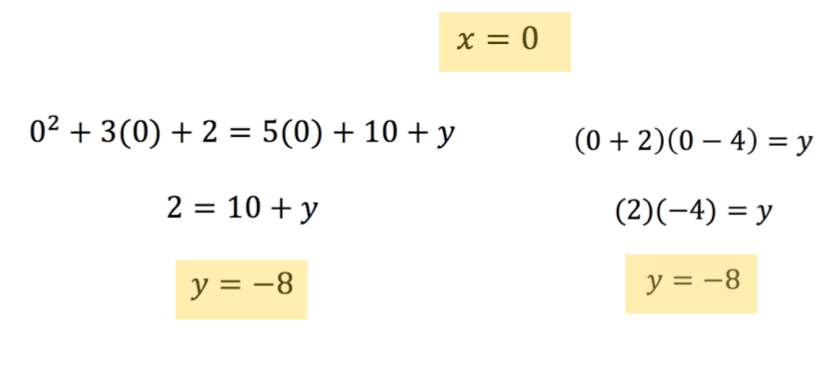
Okay! This means that both graphs share the point (0,-8). One down, two to go :)
Plug in the second test point (x=1) into the first quadratic equation:
What is the value of y?
Plug in the second test point (x=1) into the second quadratic equation: What is the value of y?
Are these two y-values the same?
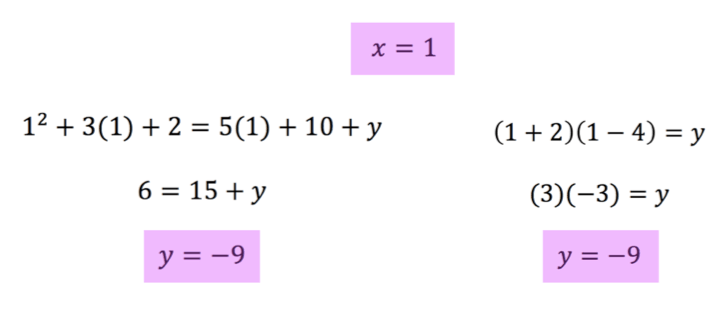
Yes! This means that both graphs share the point (1,-9). We only need one more point in common to show that the graphs are exactly the same.
Plug in the third test point (x=4) into the first quadratic equation:
What is the value of y?
Plug in the third test point (x=4) into the second quadratic equation: What is the value of y?
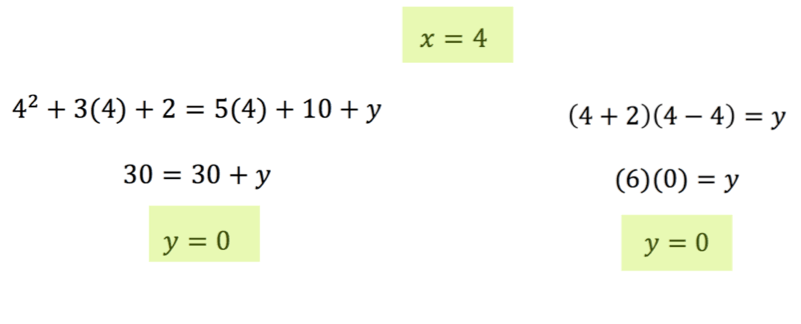
Woohoo! This means that both graphs share the point (4,0). This is their third point in common. Note that any other points we select would also be shared by both graphs, but we only need 3 to say that they are identical.
If we decided to use x=6 as a test value, would the y-values in both equations be the same?