加小数

Video

(Video) Decimal Arithmetic

by Math Antics
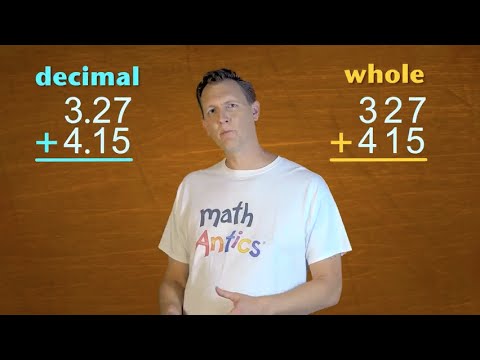
This video by mathantics covers adding decimals, subtracting decimals, multiplying decimals, and dividing decimals.

Summary\large{\text{Summary}}

Decimal addition follows the exact same process as adding two integers. You need to to correctly line up the numbers, then you can add vertically in each place value while paying attention to numbers that carry over to the next place value. The key is to line up your numbers at the decimal point.

Let's look at an example: 26.4+8.3126.4+8.31

Start by lining up the numbers vertically at the decimal point. 26.4+28.31\begin{align} &26.4\\ +\quad&\phantom{2}8.31\\ \hline \end{align} Add zeros after the decimal point to any empty spaces. 26.40+28.31\begin{align} &26.4\color{#29A603}{0}\\ +\quad&\phantom{2}8.31\\ \hline \end{align} Finally, we add as we would integers. 26.40+28.3134.71\begin{align} &26.40\\ +\quad&\phantom{2}8.31\\ \hline &34.71 \end{align}

Test Yourself: What is 5.52+3.25.52+3.2?

Choose one answer

Interactive · 1 question

Adding Decimals

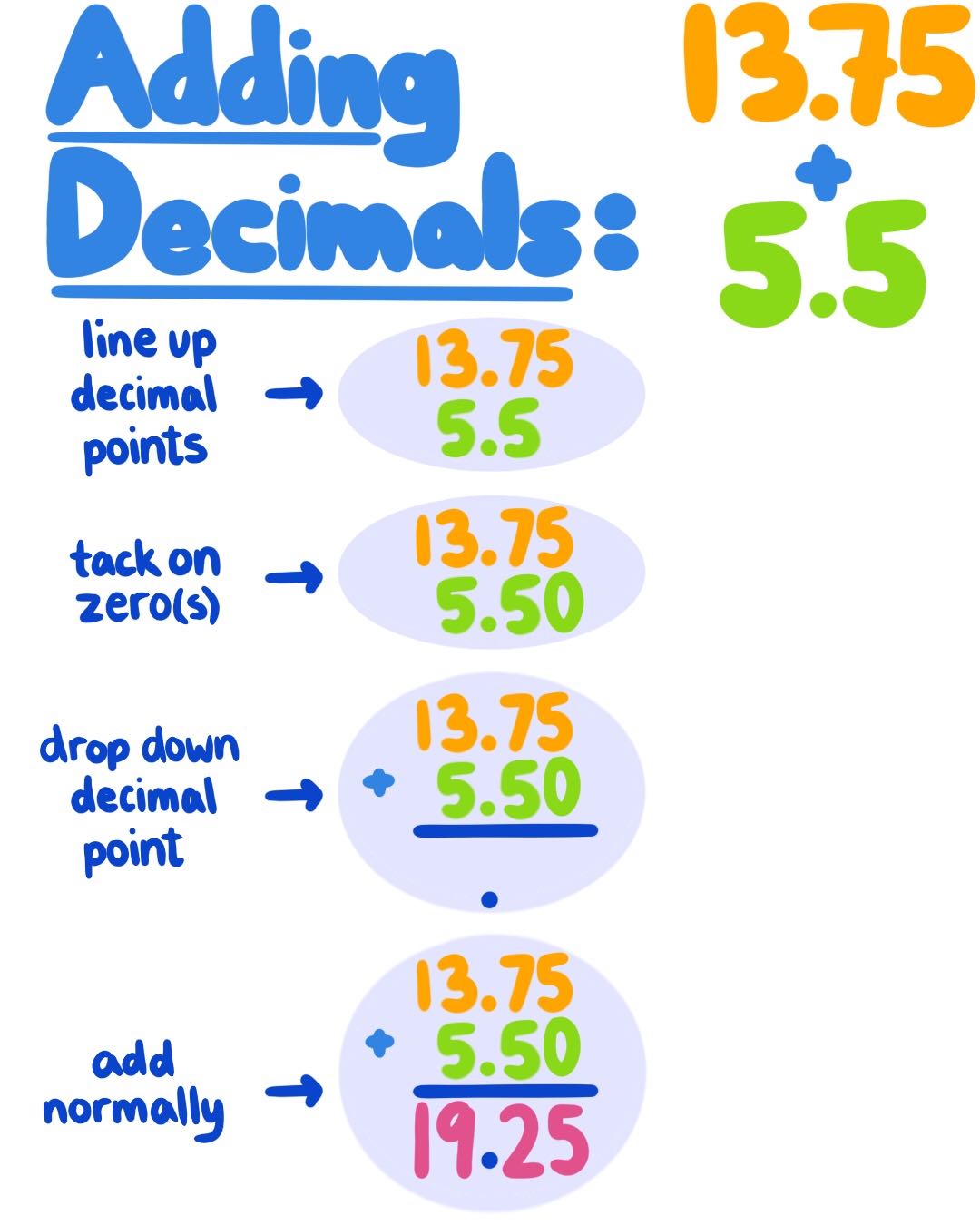
Here is an example of how to add two decimals: 13.75+5.5=19.2513.75 + 5.5=19.25

Adding Decimals: 13.75+5.5. First line up the decimal points, then tack on 0s as needed so both numbers have the same amount of digits after the decimal point, then drop down the decimal point, then add normally. The answer is 19.25.

Image by Caroline Kulczycky

In the step where you "tack on zero(s)," all you have to do is add the necessary amount of zeros so that both decimals have the same amount of digits after the decimal point. Lining up your numbers like this may make it easier to add later!

Let's do another example to practice.

58.327+2.9=?58.327+2.9={?}

Choose one answer

Interactive · 1 question

You add terminating decimals just as you would add two multi-digit integers: line up the digits with the same place value, and then add digit-by-digit.

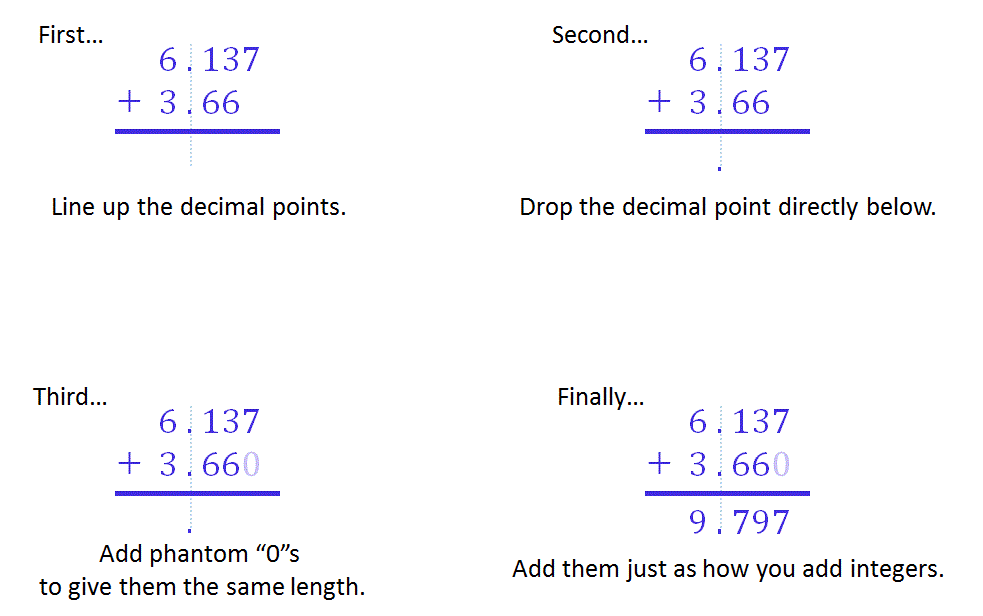
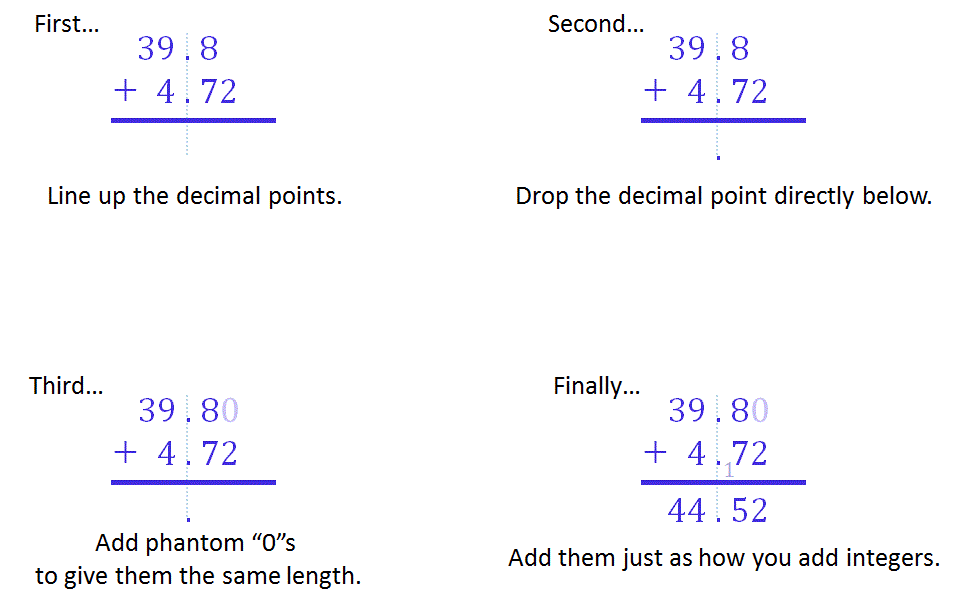
The Four-Step Method for Adding Decimals

  1. Stack one number above another, and line them up by their decimal point;
  2. Drop the decimal point directly below.
  3. Add "00" at the end of the numbers to make them have the same length—without changing the place of the decimal point.
  4. Do a column-by-column addition just as what you do with two integers.

The idea is quite simple, although the rules might seem confusing in words. Let's take a look at an example first.

Example: 6.137+3.666.137+3.66

You are riding a bike from your home to one of your friends'. Somewhat more than half way during the trip, you stopped to check how much distance you have travelled, but accidentally reset the distance tracker. The reading jumps from 6.1376.137 miles to 00. When you finally arrives at your friend's home, it reads 3.663.66. But what would the reading be if you hadn't reset the tracker?

Man riding bike through a forest, parallel to a creek

Image source: By Herriest CC0, via pixabay.com

Which of these expressions would be the readings of the distance tracker if it had remained uninterrupted?

Choose all correct answers

Type a concept, like “slope” or “photosynthesis”.

↑ ↓ to choose · Enter to openSearch explanations and problems