
Interactive · 10 questions
Welcome to "How to NEVER miss the target again 101" (Introduction)
Long ago, archery was a skill that many found to be essential to survive. Now after many years, we find archery as a sport which most people can enjoy. However, one must understand that the art of drawing a bow and hitting the center is not merely a sport. Instead, it should be understood as a difficult physics problem (just like the ones you have to solve in school/college). Needless to say, repetition is the way to achieve perfection, however the question is: What is going on [unconsciously] in the professional archer's mind that allows them to hit the target?
In this lesson, we will try to understand the physics of the bow and arrow. This will allow us to understand what is going on (usually unconsciously) in the mindset of an olympics - level archer.
Note that due to the fact that this lesson is focusing on the physics of a bow and arrow in general, we will not get so specific to the point of talking about the physics of each individual type of bow and arrow.
Ready to move on?
How does a bow and arrow work?
General Definition
We will start off by giving a general, physics definition of a bow.
A bow is a basic machine called a “two-arm spring.”
Ready to move on?
"Drawing" the bow
When an arrow is drawn back the bow stores mechanical potential energy in the part that bends. This force that the archer applies to the bow is called Draw Weight. The draw weight bends the limbs of the bow and adds elastic potential energy. Thus, the bow is like a spring that stores the energy to put into the arrow. We can represent this mathematically as:
The Draw Weight is directionally proportional to the Draw Length , thus this follows Hooke’s Law which tells us that the deformation of an object (in this case, the limbs of the bow curving back) is proportional to the force causing it.
Normally, we can use
to find elastic potential energy. However, since a bow is thicker in the middle, we need to use
where is defined as efficiency. We divide by two because since a bow has two limbs.
Ready to move on?
Releasing the Arrow
When the arrow is released, all of its potential energy becomes kinetic energy.
You can also define this as
since kinetic energy is what gives the arrow its velocity. ( mass of arrow)
Ready to move on?
The "Archer's Paradox"
What is it?
There is a very interesting physical phenomenon in the physics behind archery, known as the Archer's paradox. When an arrow is released to the left (or right) of a bow and is deliberately aimed off target, it will straighten out during release and hit the target.
This happens since there is a large force (in comparison to the actual weight of the arrow) acting in the direction of the arrow shaft. Thus, the arrow begins to oscillate back and forth. This is the natural vibration the arrow experiences when subjected to a brief but large force. Think of it like hitting something with a hammer which causes that something to vibrate. The force acting on the arrow is equal to the draw force as the archer pulls the string back to the release position. This force can be in the range of 30-50 lb which is very large compared to the mass of the arrow, which is why it accelerates so rapidly (which we can attribute to Newton's second law, ).
Thus, the physics of archery is more than just shooting an arrow at the target. One must also account for the oscillation of the arrow during the release. The arrow needs to have just the right amount of flexibility, also called dynamic spine, to flex and then flex back toward its target.
Ready to move on?
Dynamic Spine
We require the perfect amount of dynamic spine since if the arrow is too stiff, then it is not flexible enough which will cause it to go off to the side the arrow head is pointing to. If it has too much dynamic spine, or flexibility, then the arrow will be deformed too much and miss the target.

Ready to move on?
Full explanation of the "Archer's Paradox" (Provided by Real World Physics)
NOTE: PLEASE CLICK ON THE LINKS FOR THE FIGURES AS THEY ARE REQUIRED FOR THIS EXPLANATION TO MAKE SENSE
Figure 1: Arrow position before release
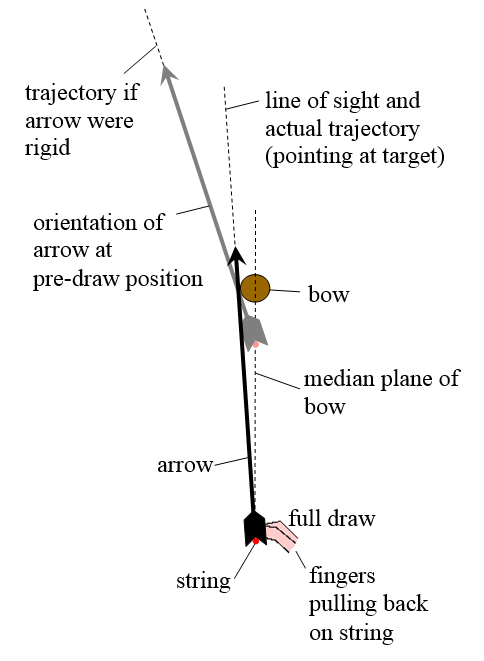
In the above figure the line of sight purposely kept to the right of the center of the target by a distance . This is because the arrow will straighten out and fly parallel to the median plane, but will also be offset from it by a distance .
Part 1
Figure 2: Arrow immediately after release.
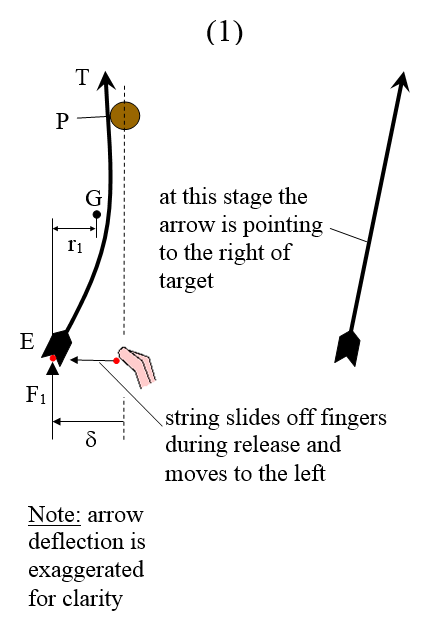
We see that three events occur in part 1:
1.) As the archer opens his fingers the string slides off and moves to the left. This happens because, as the fingers open the friction between string and finger becomes insufficient to hold the string in place. So it slides off, and it does so at an angle to the median plane of the bow. This results in an initial sideways movement of the string. In reality, it would be impossible for an archer to open his fingers fast enough to prevent the string from sliding off to the side a bit, since the string moves much too quickly. However, for purposes of getting the arrow to fly straight it is desirable that the string initially deflects to the left a bit. This is the first stage of what must happen during the mechanics of the release.
2.) The leftward motion of the string excites a mode of oscillation where the arrow begins to vibrate in the plane of the page. The string force F1 contributes to the deflection of the arrow beyond that due to the leftward motion of the string by itself. Note that F1 acts in the direction of the arrow shaft.
3.) The arrow is contacting the bow at point due to a clockwise moment, which can be taken about the center of mass (of the arrow) at the instant shown. This moment is equal to , where is the moment arm makes with .
Ready to move on?
Part 2
Figure 3: Arrow as it reaches the approximate halfway point past the bow.
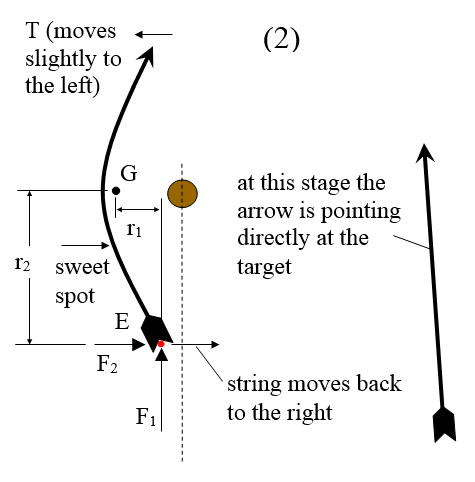
Two events occur in part 2:
1.) The string moves to the right, as it restores its original position with the median plane of the bow. As a result, the string "pulls" on the arrow with a force .
2.) The tip of the arrow moves slightly to the left. This is due to a counter - clockwise moment taken about the center of mass at the instant shown. This moment is equal to (), where is the moment arm makes with .
The reason the tip of the arrow moves to the left is obvious if one considers the general moment equation for a rigid body.
General Moment Equation for an arrow
Where is the sum of the moments about the center of mass ; is the moment of inertia of the arrow about the center of mass , about an axis pointing out of the page; is the angular acceleration of the arrow
Since the sum of the moments is counter-clockwise, is also counter-clockwise, which means the arrow rotates counter-clockwise.
Now, the lateral (left and right) motion of is due to two separate contributions:
(a) The counter-clockwise rotation of the arrow due to . This causes to move to the left.
(b) The lateral (translational) motion of the arrow due to the string pulling to the right. Since is below the sweet spot (shown in the figure above), movement of to the right causes movement of to the left.
The motion of to the left essentially straightens out the path of the arrow from the first stage so that it flies straight upon leaving the bow.
Ready to move on?
Part 3 (Final part)

In the last part as displayed in figure 3, the arrow exits the bow completely, having completed (approximately) one full oscillation. The arrow is now flying straight to the target. It will continue oscillating all the way to the target, with oscillation gradually decreasing in amplitude, but maintaining the same frequency throughout the flight.
Note: Due to the induced counter-clockwise angular acceleration of the arrow in part 2, one might expect the arrow to keep turning counter-clockwise during the flight. However, this is not the case. The vanes (fletchings) at the back of the arrow straighten out the arrow during flight, helping it fly true to the target. So any rotation is quickly eliminated.
Ready to move on?
Considerations outside of the Archer's Paradox
While the Archer's paradox is one huge factor to consider in how you release the arrow, one must consider the other following factors (which we will quickly list as we don't want too long of a lesson. Click on the links of the names of these factors for a more in-depth explanation of thsese factors by wikipedia). However, these only apply indoors (so research ay be needed for outdoors).
Without air resistance the following formulas can be used:
Range:
Max Height:
Where is gravity and is the initial velocity of the arrow calculated with for which is the mass of the arrow.
Ready to move on?
Concluding Remarks
If you have understood everything, then congratulations! You have learned what unconsciously goes on inside of the head of an olympic - level archer! Now you may ask ... HOW IN THE WORLD DO YOU CONSIDER EVERYTHING SO FAST? Well, just like most other things in life, you need practice. A LOT of practice. I hope you enjoyed the lesson, and keep exploring!