求等差数列

Before this, knowIntro to Sequences: Patterns and Formulas

Video · + 4 min read

(Video) Arithmetic Progressions

by Eddie Woo

Here's some videos by Eddie Woo where he explains arithmetic sequences and series.

Recall that a set is a collection of numbers, a sequence is a set with order, and a series is the sum of a sequence.

In this video he goes over: ∘ Arithmetic Sequences∘ Sum of an Arithmetic Sequence∘ General Features∘ Odd Number of Terms∘ Proving it’s Arithmetic\\\begin{align} &\circ\text{ Arithmetic Sequences}\\ &\circ\text{ Sum of an Arithmetic Sequence}\\ &\circ\text{ General Features}\\ &\circ\text{ Odd Number of Terms}\\ &\circ\text{ Proving it's Arithmetic}\\ \end{align}

Arithmetic Sequence

This type of sequence contains terms that have a common difference. The difference between the later and previous term is called the common difference.

An example would be the sequence of even numbers. 2,4,6,⋅⋅⋅2,4,6,\cdot\cdot\cdot The common difference between each term is 22. To get from term 11 to term 22 you just add two. The odd numbers are also an arithmetic sequence. They have the same difference, just a different starting point.

If we wanted to write the sequence of even numbers as a general algebraic expression we would look at how the term number differs from the terms. 2,4,6,⋅⋅⋅↑↑↑a1a2a3\begin{array}{cccc} 2,&4,&6,&\cdot\cdot\cdot\\ \uparrow&\uparrow&\uparrow\\ a_1&a_2&a_3 \end{array} We can see that the term is double the term number. So our general algebraic expression would be: an=2na_n=2n

What we find is that every arithmetic sequence can be written as some constant times nn plus another constant. In other words, they'll always have this form: an=kn+ca_n=kn+c Here, cc tells you where you begin and kk tells you how far you progress when you move from term to term.

For example, the sequence of odd numbers would look like: an=2n−1a_n=2n-1

It would be really easy for us to define TnT_n for the multiples of three now. We know they progress by three each time. an=3na_n=3n

Sum of an Arithmetic Sequence

Suppose we wanted to find the sum of the sequence of odd numbers under 100100. 1+3+5+7+⋅⋅⋅+93+95+97+991+3+5+7+\cdot\cdot\cdot+93+95+97+99 How would we do this? We could brute force it and just add every term but I personally don't want to do that. Instead, because of the orderliness of the series, there's a pattern that can be exploited.

Because the arithmetic series is defined by this common difference, you can take term 11 and term 5050 (because an=2n−1a_n=2n-1 and if we plug in 5050 it gives us 9999) and add them together to make 100100. 1+3+5+7+⋅⋅⋅+93+95+97+991+99=100{\color{#8925AE}{1}}+3+5+7+\cdot\cdot\cdot+93+95+97+{\color{#8925AE}{99}}\\ 1+99=100 Now if we go up one term from the first, we add two. And if we go down one term from the last term, we subtract two. Therefore, these two can be added together to create another 100100. 1+3+5+7+⋅⋅⋅+93+95+97+993+97=1001+{\color{#8925AE}{3}}+5+7+\cdot\cdot\cdot+93+95+{\color{#8925AE}{97}}+99\\ 3+97=100 You can keep on doing this! 1+3+5+7+⋅⋅⋅+93+95+97+991+3+5+7+⋅⋅⋅+93+95+97+991+3+{\color{#8925AE}{5}}+7+\cdot\cdot\cdot+93+{\color{#8925AE}{95}}+97+99\\ 1+3+5+{\color{#8925AE}{7}}+\cdot\cdot\cdot+{\color{#8925AE}{93}}+95+97+99 But now the question becomes, how many times can you do this? How many of these 100100s are you going to get?

To get 100100 you need to combine two of the terms. You need a pair. So how many pairs can you make with 5050? 2525 pairs! In our sum we have the sum of these first 5050 terms equal to the 2525 pairs that add up to 100100. S50=25⋅100=2500S_{50}=25\cdot100=2500

(Video) Arithmetic Progressions

by Eddie Woo

General Features of an Arithmetic Sequence/Series

Can we generalize this? Suppose we didn't have actual numbers. Instead, our first term was a1a_1 and the common difference between every number is dd. So we could write this sequence as: a1,a1+d,a1+2d,⋅⋅⋅↑↑↑a1a2a3\begin{array}{cccc} a_1,&a_1+d,&a_1+2d,&\cdot\cdot\cdot\\ \uparrow&\uparrow&\uparrow\\ a_1&a_2&a_3 \end{array} So we can define ana_n as: an=a1+(n−1)da_n=a_1+(n-1)d Now we need to find the sum of the whole thing, SnS_n. In the previous example, we combined together the first and the last term. Then we multiplied this by the amount of terms we had, n2\frac{n}2. Sn=n2(a1+an)S_n=\frac{n}2(a_1+a_n) Here, ana_n stands for the last term. These were the numbers that, combined together, gave us the sum that kept repeating. In the previous example, that sum was 100100.

We know what the last term is because we defined what ana_n is. So we can simplify this. Sn=n2(a1+an)=n2(a1+a1+(n−1)d)Sn=n2[2a1+(n−1)d]\begin{align} S_n&=\frac{n}2(a_1+a_n)\\ &=\frac{n}2(a_1+\color{#8925AE}{a_1+(n-1)d})\\ S_n&=\frac{n}2[2a_1+(n-1)d] \end{align}

The first equation, Sn=n2(a1+an)S_n=\frac{n}2(a_1+a_n), is useful for when you know the first and the last term. The final equation, Sn=n2[2a1+(n−1)d]S_n=\frac{n}2[2a_1+(n-1)d], is useful if you know the difference between each of the terms.

(Video) Arithmetic Progressions

by Eddie Woo

Odd Number of Terms

In the examples above, we had sequences/series with an even number of terms, and generalized the summation formula to be Sn=n2[2a1+(n−1)d]S_n=\frac{n}2[2a_1+(n-1)d] Does this work when you have an odd number of terms?

Actually, yes! If we look at the same series from before, the odd numbers under 100100, but changed it to 9898, we would get an odd number of of terms. 1,3,5,⋅⋅⋅,95,97↑↑↑↑↑a1a2a3a48a49\begin{array}{cccccc} 1,&3,&5,&\cdot\cdot\cdot,&95,&97\\ \uparrow&\uparrow&\uparrow&&\uparrow&\uparrow\\ a_1&a_2&a_3&&a_{48}&a_{49} \end{array}

This seems like it wouldn't work. If we plug n=49n=49 into our equation we get 492\frac{49}2 out front. We've introduced a fraction into this. How could the sum of whole numbers give us a fraction? But actually, let's look closer at the equation. Sn=492[2a1+(n−1)d]S_n=\frac{49}{2}[{\color{#8925AE}{2a_1}}+(n-1)d] Our a1a_1 term is being multiplied by 22. Therefore, no matter the aa, this will come out to be an even number. Sn=492[2a1+(n−1)d]S_n=\frac{49}{2}[2a_1+{\color{#8925AE}{(n-1)d}}] Since we have an odd number of terms, an odd number minus one gives us an even number. No matter the value of dd, this part will stay even. Then, an even plus and even gives us an even.

Since we have an even number being divided by 22, it doesn't cause us any fractions. Therefore, an odd number of terms still works for this equation.

Proving a Series/Sequence is Arithmetic

Often you'll be given a sequence or series and are asked to prove that it is arithmetic. To do this we want to show that every term minus the previous term is equal to some constant. an−an−1=da_n-a_{n-1}=d

If you were given the sequence 1,3,5,7,⋅⋅⋅,971,3,5,7,\cdot\cdot\cdot,97 Then you would need to show a few a2−a1=2a3−a2=2a4−a3=2a_2-a_1=2\\ a_3-a_2=2\\ a_4-a_3=2

If you were given the general algebraic expression for the nthn^{\text{th}} term an=2n−1a_n=2n-1 Then you find the difference between this and the previous term. an−an−1=(2n−1)−(2(n−1)−1)=(2n−1)−(2n−2−1)=(2n−1)−(2n−3)=2n−1−2n+3=2\begin{align} a_n-a_{n-1}&=(2n-1)-(2(n-1)-1)\\ &=(2n-1)-(2n-2-1)\\ &=(2n-1)-(2n-3)\\ &=2n-1-2n+3\\ &=2 \end{align}

No recipe to follow

These problems have no steps to copy. You have to understand the idea well enough to bend it to a new purpose. These are real problems from the AMC 8, AMC 10, AMC 12 and AIME, the national math competitions for middle and high school students, each with a worked solution on LIVE by Po-Shen Loh.

Video · + 1 min read

(Video) A Formula for the nthn^{\text{th}} Term

by PatrickJMT

This video by the PatrickJMT explains how to find the nth term of an arithmetic sequences.

Summary\large{\text{Summary}}

An arithmetic sequence is one that increases by the same amount each term.

The formula is: an=a1+(n−1)d\boxed{a_n=a_1+(n-1)d} Where a1=first terma_1=\text{first term} and d=common differenced=\text{common difference}.

Arithmetic Sequences: a_n = a_1+(n-1)d. a_n is the nth term, a_1 is the first term, d is the common difference.

Image source: Caroline Kulczycky

How we Got This Formula

Let's use: 3,8,13,18,23,28,⋯3,8,13,18,23,28,\cdots This sequence is arithmetic because each term differs by 55 from the adjacent terms. So d=5d=5.

Let's write our terms down. a1=1a_1=1 For a2a_2 we could write 88 but let's incorporate our dd. a2=3+5a_2=3+5 For a3a_3 we add 55 a second time. a3=3+2⋅5a_3=3+2\cdot5 To get the 44th term, we will have to add three 55s. a4=3+3⋅5a_4=3+3\cdot5 This continues. a5=3+4⋅5a6=3+5⋅5a7=3+6⋅5a_5=3+4\cdot5\\ a_6=3+5\cdot5\\ a_7=3+6\cdot5

We can see we start with 33, which is our a1a_1, and then add on 55, which is our dd, multiplied by one less than the position we're in. If we were to write a formula for the nnth term it would be: an=a1+(n−1)⋅da_n=a_1+(n-1)\cdot d

Example 1

Suppose we have: 3,8,13,18,23,28,33,⋯3,8,13,18,23,28,33,\cdots Find a10a_{10} and a202a_{202}.

Let's break out our handy new formula. The first term is, a1=3a_1=3 and the common difference is, d=5d=5. Therefore, our formula is: an=a1+(n−1)dan=3+(n−1)5an=3+5n−5an=5n−2\begin{align} a_n&=a_1+(n-1)d\\ a_n&=3+(n-1)5\\ a_n&=3+5n-5\\ a_n&=5n-2 \end{align}

Now that we have the formula, we can just plug in n=10n=10 and n=202n=202. a10=5(10)−2=50−2=48\begin{align} a_{10}&=5(10)-2\\ &=50-2\\ &=48 \end{align} a202=5(202)−2=1010−2=1008\begin{align} a_{202}&=5(202)-2\\ &=1010-2\\ &=1008 \end{align}

Example 2

Suppose you have a sequence where a8=25a_8=25 and a14=43a_{14}=43. Find a1a_1 and dd.

First, we want to write each of these given terms using the general formula. an=a1+(n−1)da8=a1+(8−1)d25=a1+7d\begin{align} a_n&=a_1+(n-1)d\\ a_8&=a_1+(8-1)d\\ 25&=a_1+7d \end{align} an=a1+(n−1)da14=a1+(14−1)d43=a1+13d\begin{align} a_n&=a_1+(n-1)d\\ a_{14}&=a_1+(14-1)d\\ 43&=a_1+13d \end{align}

Next, take either formula and solve for a1a_1. 25=a1+7d25−7d=a1\begin{align} 25&=a_1+7d\\ 25-7d&=a_1 \end{align}

Plug this into the other formula and solve for dd. 43=a1+13d43=(25−7d)+13d43=25+6d18=6d3=d\begin{align} 43&=a_1+13d\\ 43&=(25-7d)+13d\\ 43&=25+6d\\ 18&=6d\\ 3&=d \end{align}

Now that we know dd, we can plug this back into either formula. 25−7d=a125−7(3)=a125−21=a14=a1\begin{align} 25-7d&=a_1\\ 25-7(3)&=a_1\\ 25-21&=a_1\\ 4&=a_1 \end{align}

Interactive · 5 questions

There are two main types of sequences we care about, because they have very noticeable patterns.

But back up for a second, what IS a sequence? It's a collection of numbers written in some order, where the order is important for identifying a pattern, if any. Here's an example:

{0,0,0,0,0,0}\{0, 0, 0, 0, 0, 0\}

Well, that was boring. A sequence can have lots of different numbers. Here's another one:

{0,1,4,9,16,25}\{0, 1, 4, 9, 16, 25\}

This sequence is the collection of the first six perfect squares. While this a commonly seen one, we really care about two more fundamental patterns in sequences.

An arithmetic sequence is one for which you can keep adding (or subtracting) the same number to get from one element of the sequence to the next. For instance,

{2,4,6,8,10}\{2, 4, 6, 8, 10\}

is an arithmetic sequence. This is because 2+2=4,2 + 2 = 4, 4+2=6,4 + 2 = 6, and so on. We add 22 to one term of the sequence to get the next term.

Is {5,8,11,14,17}\{5, 8, 11, 14, 17\} an arithmetic sequence?

Choose one answer

Illustrated · 1 min

Maximum Depth Exceeded: Fun with Sequences and Python, Part 2

To read part 1 of this story, go here.

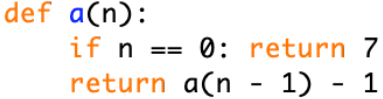
Our Python code lets us generate a sequence based on a recursive formula, which is shown below:

a(0) = 7, a(n) = a(n - 1) - 1 otherwise

Image by Joshua Siktar

What happens if we plug in a(n)a(n) for the first 2020 values of nn (starting with n=0n = 0)? Here's what we get:

a(0) = 7, a(1) = 6, ..., a(20) = -13

Image by Joshua Siktar

This is an example of an arithmetic sequence, which is a sequence where the consecutive terms differ by the same amount. Since our recursive formula has a −1,-1, that difference is −1.-1.

To read part 3 of this story, go here.

Type a concept, like “slope” or “photosynthesis”.

↑ ↓ to choose · Enter to openSearch explanations and problems