Interactive · 2 questions

+2 contributors

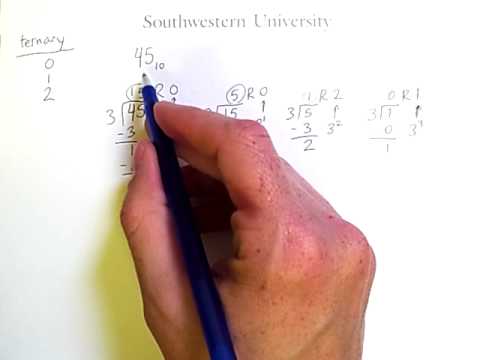
Ternary
Ternary is a numeral system with base This essentially means it only uses digits to make up its numbers:
Our normal number system is called the decimal or base- As you may have guessed it is because we use digits.
From Decimal to Ternary
To convert from a regular decimal number to a ternary number can be a little tedious, but it only requires division. Let's work through an example to see how we do it.
Suppose we want to convert from base- to base- One way we show a number is base- is to put a subscript after it with
To begin the conversion to base-, we divide our number by We don't need to worry about decimal points, just what the remainder is.
Let's divide by
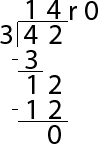
We get with remainder The remainder will be the digit in the "one's place" of our ternary number.
Next, take the number we get as our solution (minus the remainder) and divide that by Let's divide by

We get remainder This remainder will be the digit in the "ten's place" of our ternary number.
We again divide our result by This will go till we get a result of So let's divide by

We get remainder This will be the digit in the "hundred's place" of our ternary number.
We're almost done! One more division. Divide by

We get another remainder of This will be the digit in the "thousand's place" of our ternary number. We know to stop here because we finally get up top.
So, we got the remainders . The ternary version of will be these numbers but written in reverse order. So:
From Ternary to Decimal
Don't worry, this way is much simpler in my opinion. Let's use the number we just found, , and convert it back to .
Starting with the last digit, we want to multiply each digit by raised to a power starting from and then add them all together. In other words, is multiplied by , is multiplied by , is multiplied by , and is multiplied by .
Practice
Try converting each way on your own.
What is in base-3?
Solution
I won't show all of the division because I'm lazy but start by dividing by Next, divide by Finally, divide 2 by 3. We know to stop here because we get a as our end result. The ternary number, from left to right, will be the last remainder up to the first remainder.

What is in base-
Solution
We want to multiply each digit by raised to increasing powers. So,