Illustrated · 3 min

+3 contributors



Commutative Properties
The four operations, addition, subtraction, multiplication, and division, are important skills in pre-algebra.
It is important to realize that oftentimes the order in which you write the numbers out matters, and sometimes it doesn't.
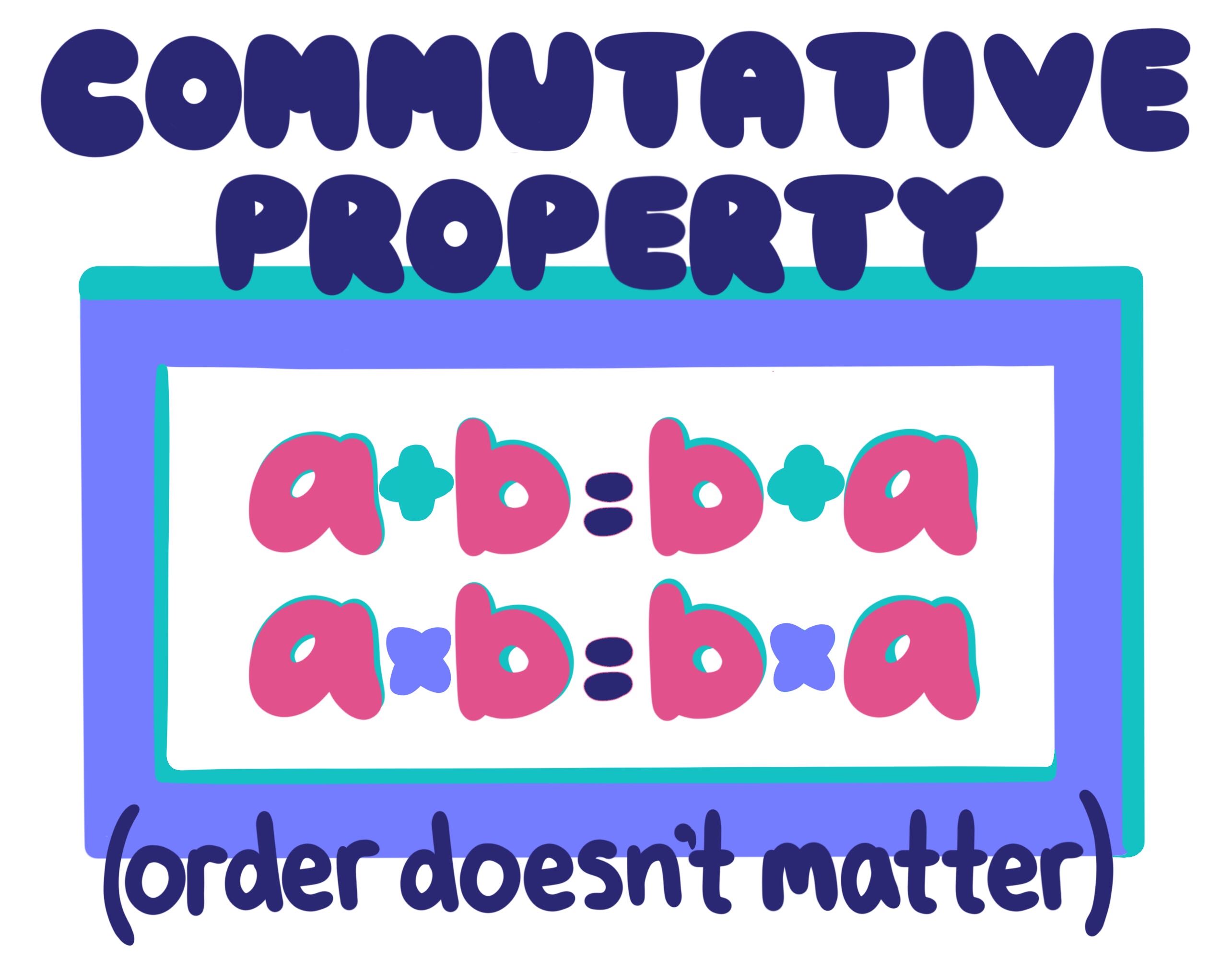
We're going to focus on addition and multiplication here, because for those operations you can flip the order in which you write the numbers.
In particular, if and are numbers, then
As a result of this beautiful mirror-like symmetry we call addition and multiplication commutative operations.
Commutative Addition
While we can look at equations all day, I want to feature some mouth-watering examples that highlight these facts when talking about food.

We're going to talk about why adding is commutative by counting M&Ms. Let's say you have red M&Ms and orange M&Ms (your big brother ate all the other colors, sadly).
You're not sure if you want to eat the red M&Ms first, or the orange ones first, but one thing's for sure: you're eating ALL the M&Ms.
If you eat the red ones first, and then the orange ones, you eat M&Ms, followed by M&Ms. Adding this together means you eat a total of M&Ms.
If on the other hand, if you eat the orange ones and THEN the red ones, you eat M&Ms followed by M&Ms.
This still makes for a total of M&Ms. What we have shown is that because both sides of the equation equal
While that's a tasty fact to keep in mind, what's even sweeter is that you can do this even if you have MORE than two different colors of M&Ms.
Let's say you now have green M&Ms in addition to the red M&Ms and orange M&Ms.
If you want to eat the M&Ms in the order green, red, orange then you eat M&Ms. On the other hand if you switch up the order and eat the M&Ms in the order orange, green, red, then you eat M&Ms. This should make sense, because at the end of the day all of the M&Ms will be gone. Since both of these sums equal we have shown
Let us note this is very different from the associative property. The associative property introduces parentheses. It asks you to do the operations in a certain order. No parentheses here!
Commutative Multiplication
Now we're going to show why multiplication is commutative by figuring out how many ways to make a sandwich.

Let's say that a sandwich has three components: bread, cheese, and meat.
If you're building a sandwich you can choose the bread, cheese, and meat in any order and still have the same sandwich. It's the same ingredients all piled high on some tasty carbohydrates.
We'll use this fact to make it clear that multiplication is commutative.
You open up your pantry and see three different types of bread, five types of cheese, and two types of meat.
Let's say you want to choose one of each to build a sandwich for lunch.
In one case you choose the bread first, then the cheese, then the meat. The number of ways to do this is because we multiply the number of choices for each step together. The key is that the order of the steps doesn't matter.
If instead we choose the meat first, then the bread, and then finally the cheese then our number of ways for building the sandwich is
That is, no matter which component of the sandwich we choose first, we can build the same number of different sandwiches.
If you don't believe me, go buy a lot of bread, cheese, and meat and try this at home yourself. Happy eating!