
Interactive · 8 questions
+6 contributors





First things first, let's remember what a compound inequality is. A compound inequality is two separate inequalities that are joined together by "and" or "or."
If you're more of an English/grammar person, think of a compound inequality like a compound sentence. There are two independent clauses joined together by words like "and" and "or." It's the same thing in math, except replace the clauses with inequalities.
Let's look at two examples of how to solve word problems with compound inequalities. We'll look at one example with "and" and one example with "or."
Example 1:

Image source: by Hannah Bonville
There are a few things to notice about this word problem before we set up our compound inequality.
The phrase "between and percent" tells us that this is going to be a compound inequality with the connector "and." We'll look at how to write that in a minute.
The other thing to notice is the word inclusive. This means that and (the two ends of the range) need to be included as possible solutions themselves. To show that in our inequality, we just need to use and (instead of and ).
The first thing we need to do is figure out what the end points are for what the ant can carry. We know its bodyweight is , so we need to find out what and of that value are.
What is of mg?
of is , which is .
What is of ?
of is , which is .
We know that the ant can carry between and , inclusive. We need to write an inequality that represents that information.
Which inequality represents this information?
An ant can carry an amount () if it's between mg and mg, inclusive, so our inequality is:
How can we write this solution in interval notation?
If we wanted to write this in interval notation, it would look like this: . Notice the brackets that we used to indicate "inclusive."
We can also verify that this inequality makes sense by plotting our range on a number line.

Image source: by Hannah Bonville
Example 2:
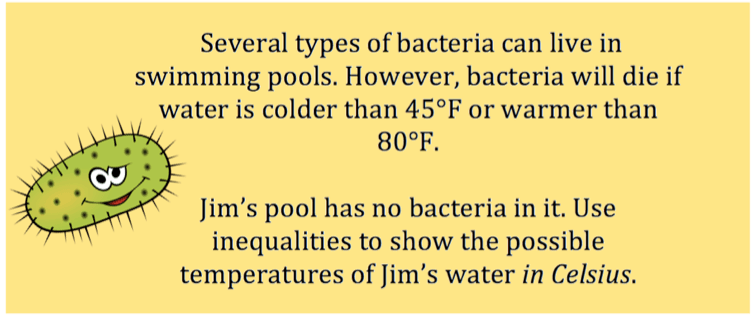
Image source: by Hannah Bonville
First, let's review the problem for any signal words. One thing to note is that this problem uses the phrase "colder than degrees or warmer than degrees." This means this will be an "or"-style compound inequality.
Also notice that the problem is asking us for the answer in Celsius, not Fahrenheit.
Last, there's no mention of "inclusive." This means that we will be using and signs.
Let's start by converting the two endpoints ( and ) from Fahrenheit to Celsius. Here's the formula to convert between Fahrenheit and Celsius:
Which quantity is equivalent to °F?
What quantity is equivalent to °F?
Now we can write two separate inequalities to show the possible temperature of Jim's pool water.
Check off the two inequalities that show the possible temperature of Jim's pool.
To write the inequality that describes the temperature of Jim's water, we would use both those equations and say:
This tells us that Jim's water is either less than degrees Celsius or greater than degrees Celsius.
What is the interval notation for this solution?
The interval notation for this solution looks like this: .
This can be also written as . The symbol indicates the union of sets—which is a fancy way of saying that the solution can be in either of the two ranges we wrote.
We can also verify this using a number line.

Image source: by Hannah Bonville
