勾股定理的逆定理

Before this, know勾股定理

Interactive · 2 questions

Converse of the Pythagorean Theorem

Don't let the name of this concept stress you out. It's not as complicated as it might seem.

A right triangle with sides a, b, c.  By the Pythagorean Theorem, a^2+b^2=c^2.

The Pythagorean theorem applies to right triangles.

Recall that the Pythagorean Theorem states, for a right triangle with legs of length aa and bb and hypotenuse of length cc, that a2+b2=c2a^2+b^2=c^2. The hypotenuse is the side that is across from the right angle, and it is the longest side of the triangle. aa and bb are the lengths of the other two sides, called legs.

The Converse of the Pythagorean Theorem tells us that if the square of one side of a triangle is equal to the sum of the squares of the other two sides, then the triangle is a right triangle.

So, what the Converse of the Pythagorean Theorem allows us to do is to determine if a triangle is a right triangle.

If you plug in the lengths of each side of the triangle into the Pythagorean equation and get a TRUE statement, then the triangle is a right triangle.

Note: In order for a2+b2=c2a^2+b^2=c^2 to be true, the side length cc must be the largest side length. So in order to test whether a triangle is right, you only need to plug in values where cc is the largest among a,b,ca,b,c.

A right triangle with sides 3, 4, 5.

Plug in the lengths of each side into the Pythagorean equation:

a2+b2=c2a^2+b^2=c^2

Is this a right triangle?

Choose one answer

Interactive · 1 question

The Converse of the Pythagorean Theorem

Lets begin by asking the question: "What is a converse?"

In mathematics a converse is a theorem whose hypothesis and conclusion are the conclusion and hypothesis of another theorem. In other words, the converse of the Pythagorean Theorem is the reversal of the Pythagorean Theorem.

The Pythagorean Theorem states that the sum of the squares of the legs of a right triangle is equal to the square of the hypotenuse: a2+b2=c2a^2+b^2=c^2 The converse of the Pythagorean Theorem is the Pythagorean Theorem flipped.

The converse of the Pythagorean Theorem states that: If the square of the longest side of the triangle is equal to\text{If the square of the longest side of the triangle is equal to} the sum of the squares of the other two sides of the triangle,\text{the sum of the squares of the other two sides of the triangle,} then the triangle is a right triangle.\text{then the triangle is a right triangle.}

The Pythagorean theorem is used to find the length of a missing side of a right triangle, the converse of the Pythagorean Theorem is used to determine if a triangle is a right triangle or not.

Try it!

Is the triangle ABC with side lengths of 66 inches, 88 inches, and 1010 inches a right triangle?

Choose one answer

Read · 1 min

Proof of the Converse of the Pythagorean Theorem

The converse of Pythagorean Theorem states that if three sides of a triangle are aa, bb and cc such that a2+b2=c2a^2 + b^2 = c^2, then the triangle is right angled.

Proof:

There are many proofs for this but you can use Pythagorean theorem to prove this.

Let the triangle ABCABC have side lengths aa, bb and cc such that a2+b2=c2a^2+b^2=c^2. We will prove that this triangle is right angled.

We will construct a right angled triangle DEFDEF with side lengths aa, bb and dd (with dd being the hypotenuse). Thus, a2+b2=d2a^2 + b^2 = d^2.

But we already know that a2+b2=c2a^2 + b^2 = c^2. This implies c2=d2c^2 = d^2, which implies c=dc=d. Therefore, triangle ABCABC is congruent to triangle DEFDEF by the SSS criterion.

Therefore, triangle DEFDEF is right angled.

Video

(Video) Video’s Title

by Youtube Name

In this video, we learn that the converse pythagorean theorem can be used to tell if a triangle is a right triangle given all the side lengths.

Summary\large{\text{Summary}}

Pythagorean theorem: If a triangle is a right triangle (has a right angle), then a2+b2=c2a^2+b^2=c^2.

Converse: If a2+b2=c2a^2+b^2=c^2 in a triangle with cc is the longest side, then a triangle is a right triangle.

1 right triangle one acute triangle

If a triangle is not a right triangle, there are 22 other options for types of triangles.

  1. Acute: Has 33 acute (less than 9090 degree) angles.

  2. Obtuse: Has a single obtuse (greater than 9090 degree) angle and 22 acute angles.

  3. Right: Has 11 right angle (9090 degrees).

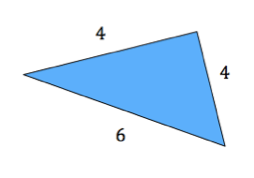
Actue triangles follow the inequality of c2<a2+b2c^2<a^2+b^2. Obtuse triangles follow the inequality of c2>a2+b2c^2>a^2+b^2. Notice, when given a problem, triangles are not always drawn to scale. That means do the math, don't rely on the picture to figure out if a triangle is right!

Type a concept, like “slope” or “photosynthesis”.

↑ ↓ to choose · Enter to openSearch explanations and problems