Read · 1 min

One of the most fundamental things you need to know in any science is how to convert between units.

You were probably told in elementary school that to convert 10001000 centimeters to meters, you need to divide 10001000 by 100100, because a centimeter is smaller than a meter. This method does work, but in the long run, it can become a disorganized way of converting units.

So, we are going to use something called the factor-label method. The idea behind this is we're going to multiply a quantity by a fraction, which, in theory, is equal to 1. This is best learned by example:

To convert 10001000 centimeters by meters, we multiply the quantity (10001000 centimeters) by a conversion factor equal to 1:

(1000 cm)(1 m100 cm)=10 m(1000 \text{ cm})\left(\frac{1 \text{ m}}{100 \text{ cm}}\right) = 10 \text{ m}

In this method, we write the fraction such that we can cancel out some units that we do not need.

Another example:

Convert 235235 kilojoules to calories.

(235 kJ)(1000 J1 kJ)(1 cal4.18 J)=56220 calories(235 \text{ kJ})\left(\frac{1000 \text{ J}}{1 \text{ kJ}}\right)\left(\frac{1 \text{ cal}}{4.18 \text{ J}}\right) = 56220 \text{ calories}

Illustrated · 1 min

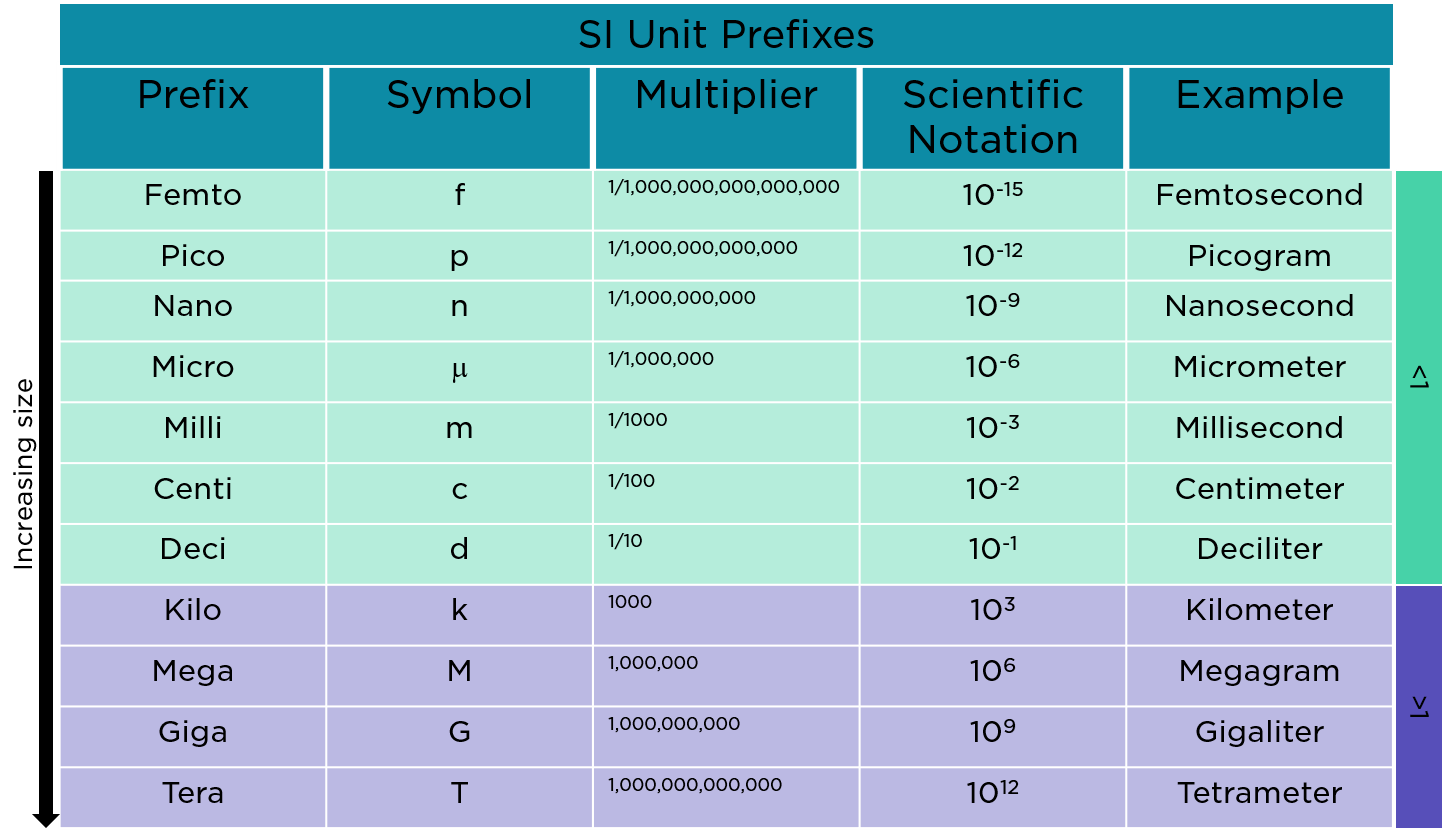
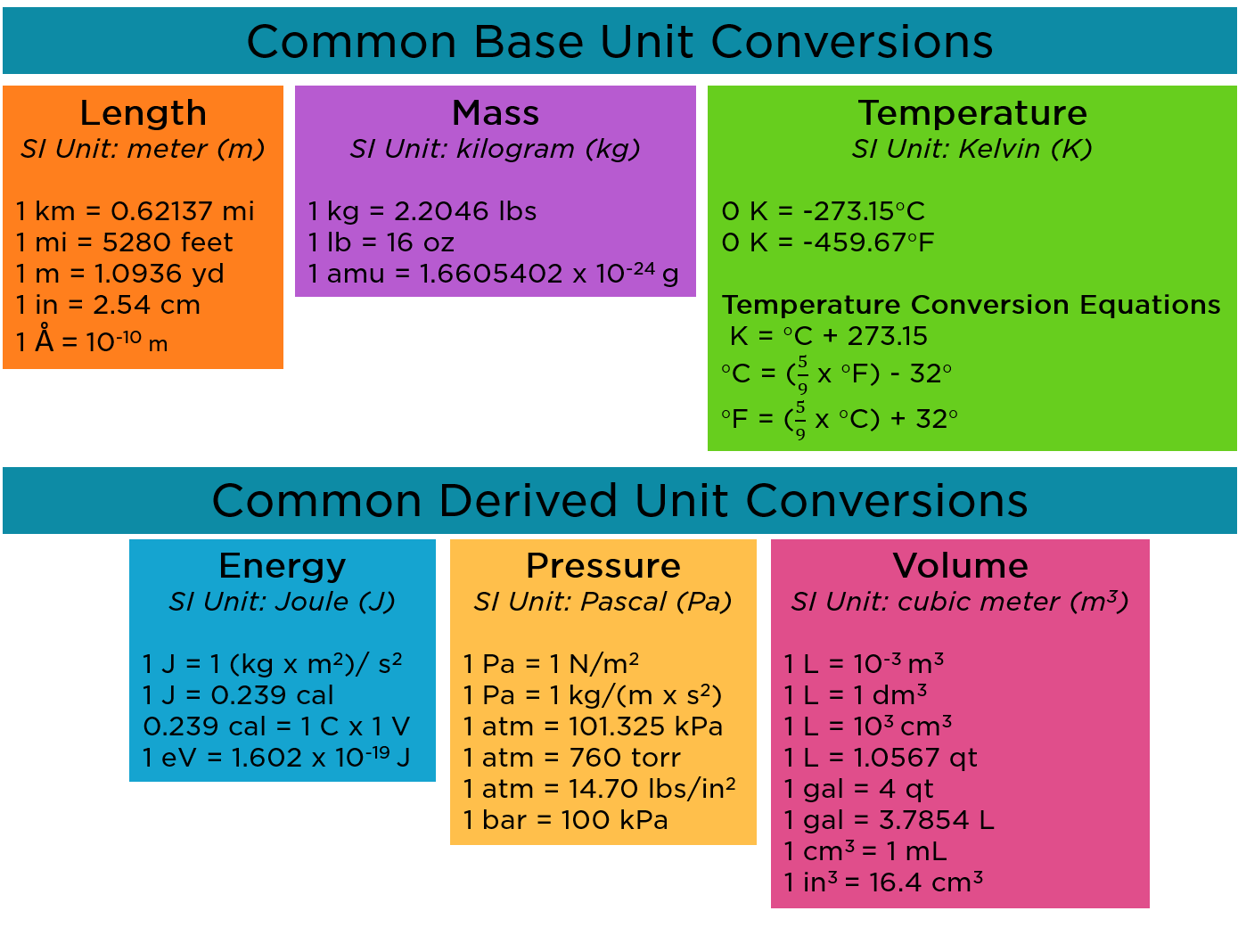
I've provided a unit conversion table as a reference.

SI unit prefix chart including symbols, multipliers, scientific notation, and examples.

Image source: By Valeri Natole

This chart shows common units and their conversions to other common units. At the top are base unit conversions. They include length, mass, and temperature. Below are derived unit conversions. They include energy, pressure, and volume.

Image source: By Valeri Natole

Type a concept, like “slope” or “photosynthesis”.

↑ ↓ to choose · Enter to openSearch explanations and problems