
Illustrated · 1 min
Coriolis Force
Once air has been set in motion by the pressure gradient force (force caused due to change in pressure), it undergoes an apparent deflection from its path, as seen by an observer on the earth. This apparent deflection is called the Coriolis force and is a result of the earth's rotation.
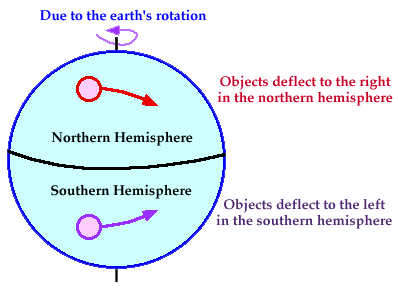
A Schematic Representation of Coriolis Forces
The amount of deflection the air makes is directly related to both the speed at which the air is moving and its latitude. Therefore, slowly blowing winds will be deflected only a small amount, while stronger winds will be deflected more. Likewise, winds blowing closer to the poles will be deflected more than winds at the same speed closer to the equator. The Coriolis force is zero right at the equator.
Real Life Illustration
A ball rolling across the surface of a rotating merry-go-round is a great demonstration of the Coriolis force.
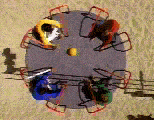
A real life example
Sources:
Image/Text/Data from the University of Illinois WW2010 Project.http://ww2010.atmos.uiuc.edu/(Gh)/guides/mtr/fw/crls.rxml