什么是小数?

Video · + 1 min read

(Video) Fractions and Decimals

by Math Antics
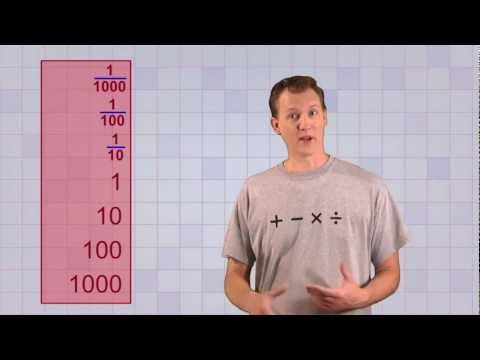
Here's a video by mathantics that explains the basics of decimals.

Summary\large{\text{Summary}}

A decimal is used to represent numbers between two integers. The following are examples of decimals. 0.5,4.245,11.0,−5.0010.5,\quad\quad4.245,\quad\quad11.0,\quad\quad-5.001

With whole number place values, we multiply by 1010 to get to the next place value. Ones multiplied by 1010 gets us to tens. Multiply that by 1010 and we get hundreds. With decimals, we go the opposite direction and divide by 1010. Ones divided by 1010 gives us tenths, or 110\frac1{10}. Divide this by 1010 again and we get hundredths, or 1100\frac{1}{100}.

The building blocks for a number, now that we include decimals, are: ⋯1,000100101110110011,000⋯\cdots\quad1{,}000\quad100\quad10\quad1\quad\frac1{10}\quad\frac1{100}\quad\frac1{1{,}000}\quad\cdots

The decimal point is used to indicate we have a decimal number. It will always be between the ones place and the tenths place. Everything to the left of the decimal point is called the integer part of the number. Everything to the right of the decimal point is called the decimal part of the number.

Test Yourself: Write 310\frac3{10} as a decimal.

Choose one answer

Preparing for a math contest?

Working through past problems on one idea at a time is one of the most effective ways to prepare. These are real problems from the AMC 8, AMC 10, AMC 12 and AIME, the national math competitions for middle and high school students, each with a worked solution on LIVE by Po-Shen Loh.

Interactive · 1 question

How Do We Define "Decimal"?

Decimal actually has more than one meaning:

  • A number that contains a so-called decimal point;
  • A number written in base-1010 system.

Here, we use decimal in the first sense: a number that contains a decimal point. Decimal point is the little point in 0.6180.618 that separates 00 and 618618. When you write it down, the decimal point looks just like a period.

More Examples of Decimals

−72,1,153,496,1729,4294967297-72, 1, 153, 496, 1729, 4294967297 are not decimals.

However, 6.67408,22.4,−0.142857‾,2.71828...6.67408, 22.4, -0. \overline{142857}, 2.71828... are all decimals.

Notation

  • the over-line denotes a repeating decimal here, meaning that the number −0.142857‾-0. \overline{142857} would actually look like −0.142857142857142857142857142857142857142857142857...-0.142857142857142857142857142857142857142857142857... and it keeps repeating without stop.
  • "..." means that the digits that follows are omitted.

Which of these numbers should be called "decimals?"

Choose all correct answers

Interactive · 2 questions

What is a Decimal?

A decimal is a number that contains a decimal point.

The number will be separated into two parts: the whole number part and the decimal part. These two parts are separated by the decimal point. Just like regular whole numbers, we can add, subtract, multiply, and divide decimals. They're numbers all the same.

Examples of Decimals: −1.2,2.095,3.00-1.2, \quad2.095,\quad 3.00

Decimals can represent both integers (like 3.003.00) and non-integers (like −1.2-1.2).

Decimals: numbers that contain decimal separators (points). They can denote  integers and non-integers.

Image by Caroline Kulczycky

Decimals are based on a powers of 1010 system and appear everywhere in scientific notation. As we move from left to right, the value of the digits gets divided by 1010.

  • As we move to the left, each digit is 1010 times larger.
  • As we move to the right, each digit is 1010 times smaller.

Any whole number can be written as a decimal (Example: 7.00,19.007.00, 19.00).

A decimal can have an infinite amount of digits to the right of the decimal point. There are also an infinite number of decimals between any adjacent whole numbers on the number line.

We are now going to take a look at some of the types of problems you might encounter about the decimals.

Example 1 \\ Select all the decimals.

Choose all correct answers

Type a concept, like “slope” or “photosynthesis”.

↑ ↓ to choose · Enter to openSearch explanations and problems