
Video · + 2 min read
A capacitor is a device that can store electric charge. Well, "store" is quite vague is it just a bowl of charge soup? Or do we have to hold charge in our hands? Both of these sound quite unrealistic.
What do?
So there is some object that holds charge. But how? We still haven't answered that question. A capacitor holds electric charge (recall, this is basically just electrons) using two conducting objects. These objects are usually metal sheets that placed close to each other but not touching. Often times, simple capacitors are those consisting of metal plates placed parallel to each other. A side view would look like so:
Yep! A simple capacitor consists of a pair of parallel conducting (metal) plates of area separated a small distance . These could be rectangular plates or circular plates it doesn't really matter ... much.
What do we mean by a "small" distance .
Okay. This seems simple. So here's a little task for you. Go find two square metal plates and place them very close together, but make sure they don't touch! You have now made a capacitor. Right? Once you're done, click continue.
Had any luck? You guessed it! It's not that trivial! Just because you found two iron plates somewhere, it doesn't mean you know how to make a legitimate capacitor out of them. If you want to make a home-made capacitor, we recommend this awesome short video clip try it, it's fun!

If you want to focus more on the theory of capacitance, read on.
A good thing to do would be to take our question of "what stores charge?" to "what does capacitance measure?" This is still a bit sketchy but let's look at the varied points of view on this.
Google definitions:
the ability of a system to store an electric charge.
Great; this is a start, but it's kind of like what we talked about already.
Wikipedia does a slightly better job:
Capacitance is the ability of a body to store an electrical charge. Any object that can be electrically charged exhibits capacitance.
Tricked you! More words same idea.
And where there's doubt, we turn to a more quantitative approach. More specifically, the capacitance is related to the charge on the metal plates and the voltage between the plates. If the charges on the plates are and respectively, and gives the voltage between the plates, then we define the capacitance of our capacitor system to be Here, we have simply provided a definition and not a way of computing the capacitance, neither have we seen any real-life capacitors. If you want to take a look at some real-life capacitors, engineered to the market, see here:
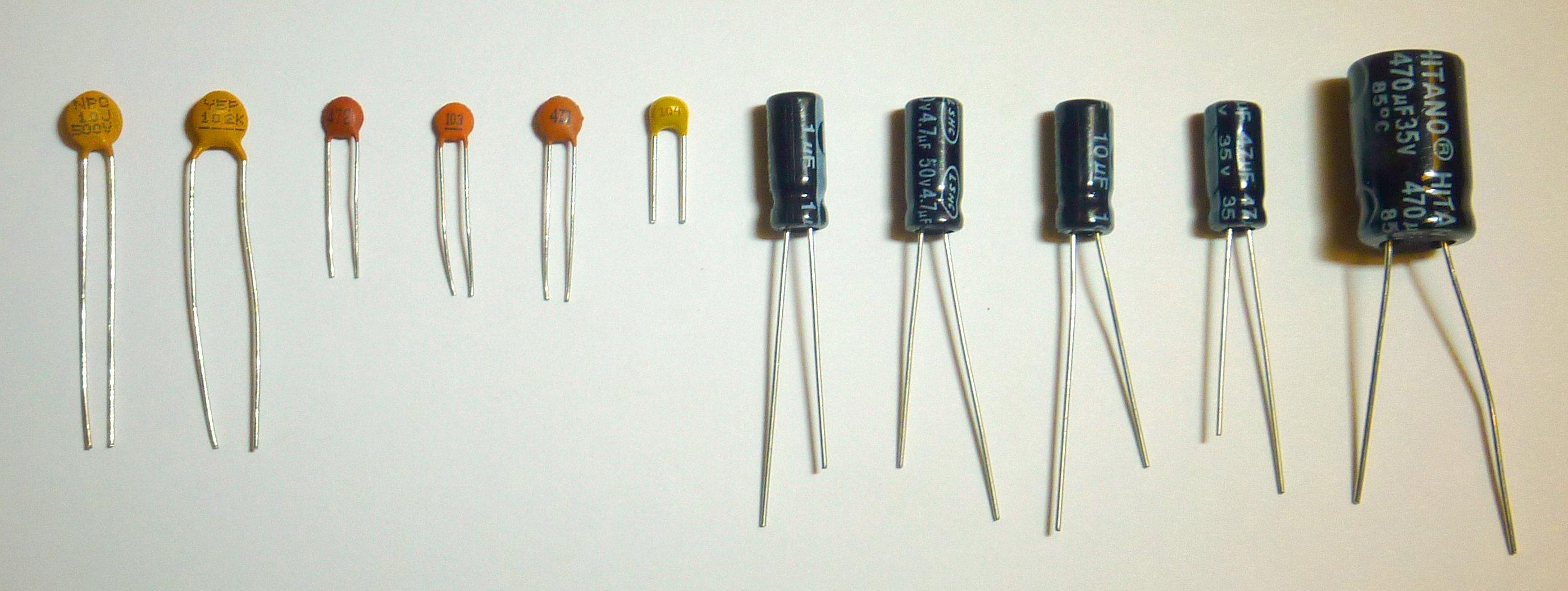
Some capacitors
In future units, we will look at a capacitor is made of, why it works, and how to use capacitances in computational physics problems!