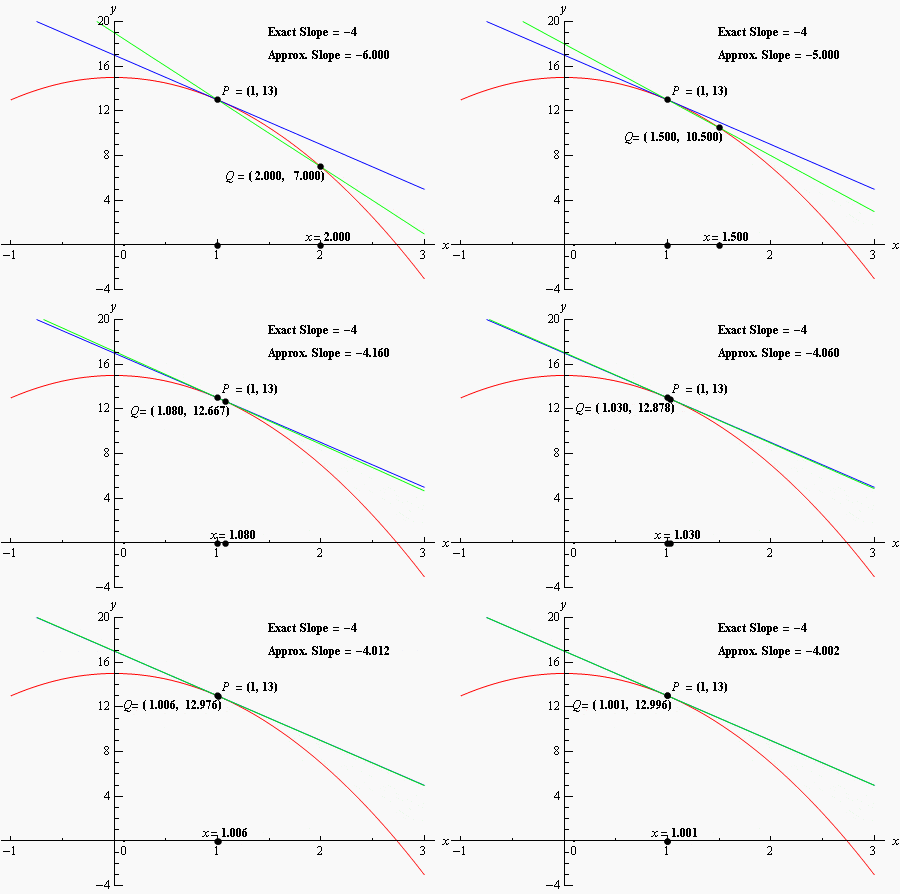
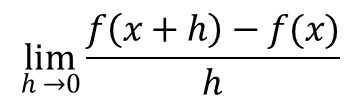
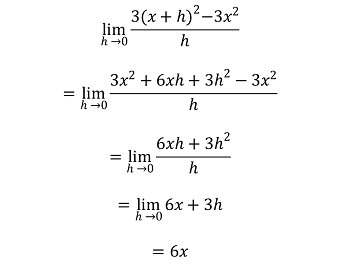
极限的定义,以及对于速度和变化量的理解

Before this, know直觉

Interactive · 2 questions

Let's think about how we can calculate the derivative at a point for a function y=f(x)y=f(x).

For example, let's sketch an arbitrary graph (in this case, we use y=x2y = x^2, but it doesn't really matter) for now, and pick two points AA and BB on the graph:

Let's say we wanted the derivative at the point AA. Well, the slope at that point would be a line that is tangent to the graph at AA (tangent meaning it intersects the graph only at that point). We don't really have any formulas dealing with tangent lines to graphs yet, but we can approach a tangent line by starting with a secant line (passes through two points).

Let's draw the line AB‾\overline{AB} and name a bunch of coordinates:

Don't be intimidated by this plot. What we're doing is fixing AA on the graph, and then treating BB as another point on the graph by increasing the xx-coordinate of AA by a small quantity Δx\Delta x.

What's the slope of AB‾\overline{AB}? That's not that difficult, we use our slope formula: Slope=y2−y1x2−x1=f(x0+Δx)−f(x0)x0+Δx−x0=f(x0+Δx)−f(x0)Δx\text{Slope} = \dfrac{y_2 - y_1}{x_2 - x_1} = \dfrac{f(x_0 + \Delta x) - f(x_0)}{x_0 + \Delta x - x_0} = \dfrac{f(x_0 + \Delta x) - f(x_0)}{\Delta x}

Our original goal was the find the slope of the tangent line at AA. Think about what we could do to Δx\Delta x to effectively find this line, and then click "Continue" when you think you have an idea.

What happens when Δx\Delta x becomes smaller? BB would then become closer and closer to AA. When Δx\Delta x finally becomes 00, BB coincides with AA! This (almost) gives us the desired line! However, we can't use a single point to define a line, since we could set the slope to any arbitrary value. Knowing this, what could we possibly do to find the tangent line?

When BB gets closer and closer to AA, the line AB‾\overline{AB} becomes closer and closer to our ideal tangent line, but when BB coincides with AA, we don't have a specific line anymore.

Hmmm...closer and closer and reaching a abnormality...we can use a limit! We can take the limit as Δx\Delta x approaches 00, and then we'll have our tangent line! Our equation is now: lim⁡Δx→0f(x0+Δx)−f(x0)Δx\lim_{\Delta x \to 0}\dfrac{f(x_0 + \Delta x) - f(x_0)}{\Delta x} And this, we denote as the derivative of f(x)f(x) at AA. If we put xx back in for x0x_0 to cover all cases of xx where there exists a derivative, we get that Derivative of f at x=f′(x)=dfdx=lim⁡Δx→0f(x+Δx)−f(x)Δx\text{Derivative of }f\text{ at } x = f'(x) = \dfrac{df}{dx} = \lim_{\Delta x \to 0}\dfrac{f(x + \Delta x) - f(x)}{\Delta x} You do not need to worry about the dfdf notation, that will be covered in the next section.

Now, lets try taking the derivative of f(x)=x2f(x)=x^2 at x=1x=1:

We know that: Derivative of x2 at (x=1)=f′(1)=lim⁡Δx→0f(1+Δx)−f(1)Δx=lim⁡Δx→0(1+Δx)2−12Δx=lim⁡Δx→01+2Δx+Δx2−1Δx=lim⁡Δx→02Δx+Δx2Δx=lim⁡Δx→02+Δx=2\begin{aligned} \text{Derivative of }x^2\text{ at } (x=1) = f'(1) = &\lim_{\Delta x \to 0}\dfrac{f(1 + \Delta x) - f(1)}{\Delta x} \\ =& \lim_{\Delta x \to 0}\dfrac{(1 + \Delta x)^2 - 1^2}{\Delta x} \\ =& \lim_{\Delta x \to 0}\dfrac{1 + 2\Delta x + \Delta x^2 - 1}{\Delta x} \\ =& \lim_{\Delta x \to 0}\dfrac{2\Delta x + \Delta x^2}{\Delta x} \\ =& \lim_{\Delta x \to 0}2 + \Delta x \\ =& \boxed{2} \end{aligned}

There! So the slope of the line tangent to the point x=1x=1 of f(x)=x2f(x)=x^2 is equal to 22.

Do you think you can try finding the derivative of some functions? Try some or yourself!

What is the derivative of f(x)=2x2f(x)=2x^2 at x=2x=2?

Choose one answer

Interactive · 1 question

IROC- Instantaneous Rate Of change

IROC is The rate of change at a particular moment which is the same as the value of the derivative at a particular point. For a function, the instantaneous rate of change at a point is the same as the slope of the tangent line at that point of a curve.

Slope=y2−y1x2−x1Slope =\frac{y_2-y_1}{x2−x1}

Using differential calculus, we can determine the limit, or the value that Δy/Δx approaches as Δy and Δx get closer to zero; it follows that this limit is the exact slope of the tangent. If y is dependent on x, then it is sufficient to take the limit where only Δx approaches zero. Therefore, the slope of the tangent is the limit of Δy/Δx as Δx approaches zero, or dy/dx. We call this limit the derivative.

dydx=lim⁡Δx→0ΔyΔx\frac{dy}{dx}=\lim_{\Delta x\to0}\frac{\Delta y}{\Delta x}

Its value at a point on the function gives us the slope of the tangent at that point. For example, let y=x2. A point on this function is (-2,4). The derivative of this function is dy/dx=2x. So the slope of the line tangent to y at (-2,4) is 2·(-2) = -4. The equation of this tangent line is: y-4=(-4)(x-(-2)) or y = -4x - 4.

f(x)=lim⁡h→0f(x+h)−f(x)h−xf(x) =\lim_{h \to 0}\frac{f(x + h) - f(x)}{h - x}

~ a brief description of a derivative ~

A function which gives the slope of the line tangent to a function. The derivative of a function f(x) commonly written f′(x)f'(x). For example if you have f(x)=x4f(x)=x^4the exponent will than go to the front of the x as a slope and the exponent will than be substrate by 1 so it will be f′(x)=4x3f'(x)=4x^3

This graph is graphing a tangent line which is equivalent to an Instantaneous Rate of Change graph.

To find the instantaneous rate of change you need to find the average rate of change by substituting the interval (x coordinate) into the given equation. Then, once you find your y coordinate you will find the other coordinates by using the first interval and add it with h. For example:

Find the slope of f(x)=2x2f(x) =2x^2 at x=5

f(x)=2(5)2f(x) =2(5)^2 f(x)=50f(x) =50 (5,50)

Then, take interval x=5 and add h: h+5 After that you will then replug the new interval h+5 into the equation. f(x)=2(h+5)2f(x) =2(h+5) ^2 f(x)=2h2+20h+50f (x) =2h^2+20h+50 the second pair of coordinates will be (h+5,(h+5,2h2+20h+502h^2+20h+50)

You will have to plug in both of your coordinates into the Slope equation above: (5,50) (h+5,(h+5,2h2+20h+502h^2+20h+50)

Slope=2h2+20hhSlope=\frac{2h^2+20h}{h} Once you divide you answer will be 2h+20

Practice problems

Calculate the Instantaneous rate of change of the function f(x)=5x3−4x2+2x+1f(x) = 5x^3 - 4x^2 + 2x + 1 at x = 2 ?

Choose one answer

Interactive · 8 questions

I'm stealing a good amount of stuff from Brandon Lin's explanation.

Let's try to calculate the derivative of f(x)=x2f(x)=x^2 at x=1.x=1.

Which of the following is equal to the derivative of f(x)f(x) at x=1x=1?

Choose one answer

Read · 1 min

What is a derivative, you ask? Why, it's the instantaneous rate of change!

Doesn't quite make sense yet? Ok, there are two classic ways of thinking about this:

  1. Imagine you are driving a car, and you have a friend outside watching you. Say you start from rest, and speed up slowly. Your friend sees the car change position faster and faster, also known as increasing in speed (or velocity). As the driver, you can see these changes by looking at the speedometer (and the road, of course). The speedometer value as a function of time is a well-known example of the derivative of the car's position with respect to time.

  2. From a geometrical standpoint, you can also think of the derivative as the slope of a tangent line of a function. Functions that increase rather quickly would have large derivatives in such a region, whereas functions that don't change much would have derivatives close to 0 at that region.

In fact, we can approximate slopes of a general function ff at x=ax = a with the formula:

f(a+h)−f(a)h\frac{f(a+h) - f(a)}{h}

where h is some small number representing the difference between two chosen x-coordinates. Of course, using limits, we can give a more precise algebraic definition of the derivative:

lim⁡h→0f(a+h)−f(a)h\lim_{h \to 0} \frac{f(a+h) - f(a)}{h}

Interactive · 5 questions

Definition of Derivative

You're driving your car on a highway. Your initial position is 0, and your position as a function of time tt is t2t^2. The graph below shows your car's position as a function of time.

What is your position after 2 seconds?

Choose one answer

Read · 1 min

Let f(x)f(x) be a function. The derivative of f(x)f(x) at x=ax=a, denoted f′(a)f'(a) is

f′(a)=lim⁡h→0f(a+h)−f(a)hf'(a) = \lim_{h\to 0} \frac{f(a+h)-f(a)}{h}

provided the limit exists. If the limit does not exist, then f′(a)f'(a) does not exist.

Interactive · 2 questions

What does IRoC mean?

Choose one answer

Illustrated · 1 min

  1. Instantaneous rate of change known as (IRoC) is the equivalent to finding the slope of a tangent line.

A tangent line is a point on the highest curve of a graph that follows the direction of the function

  1. For example in the image above, when the difference between the 2 points smaller, the average rate of change (ARoC) will become closer to the IRoC.
  1. The equation for instantaneous rate of change is:

Where h is the difference between x values

In this problem x=3

this is how you would solve it!

Video · + 2 min read

(Video) Finding Instantaneous Rates of Change Using the Definition of Derivatives

by PatrickJMT

Here's a video by patrickJMT explaining how to find the instantaneous rate of change and how to use it to solve problems.

The problem he look at is as follows:

The rate of production of a toy can be determined by the production formula P(t)=1200t−50t2P(t)=1200t-50t^2, where P(t)P(t) is the number of units produced in a given time and tt is the time in hours since the factory shift began. At what time does the rate of toy production equal 600600 units per hour? At what time doe the rate of toy production stop?

They key phrase in this problem is rate of. This clues us in on that we need to use derivatives. So let's find the derivative of the production formula. lim⁡h→0P(t+h)−P(t)h=lim⁡h→01200(t+h)−50(t+h)2−(1200t−50t2)h=lim⁡h→01200t+1200h−50t2−100th−50h2−1200t+50t2h=lim⁡h→01200h−100th−50h2h=lim⁡h→0h(1200−100t−50h)h=lim⁡h→01200−100t−50h=1200−100t−50(0)=1200−100t\lim_{h\rightarrow0}\frac{P(t+h)-P(t)}{h}\\ \begin{align} &=\lim_{h\rightarrow0}\frac{1200(t+h)-50(t+h)^2-(1200t-50t^2)}{h}\\ &=\lim_{h\rightarrow0}\frac{1200t+1200h-50t^2-100th-50h^2-1200t+50t^2}{h}\\ &=\lim_{h\rightarrow0}\frac{1200h-100th-50h^2}{h}\\ &=\lim_{h\rightarrow0}\frac{h(1200-100t-50h)}{h}\\ &=\lim_{h\rightarrow0}1200-100t-50h\\ &=1200-100t-50\color{red}{(0)}\\ &\boxed{=1200-100t} \end{align}

So now that we got our derivative we can start answering the questions. The first part asks for the time when the rate of production is equal to 600600. 1200−100t=600100t=600t=61200-100t=600\\ 100t=600\\ \boxed{t=6} After 6 hours the production will equal 600 units.\text{After }6\text{ hours the production will equal }600\text{ units.}

The second question asks for the time when the production stops. This means, when the rate of production is zero. 1200−100t=0100t=1200t=121200-100t=0\\ 100t=1200\\ \boxed{t=12} After 12 hours the production will stop.\text{After }12\text{ hours the production will stop.}

In this video he solves another example with instantaneous rate.

The problem says:

A particle moves along a straight line with its position given by the function p=t2−6t+8p=t^2-6t+8, where pp is in meters and tt is in seconds. When does the velocity equal 3030 meters per second? When is the particle at rest?

Since we're given a formula for position, we can take the derivative to determine the velocity. p′(t)=lim⁡h→0(t+h)2−6(t+h)+8−(t2−6t+8)h=lim⁡h→0t2+2th+h2−6t−6h+8−t2+6t−8h=lim⁡h→02th+h2−6hh=lim⁡h→0h(2t+h−6)h=lim⁡h→02t+h−6=2t+(0)−6p′(t)=v(t)=2t−6\begin{align} p'(t)&=\lim_{h\rightarrow0}\frac{(t+h)^2-6(t+h)+8-(t^2-6t+8)}{h}\\ &=\lim_{h\rightarrow0}\frac{t^2+2th+h^2-6t-6h+8-t^2+6t-8}{h}\\ &=\lim_{h\rightarrow0}\frac{2th+h^2-6h}{h}\\ &=\lim_{h\rightarrow0}\frac{h(2t+h-6)}{h}\\ &=\lim_{h\rightarrow0}2t+h-6\\ &=2t+\color{red}{(0)}-6\\ p'(t)&=\boxed{v(t)=2t-6} \end{align}

The first thing the problem asks is when the velocity equals 3030 meters per second. 2t−6=302t=36t=182t-6=30\\ 2t=36\\ \boxed{t=18} After 18 seconds the particle will betraveling at 30 meters per second.\text{After }18\text{ seconds the particle will be}\\ \text{traveling at }30\text{ meters per second.}

The second question the problem asks is when the particle will be at rest. If the particle is at rest, that means its velocity is zero. 2t−6=02t=6t=32t-6=0\\ 2t=6\\ \boxed{t=3} After 3 seconds the particle will be at rest.\text{After }3\text{ seconds the particle will be at rest.}

Type a concept, like “slope” or “photosynthesis”.

↑ ↓ to choose · Enter to openSearch explanations and problems