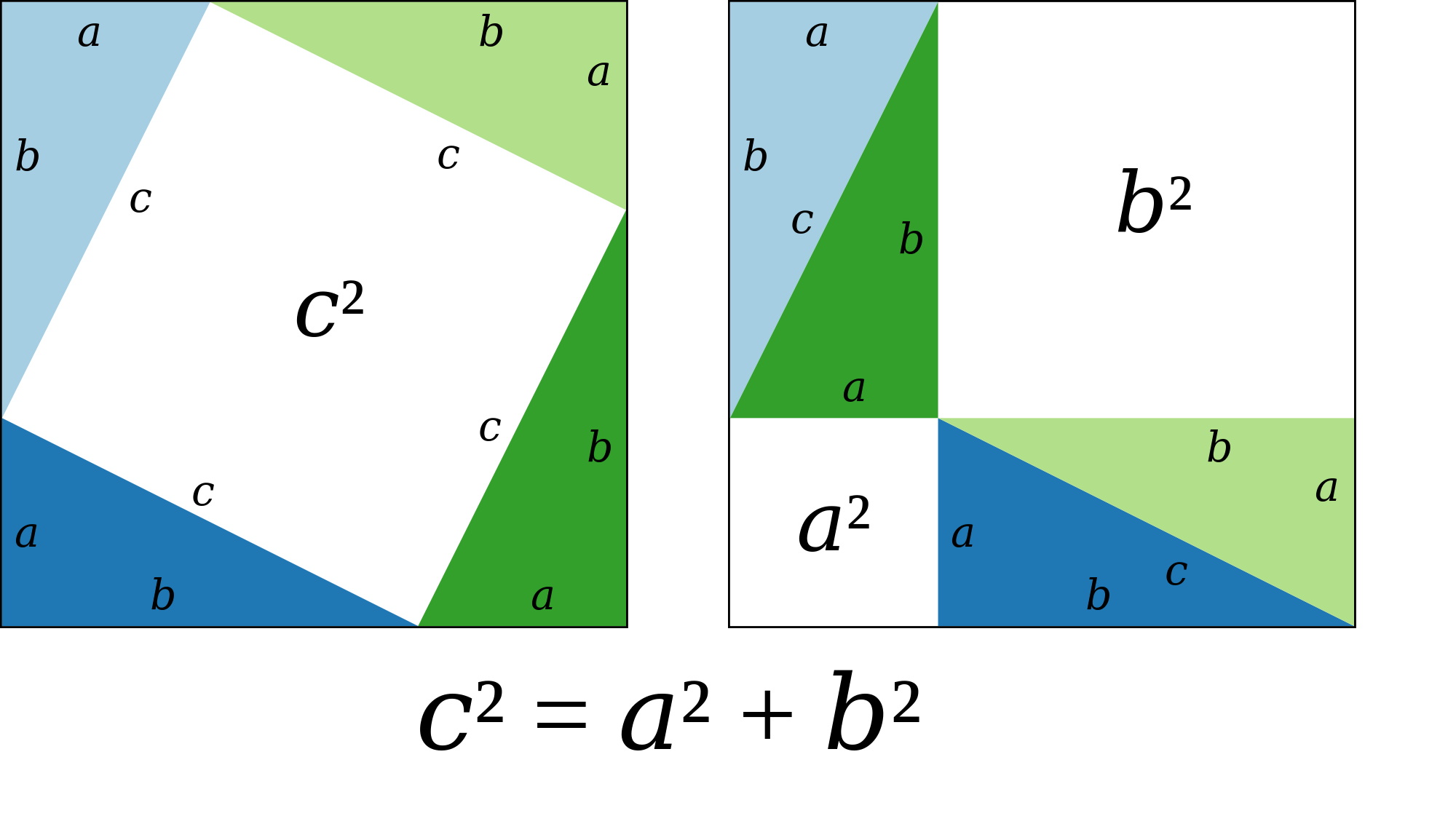
勾股定理

Before this, knowAngles in Right Triangles

Interactive · 7 questions

Pythagoras

Pythagoras was born around 570570 B.C. on the Greek island Samos. When he was 4040, he moved to Italy where he founded his sect:

Choose one answer

Put ideas together

Contest problems often need this idea together with one or two others. That is where understanding goes deeper than memory. These are real problems from the AMC 8, AMC 10, AMC 12 and AIME, the national math competitions for middle and high school students, each with a worked solution on LIVE by Po-Shen Loh.

Interactive · 4 questions

The Theorem of Pythagoras

Some terminology used here:

Right-angled triangle: This is a triangle that has one angle that is a right angle. These triangles are also called right triangles.

Hypotenuse: The hypotenuse is the name for the longest side in a right-angled triangle.

Pythagorean Triples

In ancient times, people noticed relationships between the lengths of sides of right-angled triangles. At first they found certain sets of similar right-angled triangles that always had their sides in the same ratio.

One of the simplest examples is the set of similar triangles with their sides in a ratio of 3:4:53:4:5. From experience, people knew that any triangle with its sides in this ratio would be a right-angled triangle.

Similarly, from experience, people discovered a number of other sets of similar right-angled triangles, where the lengths of the sides were in an integer ratio. A 3800 year-old tablet from Babylonian times shows a list of some Pythagorean triples.

These Pythagorean triples (the triple refers to three natural numbers in the ratio) were tremendously useful in calculating lengths.

A simple exercise using a triple:

If a right-angled triangle is given with a side of length 12 cubits and another side that is 16 cubits, the length of the hypotenuse is _______ cubits.

Interactive · 15 questions

Welcome to Pythagorean Land

Triangle 1:

Triangle 2:

Which of these triangles is more special?

Choose one answer

Interactive · 1 question

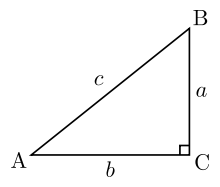
The Pythagorean Theorem is a rule relating the two legs and the hypotenuse of a right triangle.

We see in the diagram, aa and bb are the legs and cc is the hypotenuse:

The Pythagorean Theorem states that a2+b2=c2a^2+b^2=c^2, no matter the right triangle a,b,ca,b,c.

What is the hypotenuse of a right triangle with legs of length 33 and 44?

Interactive · 3 questions

Pythagorean Theorem - Motivation

Let's assume we just finished exploring the SAS congruence theorem. What would be a good part of SAS to fix in search of a relation?

Side lengths are pretty arbitrary - you can choose any positive real number. We fix the angle in between. What would be a good angle to explore?

Many things occur with 90∘90^\circ angles... Now what's the relationship?

We want to find a relationship between three variable sides. What can we do to simplify that and get started on a diagram?

We fix one of the sides, without loss of generality ABAB. However, we still have a point free to move around. What options do we have for that point?

Recall that one of the angles is 90∘90^\circ, and remember your goal is to vary this point to easily find a pattern. Which seems easiest?

Let's assume, without loss of generality, that ∠ABC=90∘\angle ABC=90^\circ.

Do something!

Now that we only have one thing to vary, CC, we take note of side length combinations, such as (AB,34AB,54AB)(AB,\frac{3}{4}AB,\frac{5}{4}AB) and (AB,125AB,135AB)(AB,\frac{12}{5}AB,\frac{13}{5}AB).

What would make the side lengths convenient to work with?

If they were integers. You may have noted different side lengths, but if we noted those in the last part, then we get (3,4,5)(3,4,5) and (5,12,13)(5,12,13). What type of relationship is it?

The result we're about to discover is a pretty primitive result. What did they use geometry for back in the old days?

They used it for farming. What shape would make a usual plot of land?

Square.

What can we do with (3,4,5)(3,4,5) and (5,12,13)(5,12,13) to experiment, given the direction we just found?

Square them, and we get (9,16,25)(9,16,25) and (25,144,169)(25,144,169). What's the most basic operation we can perform on these?

Add them. What relationship do you notice?

9+16=259+16=25 and 25+144=16925+144=169. What would this mean for △ABC\triangle ABC?

AB2+BC2=AC2AB^2+BC^2=AC^2. Let's try to prove it!

What's the easiest side of the equation to deal with?

The right hand side, AC2AC^2. Let's draw it in. How?

We have to draw in ACAC squared...

AC2AC^2 is the area of a square with side length ACAC. Which side do we draw it on, though?

We draw a square with side ACAC on the side opposite BB to avoid getting cluttered.

What would the other side of the equation look like geometrically?

What do we want to show?

We want to show that the sum of the areas of the squares with side lengths ABAB and BCBC is the area of the square with side length ACAC. Can we prove it directly?

Not easily. Back to this diagram.

Let's consider whether we need each part - the triangle and the square. Why did we put in the square?

To get the right side of the equation, so there's no use in removing it. What would we have without the triangle?

We would be removing the main thing, so the triangle, and thus both parts, are to stay. But what's arbitrary?

Is anything arbitrary from the triangle's perspective? Could we have constructed a square just as special?

No, this square is built on the hypotenuse, the side opposite the right angle. What about from the perspective of the square?

Choose side ACAC for the triangle is arbitrary. Which side would be a non-arbitrary place to put another triangle?

Due to restrictions with discovery trees in expii, we're just going to go with side (AC)(CA)(AC)(CA).

Reflectional Symmetry:

Rotational Symmetry:

How should we orient the new triangle?

Choose one answer

Interactive · 3 questions

Vocabulary

Right triangles are one of the most important topics to learn in geometry and are used heavily throughout trigonometry as well.

There are two different ways to classify sides of a right triangle:

Legs: these are the sides of a right triangle that make up the right angle.

Hypotenuse: this is the remaining side of right triangle. This will also always be the longest side of the triangle (You'll see why in a minute)

The lengths of these sides are related to one another by arguably the most important theorem in geometry, known as the Pythagorean Theorem\color{purple}{\text{Pythagorean Theorem}}.

This theorem\color{purple}{\text{theorem}} states that the sum of the squares of the legs of a right triangle is equal to the square of the hypotenuse. For this to be true, the hypotenuse must always be the longest side length.

How would this theorem be written algebraically, if a and b are the lengths of the sides and c is the length of the hypotenuse?

Choose one answer

Illustrated · 1 min

Pythagorean theorem is a very easy and a very useful theorem. it is used to find the sides of a right angled triangle.if we are given two sides of a right angled triangle, we can easily find the third side by the formula- a2+b2=c2a^2 + b^2 =c^2 where a,b and c represents perpendicular,base and hypotenuse respectively. But have you ever thought why this formula is true?What is the proof of the Pythagorean theorem? Well ! Don't worry! Here is the answer.

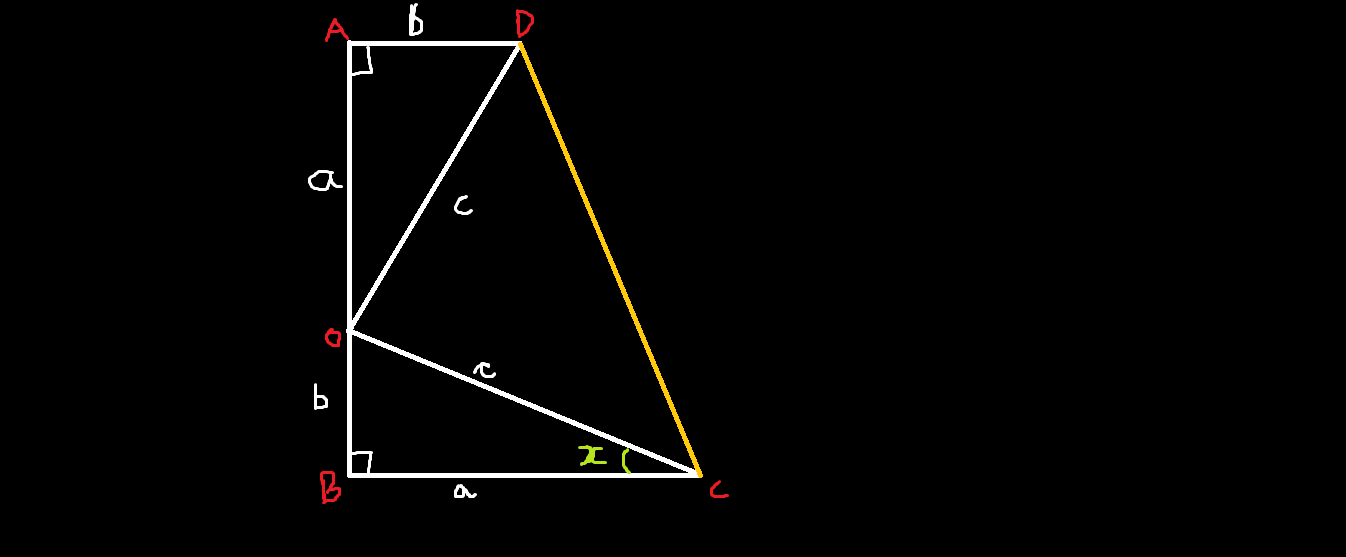
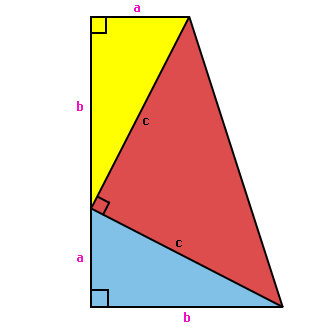
Here there are two identical right angled triangles and another right angled triangle OCD. The angle of DOC is 90 degree because if we take AOD as x , BOC will be 90-x. This is because BCO will also be equal to x. As we add 90-x and x we get 90 degree so we can say that DOC is 90 degree. Now we will make an equation showing that the sum of area all the three triangles is equal to the area of the trapezium. So-

12⋅ab+12⋅ab+12⋅c2=12(a+b)sum of parallel sides⋅(a+b)height of trapezium\frac12\cdot ab +\frac12\cdot ab +\frac12\cdot c^2 \\= \frac12(a+b)\text{sum of parallel sides}\cdot (a+b)\text{height of trapezium} ab2+ab2+c22=12(a+b)2\frac{ab}2 + \frac{ab}2 +\frac{c^2}2 =\frac12 (a+b)^2 ab+c22=12(a2+b2+2ab)ab + \frac{c^2}2 = \frac12 (a^2 + b^2 +2ab)

Now we can multiply both the sides by two to get rid of fractions.

2ab+c2=a2+b2+2ab2ab + c^2 = a^2 + b^2 +2ab

Now the 2ab on both the side will cut leaving-

c2=a2+b2c^2 = a^2 + b^2

Hence proved !

Read · 1 min

Like all triangles, the three angles of a right triangle sum to a total measure of 180180 degrees; however, a right triangle has one right (90-degree) angle.

Right triangles also have another special property known as the Pythagorean Theorem. If aa and bb are the lengths of the triangle's legs and cc is the length of the triangle's hypotenuse, then

a2+b2=c2a^2 + b^2 = c^2

There are also some special forms of right triangles:

30-60-90 right triangle: the angles have measures of 3030, 6060, and 9090 degrees. The sides have lengths mm, m3m\sqrt{3}, and 2m2m for a positive value of mm. Note that this satisfies the Pythagorean Theorem:

m2+(m3)2=(2m)2⇒m^2 + (m\sqrt{3})^2 = (2m)^2 \Rightarrow m2+3m2=4m2m^2 + 3m^2 = 4m^2

45-45-90 right triangle: the two non-right angles of the triangle each have measures of 4545 degrees. These triangles are also known as isosceles right triangles. These sides have lengths of aa, aa, and a2a\sqrt{2} for a positive value of aa. Note that these values also satisfy the Pythagorean Theorem:

n2+n2=(n2)2⇒2n2=2n2n^2 + n^2 = (n\sqrt{2})^2 \Rightarrow 2n^2 = 2n^2

Finally, note that besides the right angle, there are two other angles, each of which has a leg of the triangle opposing it. The larger of these two angles is always opposite the longer leg for right triangles.

Illustrated · 1 min

The Pythagorean Theorem is one of the most basic and useful relationships in all of geometry. Suppose we have a right triangle with sides aa, bb, and cc. Two of the sides must be separated by and angle of 90º90º for this to be a right triangle. Let us say that the two sides in this case are aa and bb. The Pythagorean Theorem states that for any such right triangle:

a2+b2=c2a^2+b^2=c^2

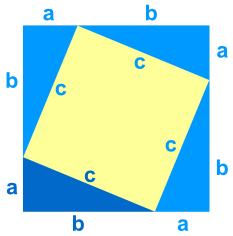
For a simple geometric proof of this concept, let us inscribe a tilted square with side length cc inside another larger square.

This figure now gives us four congruent right triangles and an inscribed square, EFGH. Let us call the length of AE=BF=CG=DH=aAE = BF = CG = DH = a and AH=BE=CF=DG=bAH = BE = CF = DG = b, as in the original example. The side length of the square is cc, which also forms the hypotenuse of the right triangles with leg a and b in this case. Now, the length of one side of the outer square is a+ba+b, so we can say that the area of the outer square is (a+b)2(a+b)^2. However, another way we can define the area of this outer square is by adding up the areas of the four triangles and the inner square. (See: Area of triangles; Area of Square) This gives us 4(12ab)+c24(\dfrac{1}{2}ab)+c^2 as another formula for the area of the larger square. Since the former and the latter are both representing the same area, we can set them equal to each other. This gives us:

(a+b)2=4(12ab)+c2(a+b)^2=4(\dfrac{1}{2}ab)+c^2

Expanding on the left and simplifying on the right:

a2+2ab+b2=2ab+c2a^2+2ab+b^2=2ab+c^2

Subtracting 2ab2ab from each side, we are left with our original formula for the Pythagorean Theorem:

a2+b2=c2a^2+b^2=c^2

There are numerous other proofs for the Pythagorean Theorem, some more complex than others. This is simply a very basic introduction into the Pythagorean Theorem and how to conceptualize its principle.

Read · 1 min

Pythagoras once planted a seed.

30 years later, it grew into a tall elm and said "Gee, I'm a tree."

...

...

Don't get it?

"Geometry!"

Video · + 3 min read

The Pythagorean theorem is one of the most famous equations you will come across in your early mathematic career. But how is it derived?

Let us briefly explore this theorem and its proof

Pythagorean Theorem

The sum of the squares of the two legs is equal to the square of the hypotenuse, or:

a2+b2=c2a^2+b^2= c^2

Right triangle

But what is the theorem saying?

Colloquially, it says that if you were to build squares on each of the sides of the triangle, the sum of the areas of the squares with side length aa (area a2a^2) and side length bb (area b2b^2) would be equal to the area of the square made with side length c (area c2c^2)

But why is this true? To answer that we need only consult with Pythagoras' original proof.

Pythagoras' Pythagorean Proof

Pythagoras was a clever man, so his proof is also quite clever. His is a proof by rearrangement or, simply, he moved things around to make the proof easier to visualize. This is certainly allowed, as long as the figure that results, and each of its components, are perfectly equivilant to the original.

Pythagoras' original statement is as follows:

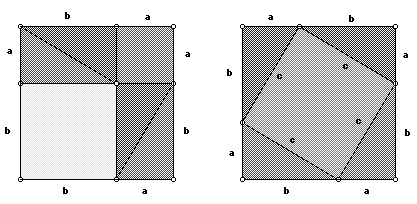
"Let a, b, c denote the legs and the hypotenuse of the given right triangle, and consider the two squares in the accompanying figure, each having a+b as its side. The first square is dissected into six pieces-namely, the two squares on the legs and four right triangles congruent to the given triangle. The second square is dissected into five pieces-namely, the square on the hypotenuse and four right triangles congruent to the given triangle. By subtracting equals from equals, it now follows that the square on the hypotenuse is equal to the sum of the squares on the legs, Q.E.D."- Pythagoras

What Does it Mean?

For some, this still might be hard to visualize, therefore, I encourage all of you to use the image below (never be ashamed to draw things in mathematics, especially geometry, as it is often imperative to understanding the question or proof!)

Pythagorean Theorem representation.

Note I did not create this diagram, it is an adaption from Pythagoras' original found on http://jwilson.coe.uga.edu

Pythagoras proposes two rearranged squares. The first is composed of side lengths (a+b). There are six component shapes that comprise this square. Four congruent triangles and two squares, one with an area of a2a^2 and the other with area b2b^2.

In square two, the set up is different. The sides are still (a+b) however this triangle is only made of of five pieces, four congruent triangles and one large square with area c2c^2

Now, since this equation deals with areas, let us find the areas.

The area of the first square can be: 4(1/2)ab+a2+b24(1/2)ab+ a^2 + b^2 or (a+b)2(a+b)^2

The area of the second can be: 4(1/2)ab+c24(1/2)ab+ c^2 or (a+b)2(a+b)^2

Now what to do? Well, all these should be equivalent so let's set them equal and see what happens.

Clearly, there is a best choice for proving the theorem.

By setting 4(1/2)ab+a2+b24(1/2)ab+a^2+b^2 = 4(1/2)ab+c24(1/2)ab+c^2 we get

a2+b2=c2a^2+ b^2 = c^2

And that is how we prove the Pythagorean theorem!

In case you're still a little confused, there is a great depiction of the Pythagorean Theorem with water down below!

I hope you've learned to love this equation, because you're going to be using it until you stop doing math:)

Read · 1 min

There's a really easy geometric proof of the Pythagorean Theorem.

Imagine a square where each side is of length a + b. If you cut an axa square out of one corner and a bxb square out of the opposite corner, there will be two rectangles of area a×ba \times b. So (a+b)2=a2+2ab+b2(a+b)^2 = a^2 + 2ab + b^2, which you already knew.

Now divide the sides of the square into segments of length a, b, a, b, a, b, a, b. Cut off 4 right triangles with sides a and b, and area ab/2ab/2 and let's call the hypotenuse of those triangles c. The center part is a square of area c×cc \times c. (We know it's a square, because where its corner touches the side of the bigger square, there are three angles and those three angles sum to 180 degrees. The other two angles sum to 90 degrees.) So we can see that the area of the big square is c×c+4ab/2c \times c + 4 a b/2.

Putting the two parts together, a2+b2=c2a^2 + b^2 = c^2.

Read · 1 min

The Pythagorean Theorem can be useful in solving problems pertaining to related rates. In this box we will demonstrate a generic derivation that may be helpful for using the Pythagorean Theorem in related rates problems.

Related rates problems ALWAYS involve differentiating with respect to time. We assume both legs and the hypotenuse have lengths that are functions of time.

A(t)2+B(t)2=C(t)2A(t)^2 + B(t)^2 = C(t)^2

Now we differentiate the whole equation, noting the necessity of use of the Chain Rule:

2A(t)dAdt+2B(t)dBdt=2C(t)dCdt⇒2A(t)\frac{dA}{dt} + 2B(t)\frac{dB}{dt} = 2C(t)\frac{dC}{dt} \Rightarrow A(t)dAdt+B(t)dBdt=C(t)dCdtA(t)\frac{dA}{dt} + B(t)\frac{dB}{dt} = C(t)\frac{dC}{dt}

That's a lot of information you need, but luckily most of it will be given to you. Furthermore, it may be said (or interpreted) that one side of the triangle has a constant length. For instance, if the hypotenuse has a constant length, then the equation becomes

A(t)dAdt+B(t)dBdt=0A(t)\frac{dA}{dt} + B(t)\frac{dB}{dt} = 0

The final thing to note is the domain restriction that arises when working with triangles. We must have the following hold:

A(t)+B(t)>C(t)A(t) + B(t) > C(t)

Otherwise we violate the triangle inequality.

Interactive · 4 questions

The Pythagorean Theorem

The Pythagorean Theorem is a theorem which tells us that for a right triangle with legs aa and bb along with a hypotenuse cc, the sum of the squares of the legs is equal to the square of the hypotenuse. In mathematical terms, this means that a2+b2=c2a^2 + b^2 = c^2.

The Pythagorean Theorem

This theorem is arguably one of the most used theorems in geometry. In general, right triangles along with their respective properties, theorems, and formulas are all very prominent in geometry. But before we decide to have fun with this theorem, we should be able to prove it/understand why it works.

Ready to move on?

Choose one answer

Interactive · 6 questions

Part One

Section 1 A

The Pythagorean Theorem

Let's say that you have a wooden triangle that you're making a ruler out of. A right triangle, to be specific. The legs are 1212 inches and 55 inches. The third leg, which is called the hypotenuse, is labeled "cc inches."

What is cc?

Choose one answer

Read · 1 min

Why is the Pythagorean Theorem so important in geometry? See here.

Illustrated · 1 min

Elementary Problem related to Pythagorean Theorem

Problem:

In a triangle △ABC\triangle{ABC}, AM{AM} is the median on the side BCBC.Prove that AB2+AC2=2(AM2+BM2)AB^2+AC^2=2(AM^2+BM^2).

Extra Notes:This problem is also known as Apollonius Theorem. It is also a case of a more general theorem called Stewart's Theorem.

Proof:\textbf{Proof:}

Let's start by drawing a diagram:

So now we can see there is no right angled triangle where we can apply our dear Pythagoras Theorem. But the title says its an "Elementary Problem" so the road from here must be simple.

May be you need a hint.

When there are no right-angled triangles available on any side of a triangle the best thing to do is try to draw one. Just drop a perpendicular from AA and maybe you got the solution....

If not then

By our dear Pythagoras Theorem we have:

AB2=BD2+AD2+(BM2+MD2)+AD2AB^2=BD^2+AD^2+(BM^2+MD^2)+AD^2 AB2=BM2+2×BM×MD+MD2+AM2−MD2AB^2=BM^2+2\times{BM}\times{MD}+MD^2+AM^2-MD^2 AB2=BM2+AM2+2×BM×MDAB^2=BM^2+AM^2+2\times{BM}\times{MD}

Similarly we can obtain,

AC2=CM2+AM2−2×MC×MDAC^2=CM^2+AM^2-2\times{MC}\times{MD}.

Thus add the two equation and since AMAM is a median:

AB2+AC2=2(AM2+BM2)AB^2+AC^2=2(AM^2+BM^2)

Hence Proved.■\blacksquare


Sources:Xu, Jiagu. Lecture Notes on Mathematical Olympiad Courses for Junior Section, Volume 1.Singapore: World Scientific, 2010. Web.

Read · 1 min

Here is some extra practice on the Pythagorean Theorem. Good luck!

Video

(Video) Proving the Pythagorean Theorem

The Pythagorean Theorem states that the sum of the squares of the two legs of any right triangle equal the square of the hypotenuse. In other words:

a2+b2=c2a^2 + b^2 = c^2

But why does this always work? Richard Rusczyk works through the proof in the following video:

(Note that the actual proof, with variables and all, actually starts at about timestamp 4:15. Before that, he works through an example with real numbers.)

Type a concept, like “slope” or “photosynthesis”.

↑ ↓ to choose · Enter to openSearch explanations and problems