极限定义的应用

Interactive · 4 questions

When I was young, I had to learn the fundamentals of basketball. You can have all the physical ability in the world, but you still have to know the fundamentals.

  • Michael Jordan

In the group Differentiation Rules and Computations, we created nifty tools like the Product Rule and Chain Rule.

But you still have to know the fundamentals! Remember that a derivative just measures the sensitivity of a function at a point, which we can define (equivalently!) either in terms of a different quotient f(x+h)−f(x)h\frac{f(x+h)-f(x)}{h} (or f(y)−f(x)y−x\frac{f(y)-f(x)}{y-x} in terms of y=x+hy=x+h) or a linear approximation f(y)≈f(x)+f′(x)(y−x)f(y) \approx f(x)+f'(x)(y-x).

But enough philosophy.

Practically speaking, though, is it enough to rely on the power rule, product rule, chain rule, etc.?

Not always. Here's a series of questions showing why we sometimes need to go back to the fundamentals, and use the definition of a derivative. In the following questions, let f(x)=x(1+∣x∣)f(x) = x(1+\lvert{x}\rvert).

Is f(x)f(x) differentiable at all x>0x>0?

Choose one answer

Read · 2 min

Usage of the limit definition to find derivatives can be a tedious exercise; it requires some complicated algebra. Generally, other techniques of differentiation are preferred, but the limit definition serves as a more rigorous proof. The limit definition is defined as

f′(x)=lim⁡h→0f(x+h)−f(x)hf'(x) = \lim_{h \rightarrow 0}\frac{f(x + h) - f(x)}{h}

Illustrations of how this definition is used are quite important. We will use it to prove that the derivative of tan⁡(x)\tan(x) is sec⁡2(x)\sec^2(x).

sec⁡2(x)=lim⁡h→0tan⁡(x+h)−tan⁡(x)h\sec^2(x) = \lim_{h \rightarrow 0}\frac{\tan(x + h) - \tan(x)}{h}

Direct substitution on the right-hand side gives 00\frac{0}{0}, so another approach must be used. Use the angle addition formula for tangent on the tan⁡(x+h)\tan(x + h) term:

sec⁡2(x)=lim⁡h→0sin⁡(x)cos⁡(h)+cos⁡(x)sin⁡(h)cos⁡(x)cos⁡(h)−sin⁡(x)sin⁡(h)−tan⁡(x)h\sec^2(x) = \lim_{h \rightarrow 0}\frac{\frac{\sin(x)\cos(h) + \cos(x)\sin(h)}{\cos(x)\cos(h) - \sin(x)\sin(h)} - \tan(x)}{h}

Simplify the complex fraction:

sec⁡2(x)=lim⁡h→0tan⁡(x)cos⁡(h)+sin⁡(h)cos⁡(h)−tan⁡(x)sin⁡(h)−tan⁡(x)h⇒\sec^2(x) = \lim_{h \rightarrow 0}\frac{\frac{\tan(x)\cos(h) + \sin(h)}{\cos(h) - \tan(x)\sin(h)} - \tan(x)}{h} \Rightarrow

sec⁡2(x)=lim⁡h→0tan⁡(x)+tan⁡(h)1−tan⁡(x)tan⁡(h)−tan⁡(x)h⇒\sec^2(x) = \lim_{h \rightarrow 0}\frac{\frac{\tan(x) + \tan(h)}{1 - \tan(x)\tan(h)} - \tan(x)}{h} \Rightarrow

sec⁡2(x)=lim⁡h→0tan⁡(x)+tan⁡(h)−tan⁡(x)(1−tan⁡(x)tan⁡(h))h(1−tan⁡(x)tan⁡(h))⇒\sec^2(x) = \lim_{h \rightarrow 0}\frac{\tan(x) + \tan(h) - \tan(x)(1 - \tan(x)\tan(h))}{h(1 - \tan(x)\tan(h))} \Rightarrow

sec⁡2(x)=lim⁡h→0tan⁡(x)+tan⁡(h)−tan⁡(x)+tan⁡2(x)tan⁡(h)h−htan⁡(x)tan⁡(h)\sec^2(x) = \lim_{h \rightarrow 0}\frac{\tan(x) + \tan(h) - \tan(x) + \tan^2(x)\tan(h)}{h - h\tan(x)\tan(h)}

Some of the terms will cancel:

sec⁡2(x)=lim⁡h→0tan⁡(h)(1+tan2(x))h−htan⁡(x)tan⁡(h)\sec^2(x) = \lim_{h \rightarrow 0}\frac{\tan(h)(1 + tan^2(x))}{h - h\tan(x)\tan(h)}

There is an identity that states that 1+tan⁡2(x)=sec⁡2(x)1 + \tan^2(x) = \sec^2(x):

sec⁡2(x)=lim⁡h→0tan⁡(h)⋅sec⁡2(x)h−htan⁡(x)tan⁡(h)\sec^2(x) = \lim_{h \rightarrow 0}\frac{\tan(h) \cdot \sec^2(x)}{h - h\tan(x)\tan(h)}

Divide both sides of the equation by sec⁡2(x)\sec^2(x):

1=lim⁡h→0tan⁡(h)h−htan⁡(x)tan⁡(h)1 = \lim_{h \rightarrow 0}\frac{\tan(h)}{h - h\tan(x)\tan(h)}

At this point we must use the result that lim⁡h→0sin⁡(h)h=1\lim_{h\to 0} \frac{\sin (h)}{h} = 1. (This limit almost always comes up when dealing with trig functions.) If we expand tan⁡(h)\tan(h) as sin⁡(h)cos⁡(h)\frac{\sin(h)}{\cos(h)} and then factor out sin⁡(h)h\frac{\sin(h)}{h}, we get:

1=lim⁡h→0(sin⁡(h)h⋅1cos⁡h−tan⁡xsin⁡h).1 = \lim_{h\to 0}\left(\frac{\sin (h)}{h} \cdot \frac{1}{\cos h - \tan x \sin h}\right).

By the product rule for limits,

1=(lim⁡h→0sin⁡(h)h)⋅(lim⁡h→01cos⁡h−tan⁡xsin⁡h).1 = \left(\lim_{h\to 0} \frac{\sin(h)}{h}\right) \cdot \left(\lim_{h\to 0} \frac{1}{\cos h - \tan x \sin h}\right).

We know that the first limit is 11. In the second limit, we can substitute h=0h=0 directly to get 11, obtaining 1=1⋅11 = 1 \cdot 1.

So the derivative statement is true. In general, these computations are heavy on algebra and sometimes trigonometry (it depends on the derivative you are calculating).

Read · 1 min

The derivative is usually defined as either ddx(f(x))=lim⁡x0→xf(x0)−f(x)x0−x or ddx(f(x))=lim⁡Δx→xf(x+Δx)−f(x)Δx\begin{align*} \frac d{dx}(f(x))&=\lim_{x_0\to x}\frac{f(x_0)-f(x)}{x_0-x}\\\ \text{or}\\\ \frac d{dx}(f(x))&=\lim_{\Delta x\to x}\frac{f(x+\Delta x)-f(x)}{\Delta x} \end{align*} where f(x)f(x) is a function with argument xx.

Read · 1 min

Here are some problems to practice Using the Limit Definition of a Derivative. They may be simpler to do using another rule, but the definition is important, so use it! Good luck!

Video · + 1 min read

(Videos) Finding a Derivative Using the Definition of Derivative

by PatrickJMT

In this video by patrickJMT he shows you how to use the derivative definition to find the derivative at a point.

Recall the definition of a derivative: f′(x)=lim⁡h→0f(x+h)−f(x)hf'(x)=\lim_{h\rightarrow0}\frac{f(x+h)-f(x)}{h}

The first example he looks at is finding the derivative of f(x)=12+7xf(x)=12+7x. So we write this into our definition of a derivative. f′(x)=lim⁡h→012+7(x+h)−(12+7x)hf'(x)=\lim_{h\rightarrow0}\frac{12+7(x+h)-(12+7x)}{h} Notice if we plug in h=0h=0 we get a zero in the denominator. So to find this limit we have to do some algebra until we can plug in h=0h=0. So let's expand the top. =lim⁡h→012+7x+7h−12−7xh=lim⁡h→07hh=lim⁡h→07=7\begin{align} &=\lim_{h\rightarrow0}\frac{12+7x+7h-12-7x}{h}\\ &=\lim_{h\rightarrow0}\frac{7h}{h}\\ &=\lim_{h\rightarrow0}7\\ &=\boxed{7} \end{align} So the derivative of f(x)=12+7xf(x)=12+7x is f′(x)=7f'(x)=7.

The next example he solves is finding the derivative of G(t)=4tt+1G(t)=\dfrac{4t}{t+1}. So we need to plug this into our definition. G′(t)=lim⁡h→04(t+h)t+h+1−4tt+1hG'(t)=\lim_{h\rightarrow0}\frac{\frac{4(t+h)}{t+h+1}-\frac{4t}{t+1}}{h} So we have to get like denominators in the numerator and combine these. =lim⁡h→04(t+h)(t+1)(t+h+1)(t+1)−4t(t+h+1)(t+1)(t+h+1)h=lim⁡h→04t2+4t+4th+4h(t+h+1)(t+1)−4t2+4th+4t(t+1)(t+h+1)h=lim⁡h→04t2+4t+4th+4h−4t2−4th−4t(t+h+1)(t+1)h=lim⁡h→04h(t+h+1)(t+1)h=lim⁡h→04h(t+h+1)(t+1)⋅1h=lim⁡h→04(t+h+1)(t+1)\begin{align} &=\lim_{h\rightarrow0}\frac{\frac{4(t+h)\color{red}{(t+1)}}{(t+h+1)\color{red}{(t+1)}}-\frac{4t\color{red}{(t+h+1)}}{(t+1)\color{red}{(t+h+1)}}}{h}\\ &=\lim_{h\rightarrow0}\frac{\frac{4t^2+4t+4th+4h}{(t+h+1)(t+1)}-\frac{4t^2+4th+4t}{(t+1)(t+h+1)}}{h}\\ &=\lim_{h\rightarrow0}\frac{\frac{4t^2+4t+4th+4h-4t^2-4th-4t}{(t+h+1)(t+1)}}{h}\\ &=\lim_{h\rightarrow0}\frac{\frac{4h}{(t+h+1)(t+1)}}{h}\\ &=\lim_{h\rightarrow0}\frac{4h}{(t+h+1)(t+1)}\cdot\frac1h\\ &=\lim_{h\rightarrow0}\frac{4}{(t+h+1)(t+1)} \end{align} Now if we plug in h=0h=0: =4(t+(0)+1)(t+1)=4(t+1)(t+1)=4(t+1)2\begin{align} &=\frac{4}{(t+\color{red}{(0)}+1)(t+1)}\\ &=\frac{4}{(t+1)(t+1)}\\ &=\boxed{\frac4{(t+1)^2}} \end{align}

So the derivative of G(t)=4tt+1G(t)=\dfrac{4t}{t+1} is G′(t)=4(t+1)2G'(t)=\dfrac{4}{(t+1)^2}.

In this video he goes over another example of finding the derivative using the definition.

The function he takes the derivative of is: f(x)=x2+x−3f(x)=x^2+x-3. He first calculates just f(x+h)f(x+h) in order to keep things from getting messy in the numerator of the derivative definition. f(x+h)=(x+h)2+(x+h)−3=x2+2xh+h2+x+h−3\begin{align} f(x+h)&=(x+h)^2+(x+h)-3\\ &=x^2+2xh+h^2+x+h-3 \end{align} f′(x)=lim⁡h→0x2+2xh+h2+x+h−3−(x2+x−3)h=lim⁡h→0x2+2xh+h2+x+h−3−x2−x+3h=lim⁡h→02xh+h2+hh=lim⁡h→0h(2x+h+1)h=lim⁡h→02x+h+1=2x+0+1=2x+1\begin{align} f'(x)&=\lim_{h\rightarrow0}\frac{x^2+2xh+h^2+x+h-3-(x^2+x-3)}{h}\\ &=\lim_{h\rightarrow0}\frac{x^2+2xh+h^2+x+h-3-x^2-x+3}{h}\\ &=\lim_{h\rightarrow0}\frac{2xh+h^2+h}{h}\\ &=\lim_{h\rightarrow0}\frac{h(2x+h+1)}{h}\\ &=\lim_{h\rightarrow0}2x+h+1\\ &=2x+\color{red}{0}+1\\ &\boxed{=2x+1} \end{align}

Video · + 1 min read

(Videos) Limit Definition of Derivative for Rational Functions

by PatrickJMT

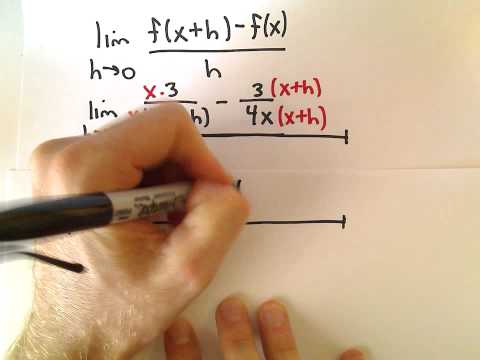
Here's a video by patrickJMT showing you how to use the limit definition of a derivative to find the derivative of a rational function.

Recall: f′(x)=lim⁡h→0f(x+h)−f(x)hf'(x)=\lim_{h\rightarrow0}\frac{f(x+h)-f(x)}{h}

The problem he solves is

Find the derivative of f(x)=34xf(x)=\frac{3}{4x}; what is the slope of the tangent line to f(x)f(x) when x=2x=2?

So we start by taking the limit definition of a derivative and applying it to our function. f′(x)=lim⁡h→034(x+h)−34xh\begin{align} f'(x)&=\lim_{h\rightarrow0}\frac{\frac{3}{4(x+h)}-\frac{3}{4x}}{h} \end{align} Whenever you have two fractions it's usually a good idea to combine them with like denominators. f′(x)=lim⁡h→034(x+h)⋅xx−34x⋅x+hx+hh=lim⁡h→03x−3(x+h)4x(x+h)h=lim⁡h→03x−3x−3h4x(x+h)h=lim⁡h→0−3h4x(x+h)h=lim⁡h→0−3h4x(x+h)⋅1h=lim⁡h→0−34x(x+h)=−34x(x+(0))=−34x2\begin{align} f'(x)&=\lim_{h\rightarrow0}\frac{\frac{3}{4(x+h)}\color{red}{\cdot\frac xx}-\frac{3}{4x}\color{red}{\cdot\frac{x+h}{x+h}}}{h}\\ &=\lim_{h\rightarrow0}\frac{\frac{3x-3(x+h)}{4x(x+h)}}{h}\\ &=\lim_{h\rightarrow0}\frac{\frac{3x-3x-3h}{4x(x+h)}}{h}\\ &=\lim_{h\rightarrow0}\frac{\frac{-3h}{4x(x+h)}}{h}\\ &=\lim_{h\rightarrow0}\frac{-3h}{4x(x+h)}\cdot\frac1h\\ &=\lim_{h\rightarrow0}\frac{-3}{4x(x+h)}\\ &=\frac{-3}{4x(x+\color{red}{(0)})}\\ &\boxed{=-\frac3{4x^2}} \end{align}

Now we want to find the tangent line's slope at the point x=2x=2. Well since the derivative is just the tangent line we can plug in x=2x=2 into that. f′(2)=−34(2)2=−316\begin{align} f'(2)&=-\frac{3}{4\color{red}{(2)}^2}\\ &\boxed{=-\frac3{16}} \end{align}

Here's another video with another example. This time the problem is:

At what point does the equation of the line tangent to the curve y=1x+2y=\frac1x+2 have a slope of −2-2?

So let's find the derivative of this function. f′(x)=lim⁡h→01x+h+2−(1x+2)h=lim⁡h→01x+h−1xh=lim⁡h→01x+h⋅xx−1x⋅x+hx+hh=lim⁡h→0x−x−hx(x+h)h=lim⁡h→0−hx(x+h)h=lim⁡h→0−hx(x+h)⋅1h=lim⁡h→0−1x(x+h)=−1x(x+(0))=−1x2\begin{align} f'(x)&=\lim_{h\rightarrow0}\frac{\frac{1}{x+h}+2-(\frac{1}{x}+2)}{h}\\ &=\lim_{h\rightarrow0}\frac{\frac{1}{x+h}-\frac{1}{x}}{h}\\ &=\lim_{h\rightarrow0}\frac{\frac{1}{x+h}\color{red}{\cdot\frac xx}-\frac{1}{x}\color{red}{\cdot\frac{x+h}{x+h}}}{h}\\ &=\lim_{h\rightarrow0}\frac{\frac{x-x-h}{x(x+h)}}{h}\\ &=\lim_{h\rightarrow0}\frac{\frac{-h}{x(x+h)}}{h}\\ &=\lim_{h\rightarrow0}\frac{-h}{x(x+h)}\cdot\frac1h\\ &=\lim_{h\rightarrow0}\frac{-1}{x(x+h)}\\ &=-\frac{1}{x(x+\color{red}{(0)})}\\ &\boxed{=-\frac{1}{x^2}} \end{align}

Now we want to know the point where the slope is −2-2. Be careful here, this means we set our derivative equal to −2-2, not plug in x=−2x=-2! −1x2=−21x2=2x2=12x=±12x=±22-\frac1{x^2}=-2\\ \frac1{x^2}=2\\ x^2=\frac12\\ x=\pm\sqrt{\frac12}\\ \boxed{x=\pm\frac{\sqrt2}{2}}

We're done now right!? Not yet! It asked for the point which means an xx-coordinate and a yy-coordinate. We only have the xx part right now. To find the yy-coordinate we can plug in x=22x=\frac{\sqrt2}2 into our original function. y=1x+2y=1±22+2y=±22+2y=±222+2y=±2+2\begin{align} y&=\frac1x+2\\ y&=\frac{1}{\pm\frac{\sqrt2}2}+2\\ y&=\pm\frac{2}{\sqrt2}+2\\ y&=\pm\frac{2\sqrt2}{2}+2 \end{align}\\ \boxed{y=\pm\sqrt2+2}

So the points where the slope is equal to −2-2 are (22,2+2) and (−22,−2+2)\boxed{\bigg(\frac{\sqrt2}2,\sqrt2+2\bigg)\text{ and }\bigg(-\frac{\sqrt2}2,-\sqrt2+2\bigg)}

Video · + 1 min read

(Videos) Limit Definition of Derivative for Square Roots

by PatrickJMT

Here's a video by patrickJMT where he shows you goes over an example of using the limit definition of a derivative for a square root function.

Recall: f′(x)=lim⁡h→0f(x+h)−f(x)hf'(x)=\lim_{h\rightarrow0}\frac{f(x+h)-f(x)}{h}

The problem he looks at is:

Given that the derivative of f(x)=xf(x)=\sqrt x is f′(x)=12xf'(x)=\frac{1}{2\sqrt x}, what is the derivative of f(x)=x8f(x)=\dfrac{\sqrt x}{8}?

So let's start by putting this into our definition above. f′(x)=lim⁡h→0x+h8−x8h=lim⁡h→018(x+h−x)h=18lim⁡h→0x+h−xh\begin{align} f'(x)&=\lim_{h\rightarrow0}\frac{\frac{\sqrt{x+h}}{8}-\frac{\sqrt x}{8}}{h}\\ &=\lim_{h\rightarrow0}\frac{\frac18(\sqrt{x+h}-{\sqrt x})}{h}\\ &=\frac18\lim_{h\rightarrow0}\frac{\sqrt{x+h}-{\sqrt x}}{h} \end{align} You might have noticed that lim⁡h→0x+h−xh\lim\limits_{h\rightarrow0}\frac{\sqrt{x+h}-{\sqrt x}}{h} is the derivative of x\sqrt{x}. The problem already gave us this derivative so we can just substitute it in. =1812xf′(x)=116x=\frac18\frac{1}{2\sqrt x}\\ \boxed{f'(x)=\frac{1}{16\sqrt x}}

Notice that we ended up just multiplying the derivative of the square root of xx, f′(x)=12xf'(x)=\frac{1}{2\sqrt x}, by 18\frac18.

This next video is another example with square roots, only this time he doesn't give a derivative to easily help us out.

The problem states:

Suppose f(x)=2x+1f(x)=\sqrt{2x+1}; what is the slope of the line tangent to ff when x=4x=4?

So we start as we always do; plugging our function into the derivative definition. f′(x)=lim⁡h→02(x+h)+1−2x+1h=lim⁡h→02x+2h+1−2x+1h\begin{align} f'(x)&=\lim_{h\rightarrow0}\frac{\sqrt{2(x+h)+1}-\sqrt{2x+1}}{h}\\ &=\lim_{h\rightarrow0}\frac{\sqrt{2x+2h+1}-\sqrt{2x+1}}{h} \end{align} From here we can multiply the top and bottom by the conjugate in order to cancel out the root terms. =lim⁡h→02x+2h+1−2x+1h⋅2x+2h+1+2x+12x+2h+1+2x+1=lim⁡h→0(2x+2h+1)−(2x+1)h(2x+2h+1+2x+1)=lim⁡h→02x+2h+1−2x−1h(2x+2h+1+2x+1)=lim⁡h→02hh(2x+2h+1+2x+1)=lim⁡h→022x+2h+1+2x+1=22x+2(0)+1+2x+1=222x+1=12x+1f′(x)=12x+1\begin{align} &=\lim_{h\rightarrow0}\frac{\sqrt{2x+2h+1}-\sqrt{2x+1}}{h}\color{red}{\cdot\frac{\sqrt{2x+2h+1}+\sqrt{2x+1}}{\sqrt{2x+2h+1}+\sqrt{2x+1}}}\\ &=\lim_{h\rightarrow0}\frac{(2x+2h+1)-(2x+1)}{h(\sqrt{2x+2h+1}+\sqrt{2x+1})}\\ &=\lim_{h\rightarrow0}\frac{2x+2h+1-2x-1}{h(\sqrt{2x+2h+1}+\sqrt{2x+1})}\\ &=\lim_{h\rightarrow0}\frac{2h}{h(\sqrt{2x+2h+1}+\sqrt{2x+1})}\\ &=\lim_{h\rightarrow0}\frac{2}{\sqrt{2x+2h+1}+\sqrt{2x+1}}\\ &=\frac{2}{\sqrt{2x+2\color{red}{(0)}+1}+\sqrt{2x+1}}\\ &=\frac{2}{2\sqrt{2x+1}}\\ &=\frac{1}{\sqrt{2x+1}} \end{align}\\ \boxed{f'(x)=\frac{1}{\sqrt{2x+1}}}

Now we want to find the slope of the tangent line when x=4x=4. So we just plug this into our derivative function. f′(4)=12(4)+1f′(4)=13f'(4)=\frac{1}{\sqrt{2\color{red}{(4)}+1}}\\ \boxed{f'(4)=\frac13}

Type a concept, like “slope” or “photosynthesis”.

↑ ↓ to choose · Enter to openSearch explanations and problems