Read · 2 min
Warning: "Infinity" is Not a Number
When you were a kid you probably played the following game with one of your friends:
You: I bet I have the most Halloween candy!
Your Friend: No way, I have like a hundred candies
You: Well, I have, like, a million candies
Your Friend: Oh, I miscounted I have a quadrillion candies
You: Liar! And it doesn't matter because I have INFINITY candies
Your Friend: Well you are stupid and I have infinity plus one candies
...
And that went on for a while until the inevitable short fight, tears, and of course- candy.
But, to the point, you CANNOT HAVE INFINITY CANDIES. Infinity is NOT A NUMBER! Infinity simply is an idea- the idea that a number or quantity increases forever. (If you've ever heard the Latin phrase ad infinitum it literally means "to go on forever.") Having infinity plus one is the same as having infinity candies.
So when you see a limit like this one:
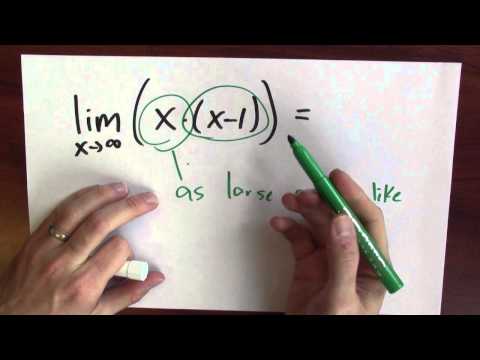
And determine that it equals this means that the limit just gets super big- endlessly big even. Whenever you pick an x value and get a big y value from the function, you could always just pick a smaller x value and get an even bigger y value. In this way, the limit doesn't really equal infinity- we just say it does to represent the idea that the limit gets infinitely big.
Think about it! You could never pick a function whose limit is exactly one more than the limit in the previous example- is basically meaningless.
If you only remember one thing: INFINITY IS NOT A NUMBER IT IS AN IDEA!
So the next time your friend says they have infinity candies you can confidently prove that they do not, and win the mathematical Halloween candy hoarding contest (Personal Advice: don't actually do this)
As a brief addition to the previous discussion, as not to sow confusion, I have to include a small caveat. Some infinities are bigger than others. This can become very relevant in more difficult limits if you end up in a situation where you have infinity over infinity or the like. The idea here is that some infinities get really big markedly faster than other infinities and thus behave differently. Nonetheless, the idea that infinity is not a number still applies