
Video
+1 contributors
Contributors

(Video) Intro to Base Exponential Function
by Carolee Pederson

Carolee Pederson has a good video introduction to exponential functions.
Video
by Carolee Pederson
Carolee Pederson has a good video introduction to exponential functions.
Illustrated · 1 min
Now that we've learned about Benford's Law, let's move onto the next lesson in log applications.
Euler's number, , is a mathematical constant we commonly use with exponents and logarithms. It's one of the most important constants in mathematics. Like , it is an irrational number, meaning that its decimal expansion goes on forever without repeating.

Image source: by Anusha Rahman
It may be helpful to memorize that .
We use a lot in natural logs.
The number occurs naturally in situations involving continuous growth and decay, making it fundamental to algebra, calculus, finances, and so many other areas!
Euler's number is the base of the natural exponential function:
This function has many unique and useful properties. The number is named after Leonhard Euler, the mathematician who helped popularize its use, though he didn't originally discover it.
Some important values to memorize:
Now let's look at the graph of .
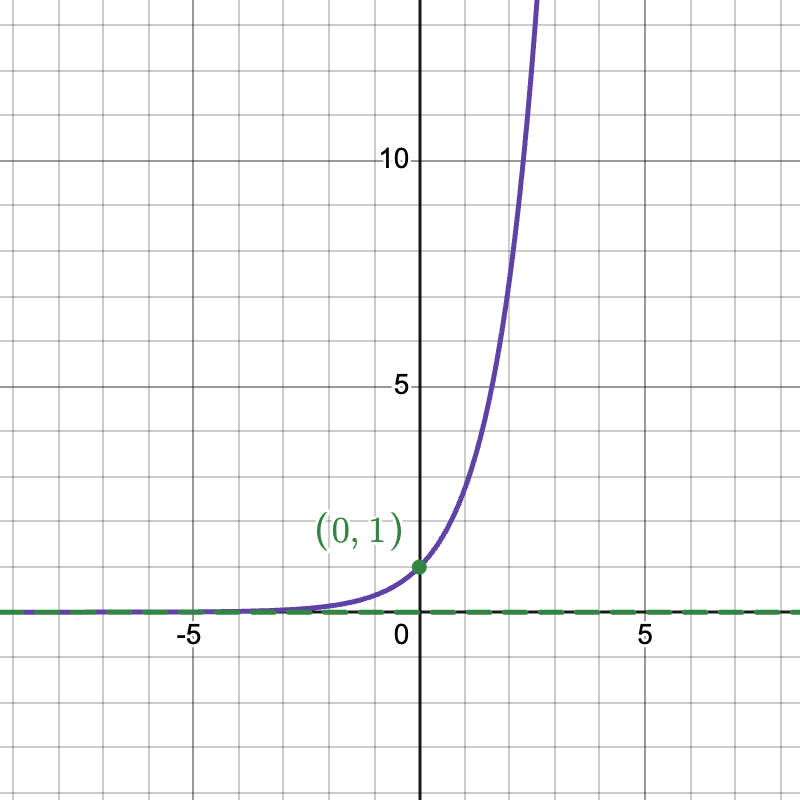
Made using Desmos
The graph of :
You can also use Euler's Formula on complex numbers.
The inverse of the exponential function is the natural logarithm.
Read · 1 min
Euler's number, written as , is one of the most important constants in math. It is a mathematical constant with an approximate value of:
The digits continue forever beyond the decimal point without repeating because the number is an irrational number. Like , its exact decimal expansion never ends.
The constant is often called Euler's constant and serves as the base of the natural logarithm, written as . It comes from historical work on compound interest. In the late 1600s, Jacob Bernoulli discovered that increasing the number of compound intervals, while keeping the same interest rate, caused an investment to approach a fixed limit. As the number of compounding periods per years gets larger, the value approaches .
Later, Leonhard Euler studied this constant and introduced the notation , which is why it now bears his name.
####Continuous Growth
One of the main reasons is so important is because it models exponential growth that occurs continuously. For continuously compounded interest, the amount in an account is given by:
, where is the initial principal, is the annual interest rate, and is the time in years. This formula describes money that is growing exponentially because interest is added continuously rather than at fixed intervals.
####Other Ways to Define
The compound interest definition is not the only way to describe . It can also be defined using an infinite series. In calculus, also appears naturally in problems involving the area under the curve of the function .
####The Function
The exponential function has several properties. It models natural growth processes and has a graph that:
Because of these properties, appears throughout math, science, economics, and statistics.
