
Illustrated · 1 min
By Caroline K

Writing Equations for Word Problems
Here is a refresher on translating words to math in case you need it for this example!

Image by Caroline Kulczycky
Illustrated · 1 min
Here is a refresher on translating words to math in case you need it for this example!
Image by Caroline Kulczycky
Video · + 1 min read
by Katie Tatum
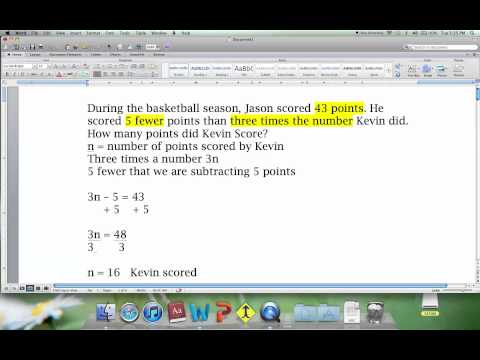
Here's a video by Katie Tatum that shows you how to create equations from a word problem.
This is a very important and useful skill to learn how to do. The trick is to locate key words that signal you to what needs to be done. For example, "fewer" means subtraction. If there's a vague term like "there's a number" then that means you should use a variable like . We can use all the information to write an expression. That expression turns the words into algebra. Then there will usually be some sort of calculation to do.
Note to those who aren't good at word problems: Personally, I've never been good at word problems, and I think a lot of people feel the same. Now that I'm older and farther into a math career I look back and find the problems—that I used to find difficult—super easy. So, don't fret. Just practice and try your best and one day, without realizing it, you'll come to understand them.
Test Yourself: Michael has twice as many baseball cards this years than he did last year. He gives a third of these to his friend Jason. Now, Michael has cards. How many did he have a year ago? This one is a little tricky.
Solution:
We want to find the number of cards that Michael had a year ago. Let's denote this with .
Currently, Michael has twice as many cards as he did last year: He gives away a third of those cards: Now, he has cards:
Let's solve for now.
Interactive · 3 questions
Let's solve some word problems in algebra. You're first going to have to first translate the problem into an equation. In other words, we set up the equation. Finally, solve the equation].
Word problems can be as simple as "find a number that's three less than twelve" or as complicated as...well, they can get really complicated.
There are lots of patterns to how words translate into numbers and operations, but it'll be tough to learn if you just try to memorize them. Instead, we're going to work through the "less than twelve" example above to practice asking questions that will help you translate.
The questions we'll ask here are:
Let's start off with the easy question. What are the numbers in the problem? "Find a number that's three less than twelve".
Right, the numbers are ("three") and ("twelve").
There's actually another number in the question: . This problem is asking you to find "a number" that's related to and , even if we don't know what that number is yet. So we're going to use as a placeholder (a variable) in our equation.

Next we'll ask what the operations are in the problem: "Find a number that's three less than twelve."
The only operation in this problem is subtraction, as shown by the word "less".

Now we need to ask the hardest question so that we can put the whole equation together and have it mean the same thing as the sentence. How do the numbers in the problem relate to each other?
"Find a number that's three less than twelve."
Think about it for a bit and try writing an equation out by yourself. Then, click continue.
From the sentence, we know that our is equal to ("that's") three less than . So we can set on one side of an equals sign: We also know it's less than , which means that must be having something subtracted from it. So we can put on the other side of the equals sign, followed by the minus symbol (): How many less than is the number? Well, is our only number left, so we can plug it in after the negative sign:
Now all we need to do is find to solve the problem! What is equal to?
Done!


