
Illustrated · 2 min
We all know how it feels to hold a hot cup of coffee in our hands. It feels nice and toasty for a while, but eventually it starts to feel like the cup is burning us! And what about when we hold a cold glass of lemonade? After a few moments, it's as if all the heat gets sucked out of our hands! These natural processes are due to nature's favorite regulatory instrument: equilibrium.
It has been observed that in nature, "heat" travels from hot things to cold things. This is about as simply put as it can get, but in reality, it's a little more complicated.
When things are "hot", that actually means that they have high internal energy. This means that the atoms that make up the object are zipping around really quickly in "hot" objects; in cold objects, the atoms are slower and more languid. "Heat transfer" is really the transfer of energy. When a fast moving atom hits a slower moving atom, there is a net transfer of energy and the slower atom starts moving faster. Therefore it seems to us that the object is "heating"; it is gaining more internal energy.
Eventually, when the objects have reached equilibrium, this means that there is no more net energy to transfer because all the atoms are now moving at the exact same speed. To us, it seems like the objects are in thermal equilibium - in layman's terms, they feel like the same temperature.
The 0th Law of Thermodynamics looks a little bit similar to the transitive property in mathematics!
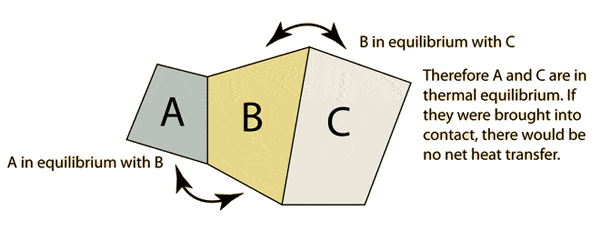
0th Law of Thermodynamics
It states that if A is in thermal equilibrium with B, and C is in thermal equilibrium with B, then A is in thermal equilibrium to C. This is true even if the atomic masses in A are different from those in B, and even if the specific heats of the materials are different. This implies that there is a different measurable property that can be considered to be the same for A and B, a property upon which heat transfer depends. This is what we call temperature!
Simple and easy, just like a surprising many things in nature are!