You have probably seen an infinite discontinuity before, you just didn't know what it was called. As usual, the best way to envision discontinuity is by graphing the function.
Example
In this example, we will look at f(x)=x1.
x
y
Now, look at the axes! Notice that, to the left of the y-axis, as the value of x approaches 0, the function grows infinitely smaller! Likewise, on the right of the y-axis, as the value of x approaches 0, the function increases infinitely! This is what we call an infinite discontinuity. We can notice one when there is a part of a function such that on one side of that part, the function tends towards infinity.
Here's a video by patrickJMT explaining what continuity is and the different types.
A function is continuous if you can draw it without lifting your pen or pencil. If there's a hole or a break in the graph (like in the picture below) you have to hop over it to go to the next part.
Suppose we have a function f(x) which is graphed below. Beneath the circle the x-coordinate is a and the y-coordinate is L. Also suppose we have a dot shaded in above and its y-coordinate is M.
If we take the limit of our function f(x) as x approaches a, we see that the points get closer and closer to our whole which is L. So,
x→alimf(x)=L
If we were to plug a into our function though, it would take us to the dot above at M. So,
f(a)=M
Clearly,
x→alimf(x)=f(a)
If we wanted to make the function continuous all you have to do is move the point into the circle to have it filled in.
Our function is now continuous because we can trace its path without having to stop. Now, the function at the point a is equal to L:
f(a)=L
And this is now equal to the limit at that point,
x→alimf(x)=f(a)
This becomes our definition.
A function f(x) is continuous at x=a if limx→af(x)=f(a).
Types of Discontinuity
There are three different types of discontinuity.
Removable Discontinuity
Infinite Discontinuity
Jump Discontinuities.
A removable discontinuity is the kind we saw above. There's a single point removed leaving a hole.
Algebraically we can tell this because the limit exists but the value at that point is different.
x→alimf(x)=L;f(a)=M
An infinite discontinuity is when the function spikes up to infinity at a certain point from both sides.
Algebraically we can tell this because the limit equals either positive infinity or negative infinity.
x→alimf(x)=±∞
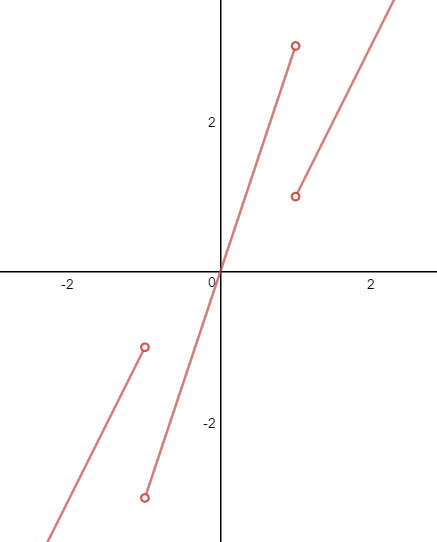
A jump discontinuity is when the function jumps from one location to another.
Algebraically we can tell this because the limit at a does not exist. The limit from either side of a goes to two different points.
x→a−limf(x)=M;x→a+limf(x)=N
Here's another video on the topic of continuity with some examples.
The following functions are continuous on their domains:
Polynomials
Rational Functions
Trig Functions
Root Functions
The example solves is finding any discontinuities for the function
f(x)={x2+3xx+1x<0x≥0
The first function is a polynomial so we know that it's continuous on its interval. The second function is a root function so we know it too is continuous on its interval. The only place where there might be a discontinuity is at x=0.
To figure this out we need to check to see if the limit at zero equals the value at zero.
x→0limf(x)=?f(0)
To find the value at 0 we use the second function because that includes zero.
x+1=0+1=1
So now we have
x→0limf(x)=?1
Next, we need to figure out what the limit is equal to. To determine this we check the limit at each side of zero.
x→0−lim and x→0+lim
Since the first function includes values to the less than zero we use it to find the left of zero limit and since the second function includes values greater than zero we use it to find the right of zero limit.
x→0−limx2+3x and x→0+limx+1
To find these limits we just plug zero into the respective function.
x→0−limx2+3x=0x→0+limx+1=1
As you can see, these two values are not equal so therefore the limit doesn't exist. This tells us that we have a jump discontinuity at x=0. If we graph this we can see it easily.