图形直觉

Before this, know单侧极限

Interactive · 6 questions

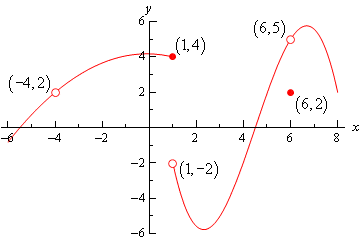
Link to image above

lim⁡x→−4−f(x)=2\lim_{x\rightarrow -4^-}f(x) = 2 lim⁡x→−4+f(x)=2\lim_{x\rightarrow -4^+}f(x) = 2 lim⁡x→−4f(x)=2\lim_{x\rightarrow -4}f(x) = 2

f(−4)f(-4) DNE (Does Not Exist). The open circle at x=−4x = -4 means that ff is not defined at this point.

lim⁡x→1−f(x)=4\lim_{x\rightarrow 1^-}f(x) = 4 lim⁡x→1+f(x)=−2\lim_{x\rightarrow 1^+}f(x) = -2 lim⁡x→1f(x)=DNE\lim_{x\rightarrow 1}f(x) = DNE

lim⁡x→1f(x)=\lim_{x\rightarrow 1}f(x) = DNE because lim⁡x→1−f(x)≠lim⁡x→1+f(x)\lim_{x\rightarrow 1^-}f(x) \ne \lim_{x\rightarrow 1^+}f(x). f(1)=4f(1) = 4 because there is a closed circle at x=1x = 1

lim⁡x→6−f(x)=5\lim_{x\rightarrow 6^-}f(x) = 5 lim⁡x→6+f(x)=5\lim_{x\rightarrow 6^+}f(x) = 5 lim⁡x→6f(x)=5\lim_{x\rightarrow 6}f(x) = 5

f(6)=2f(6) = 2 because there is a closed circle at the point (6,2)(6, 2)

Test Yourself!

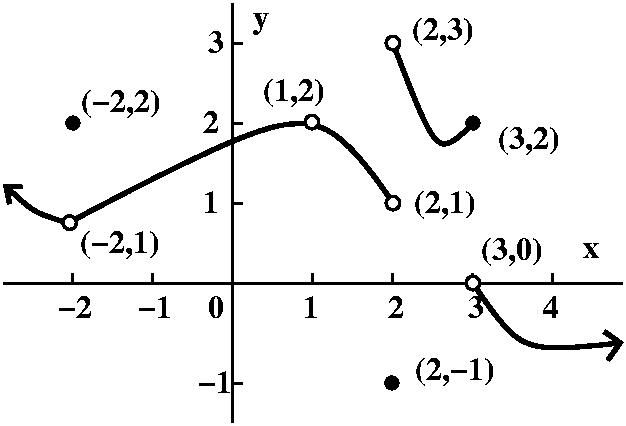
Let this graph represent the function f

Evaluate lim⁡x→−2f(x)\lim_{x\rightarrow -2}f(x)

Choose one answer

Type a concept, like “slope” or “photosynthesis”.

↑ ↓ to choose · Enter to openSearch explanations and problems