单项式因式分解

Before this, know乘法和除法单项式的幂

Interactive · 2 questions

Examples: Factoring Monomials

Factoring monomials is a process of breaking down a monomial into smaller terms. Although factoring a polynomial usually shortens the polynomial, factoring a monomial expands it.

Let's start by reviewing the definition of a monomial.

Monomial: An algebraic expression consisting of one term

For example, the expression 2x2x is a monomial, but the expression x+2x+2 is a polynomial.

Let's identify the parts a monomial might have:

3x^2

3 is the coefficient

x is the variable

2 is the exponent

Image source: By Christine

Some monomials might have more than one variable, for example:

x^2y^3

Image source: By Christine

Factoring a monomial

When you factor a monomial, you are breaking it down into smaller terms. Think of it as expressing the monomial as a product of smaller monomials!

For example, say we want to factor x2y3.x^2y^3. How can we express this monomial in terms of smaller monomials? There are actually many ways to do this! Find factors of the different components of the monomial (like the factors of x2x^2 and y3y^3) and split up the monomial accordingly. Here are some examples: (x2y)(y2)(x^2y)(y^2) (x)(xy3)(x)(xy^3) (x2y2)(y)(x^2y^2)(y)

Notice how if you multiply each factor together, you get the original monomial, x2y3.x^2y^3.

Completely Factoring a Monomial

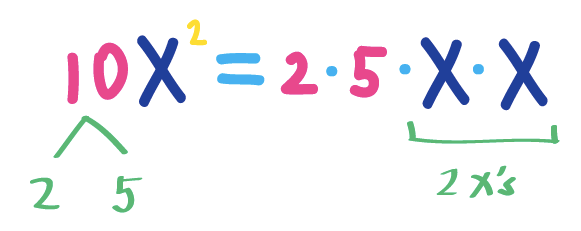
To completely factor a monomial, we expand each part of the monomial until we cannot expand anymore. For example:

x = x

x^2 = x * x

x^3 = x* x* x

Image source: By Christine

Can you completely factor x2y3x^2y^3?

Choose one answer

Interactive · 4 questions

How Do You Factor a Monomial?

First, let's remind ourselves of what a monomial is: Monomial examples\text{Monomial examples} 3x3x xx −2x-2x 4x24x^2

Monomials have only one term. When we're asked to factor a monomial, we're really being asked to EXPAND the monomial.

Think of a monomial (20b3c220b^3c^2, for example) as an accordion, all folded up. When we factor a monomial, we are unfolding that accordion, stretching it out.

Monomials are like folded accordions, and factored monomials are like expanded accordions.

Image source: By Caroline Kulczycky, using Canva.

Factorization

When you factor a monomial, you are breaking it down into smaller terms. It's like expressing your monomial in terms of smaller monomials!

For example, say we want to factor 20b3c2.20b^3c^2. How can we express this monomial using smaller terms? Well, there are multiple ways! Just think about the factors of the different parts of the monomial (like the factors of 20,b3,20,b^3, and c2c^2) and split up the monomial accordingly. Here are a few examples: (5)(4)b3c2(5)(4)b^3c^2 (20b2)(bc2)(20b^2)(bc^2) (10)(2b3c2)(10)(2b^3c^2)

Notice how if you multiply each factor together, you get the original monomial, 20b3c2.20b^3c^2.

Complete Factorization

You might be asked to find a monomial's prime factorization. This is the same thing as being asked to completely factor it.

So, let's quickly go over what prime numbers are, in order to factor monomials. A prime number is a natural number greater than 11 that is only divisible by 1 and itself. Nothing else divides into it cleanly.

Examples of prime numbers include 2,3,5,7,11,132, 3, 5, 7, 11, 13 and many more. Notice that each of these numbers only has two natural-number factors: 11 and itself.

Which of the numbers listed below are PRIME?

Choose all correct answers

Video · + 1 min read

(Video) Factor Monomials

by Chris Raymaakers and Red River College Wise Guys

The above video by Chris Raymaakers describes how to expand a monomial.

Summary\large{\text{Summary}}

Completely factoring, or completely expanding, a monomial is simple. First, we write out the prime factorization of the coefficient. Then, we write all the variables out, instead of using exponents.

In the video, they look at how to factor −18g4h-18g^4h.

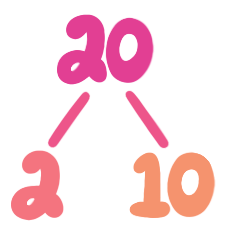
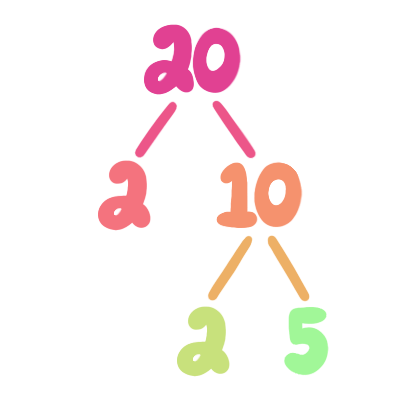
Step 1 is to take prime factorization of the coefficient, −18-18. We can rewrite this as −1×18-1\times18. −18=−1×18-18=-1\times18 Then, we can break 1818 into 22 and 99. 18╱╲29\begin{array}{ccccc} &&18&&\\ &\diagup&&\diagdown&\\ \boxed{2}&&&&9 \end{array} Since 22 is a prime, we can stop that branch. But 99 can be broken up into 33 and 33. 18╱╲29╱╲33\begin{array}{ccccccc} &&18&&&&\\ &\diagup&&\diagdown&&&\\ \boxed{2}&&&&9&&\\ &&&\diagup&&\diagdown&\\ &&\boxed{3}&&&&\boxed{3} \end{array} So the prime factorization of −18-18 is: −18=−1×2×3×3-18=-1\times2\times3\times3

Step 2 is to write out all the variables without using exponents. g4h=g⋅g⋅g⋅g⋅hg^4h=g\cdot g\cdot g\cdot g\cdot h

Finally, we can write the whole thing out. The factor of −18g4h-18g^4h is: −18g4h=−1⋅2⋅3⋅3⋅g⋅g⋅g⋅g⋅h-18g^4h=-1\cdot2\cdot3\cdot3\cdot g\cdot g\cdot g\cdot g\cdot h

Note

Factoring a monomial is not the same as completely factoring it. Completely factoring a monomial is writing down its entire prime factorization. Factoring a monomial is more general: it just means breaking down the monomial into smaller terms...these smaller terms do not have to be completely factored themselves. For example:

Monomial: −18g4h-18g^4h

Completely factored monomial: −1⋅2⋅3⋅3⋅g⋅g⋅g⋅g⋅h-1\cdot2\cdot3\cdot3\cdot g\cdot g\cdot g\cdot g\cdot h

Factored monomial: −2⋅9⋅g4⋅h=(−2)(9)g4h-2\cdot 9\cdot g^4 \cdot h = (-2)(9)g^4h

Notice that each part of the completely factored monomial, −1⋅2⋅3⋅3⋅g⋅g⋅g⋅g⋅h,-1\cdot2\cdot3\cdot3\cdot g\cdot g\cdot g\cdot g\cdot h, is completely factored. For example, you can't factor 22 or gg any more than it already is.

Also notice that each part of the factored monomial, (−2)(9)g4h,(-2)(9)g^4h, is not necessarily completely factored. For example, hh is completely factored, but 99 is not.

Type a concept, like “slope” or “photosynthesis”.

↑ ↓ to choose · Enter to openSearch explanations and problems