
Illustrated · 1 min
+2 contributors

Faraday's Law for Electromagnetic Induction
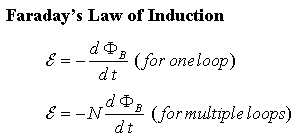
Faraday's law simply states that a moving electric field generates voltage.
Lenz's Law
When you look at the mathematical expression of Faraday's Law, you may notice that the negative sign is very important. The question is why is it so important?
Well let's think about this logically for a second. Remember that no matter what law, theorem, formula, etc. that we consider in physics, they cannot violate the Law of Conservation of Energy, and in this case they should also follow in accordance with Newton's Third Law of Motion.
Suppose we had some current which induces another current , then must have a direction that is opposite of hence repelling each other.
Within these currents, there may exist charges and that have magnetic fields which are also in opposite directions in order to conserve the momentum of the charges.
Hence Lenz's Law tells us that: If an induced current flows, its direction is always such that it will oppose the change which produced it.
Example:
A solenoid () rotating clockwise is put in a magnetic field. and . Find the magnitude of , and .