书写双曲线方程式

Before this, knowCharacteristics of Ellipses

Illustrated · 1 min

Graphing Ellipses from an Equation

We know that the general form of an ellipse equation is: (x−h)2a2+(y−k)2b2=1\frac{(x-h)^2}{a^2} + \frac{(y-k)^2}{b^2} = 1

, where aa is the semi-major axis (half the length of the longest diameter) and bb is the semi-minor axis (half the length of the shortest diameter.

There are six steps we will follow to graph an ellipse!

1. Identify the center

The center of the ellipse is at (h,k)(h,k)

2. Find the length of the major and minor axes

aa tells us how far the ellipse extends horizontally from the center, and bb tells you har far it extends vertically from the center.

3. Find the direction of the major axis

The major axis is the longest diameter of the ellipse. If a>ba>b, then the major axis lies along the xx-axis. If b>ab>a, then the major axis lies along the yy-axis.

4. Plot the vertices

Vertices are where the ellipse intersects the major axis. They are located aa units away from the center along the major axis.

5. Plot the co-vertices

The co-vertices are the points where the ellipse intersects the minor axis. They are located bb units away from the center along the minor axis.

6. Draw the ellipse

Connect the points smoothly! Make sure the curve is symmetrical on both axes.

Example

Graph the ellipse with the equation: x24+y29=1\frac{x^2}{4} + \frac{y^2}{9} = 1

1. Identify the center

The ellipse is centered at the origin, (0,0)(0,0), as h=0h=0 and k=0k=0.

2. Find the length of the major and minor axes

a=2a=2 and b=3b=3

3. Find the direction of the major axis

Since a<ba<b, the major axis lies along the yy-axis.

4. Plot the vertices

The vertices are at (0,±3)(0, \pm3)

5. Plot the co-vertices

The co-vertices are at (±2,0)(\pm2, 0)

6. Draw the ellipse

Let's first plot all the points, then we can see what the ellipse looks like!
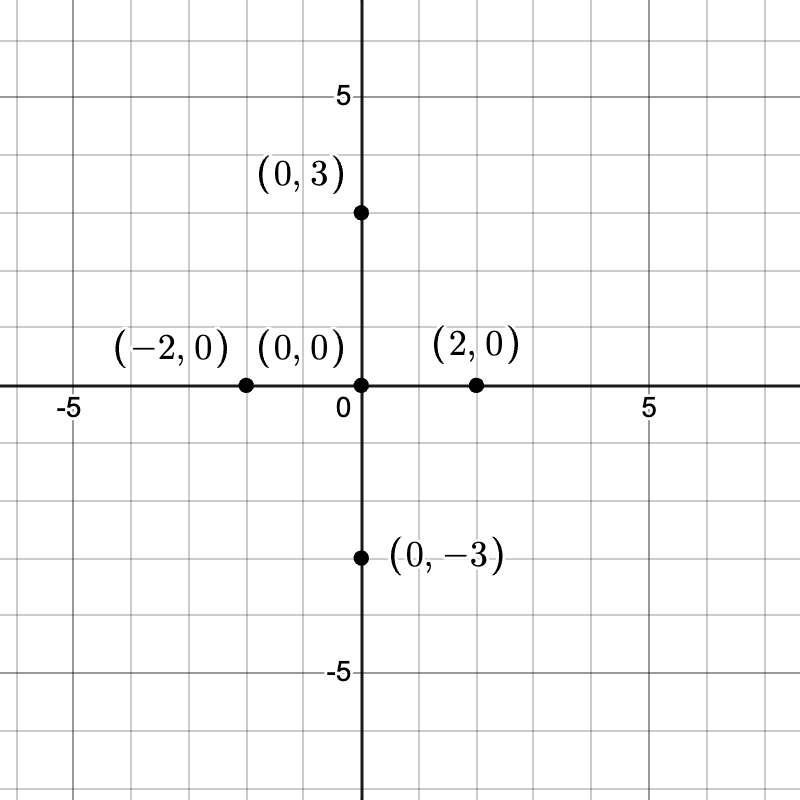
Plotted points: (0,0), (0,3), (0,-3), (2,0), and (-2,0)

Graph made using Desmos

Now that we have our points plotted, we can connect the dots and sketch our curve!
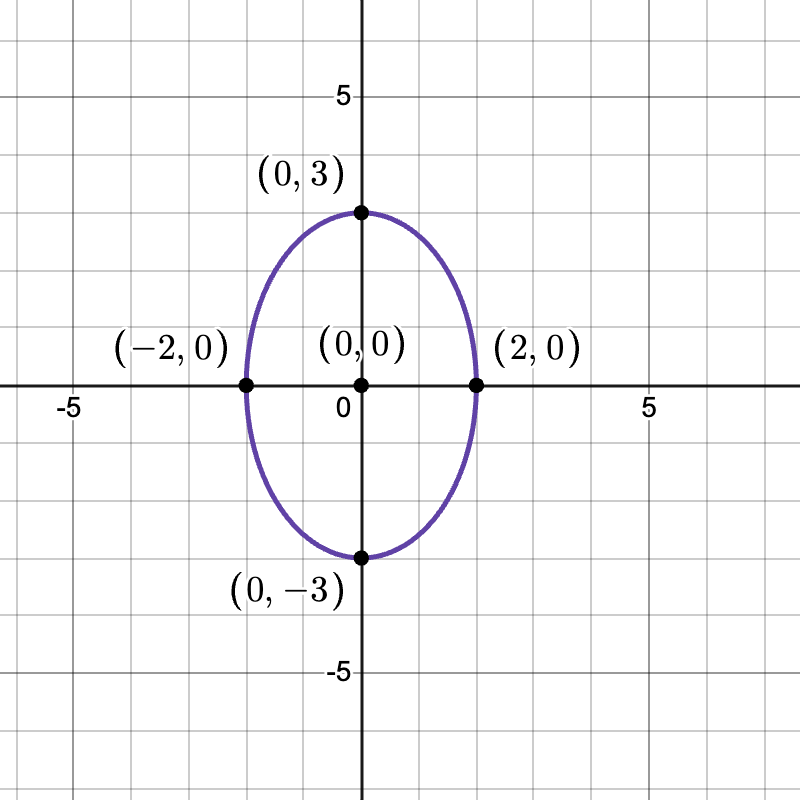
Points connected to create the ellipse

Graph made using Desmos

Video

(Video) Graph Ellipses from an Equation

by Anusha Rahman

In this lesson by Anusha Rahman, you will learn how to graph an ellipse from an equation.

Summary

In this video, you will learn to graph the ellipse from the following equation:

(x−3)252+(y−4)232=1\frac{(x-3)^2}{5^2} + \frac{(y-4)^2}{3^2} = 1

Illustrated · 2 min

Graph Ellipses from an Equation

We've already learned how to graph an ellipse from the foci. When graphing ellipses from an equation, there are a few simple steps you can follow to conquer the task.

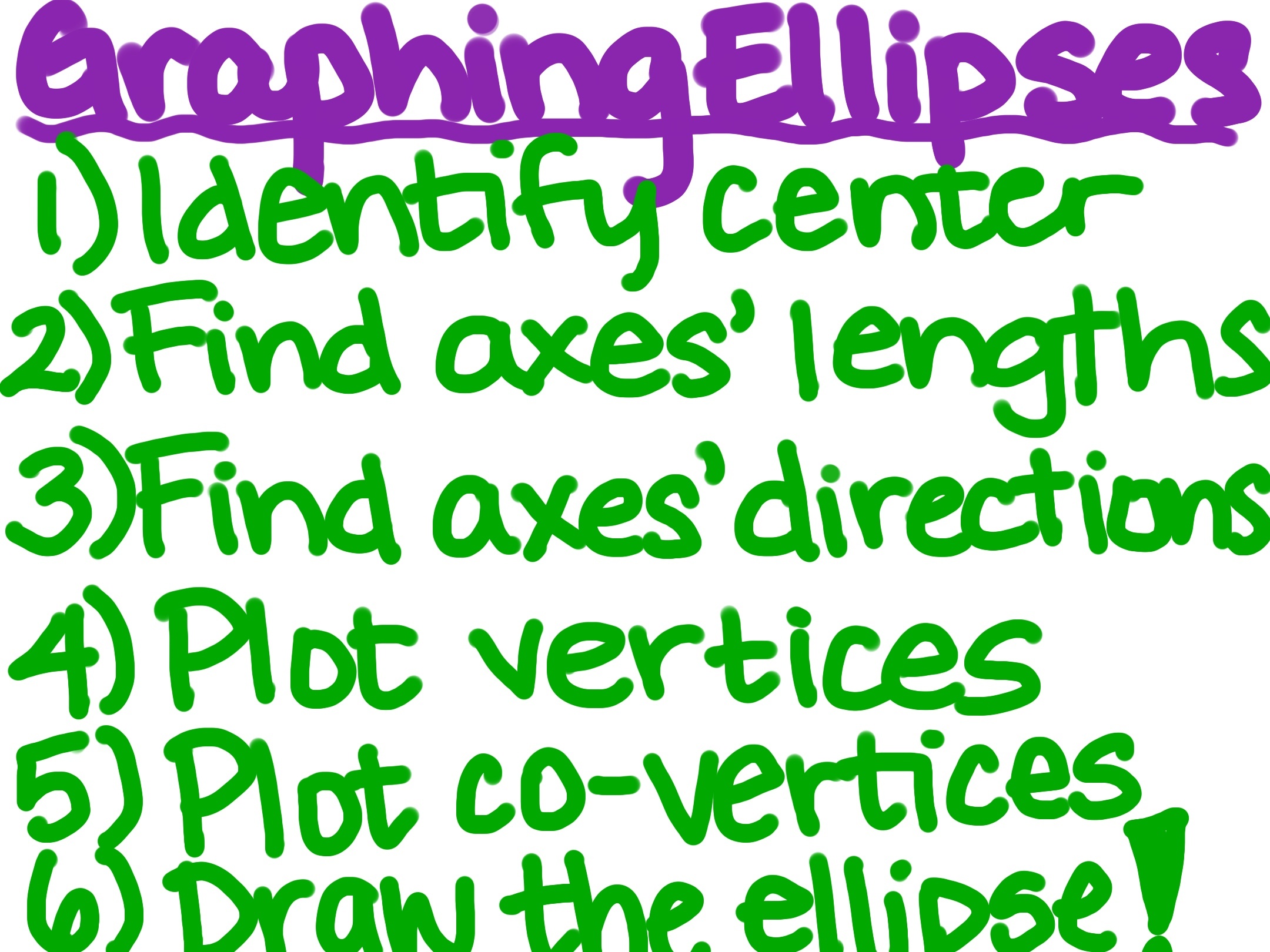
Graphing Ellipses
1) Identify center
2) Find axes' length
3) Find axes' directions
4) Plot vertices
5) Plot co-vertices
6) Draw the ellipse!

Image source: by Anusha Rahman

Example

Let's say you were given the following equation: (x−3)214+(y−5)29=1\frac{\left(x-3\right)^{2}}{14}+\frac{\left(y-5\right)^{2}}{9}=1

Seems a little overwhelming at first, but in the above image, we were given the tools to tackle this problem!

First, we will identify the center. Based on our previous knowledge of the centers of ellipses, we know that this ellipse has a center at (3,5)(3,5).

Second, we will find the length of the axes. Again, we've seen this concept before! Hint, look at the denominator. Using the tools already in our arsenal, we know that the semi-major axis length is a=4a=4. We know that the semi-minor axis length b=3b=3.

Third, find the direction of the axes. This one is a little trickier, but we have a set of rules we can follow.

  • If a2>b2a^2 >b^2: The major axis is aligned with the x-axis, and the minor axis is aligned with the y-axis. This is a horizontal major axis.
  • If b2>a2b^2 > a^2: The major axis is aligned with the y-axis, and the minor axis is aligned with the x-axis. This is a vertical major axis.

In our example, we have a horizontal major axis.

Fourth, plot the vertices. We have rules for these, too!

  • For a horizontal major axis: Vertices are at (h−a,k)(h-a,k) and (h+a,k)(h+a,k)
  • For a vertical major axis: Vertices are at (h,k−a)(h,k-a) and (h,k+a)(h, k+a)

In our example, the vertices are at (−1,5)(-1,5) and (7,5)(7,5).

Fifth, plot the co-vertices.

  • For a horizontal major axis: Vertices are at (h,k)(h,k) and (h,k+b)(h,k+b)
  • For a vertical major axis: Vertices are at (h−b,k)(h-b,k) and (h+b,k)(h+b, k)

In our example, the co-vertices are at (3,8)(3,8) and (3,2)(3,2).

Sixth, and last, we will connect all the dots and draw the ellipse! Here is a graph of what your ellipse should look like:

Graph of the example ellipse

Graph made using Desmos

In the next lesson, we will learn about ellipse transformations.

Type a concept, like “slope” or “photosynthesis”.

↑ ↓ to choose · Enter to openSearch explanations and problems