复数:大小值

Before this, know复数乘法

Interactive · 1 question

Magnitude of Complex Numbers

The magnitude of a complex number is its distance from the origin in the complex plane. The concept may seem a little bit foreign right now as you build up your knowledge of complex numbers, but the process is very similar to finding the distance between two points on a coordinate plane or a number line.

Recall the distance formula for points on the Cartesian plane: Distance =(x2−x1)2+(y2−y1)2\text{Distance }=\sqrt{(x_2-x_1)^2+(y_2-y_1)^2} As always, be careful with the square root!

If you're finding the distance from the origin in the Cartesian plane, this formula gets simplified: Distance =x2+y2\text{Distance }=\sqrt{x^2+y^2} As x1x_1 and y1y_1 would both be 00.

When we move onto the complex plane, we use the same process. We're still only looking at the positive square root since distance is always positive. Let's look at the complex plane to refresh our minds.

The x-axis is replaced with the real axis which will show the real component of our complex numbers. The y axis is replaced with the imaginary axis, and will show the imaginary component of our complex numbers.

Made with Desmos

The xx-axis is replaced with the real axis, and the yy-axis is replaced with the imaginary axis. We can use this information to alter our distance formula from the origin to be used with the complex plane.

Let's say we have a complex number in rectangular form: z=a+ib.z=a+ib. We sometimes denote the magnitude (or distance from the origin) of zz as ∣z∣.|z|. (Careful: this is the same signage we use to find the absolute value).

Similar to the distance formula, the formula for the magnitude of a complex number z=a+ibz=a+ib is as follows: ∣z∣=a2+b2|z|=\sqrt{a^2+b^2}

Where aa is our real component and bb is our imaginary component. Let's look at an example of this.

Graph of 3+2i on the complex plane. It is 3 units in the positive direction on the real axis, and 2 units positive on the imaginary axis.

Made with Desmos

This is a graph of the point 3+2i3+2i on the complex plane. It is 33 units to the right, and 22 units above the origin, similar to the point (3,2)(3,2) in the Cartesian plane. To break this down even further, this complex number has a real component of 33 and an imaginary component of 22. Let's plug this into our magnitude formula: ∣z∣=a2+b2∣z∣=(3)2+(2)2∣z∣=13\begin{align} |z| &= \sqrt{a^2+b^2}\\ |z| &=\sqrt{(3)^2+(2)^2}\\ |z| &= \sqrt{13}\end{align}

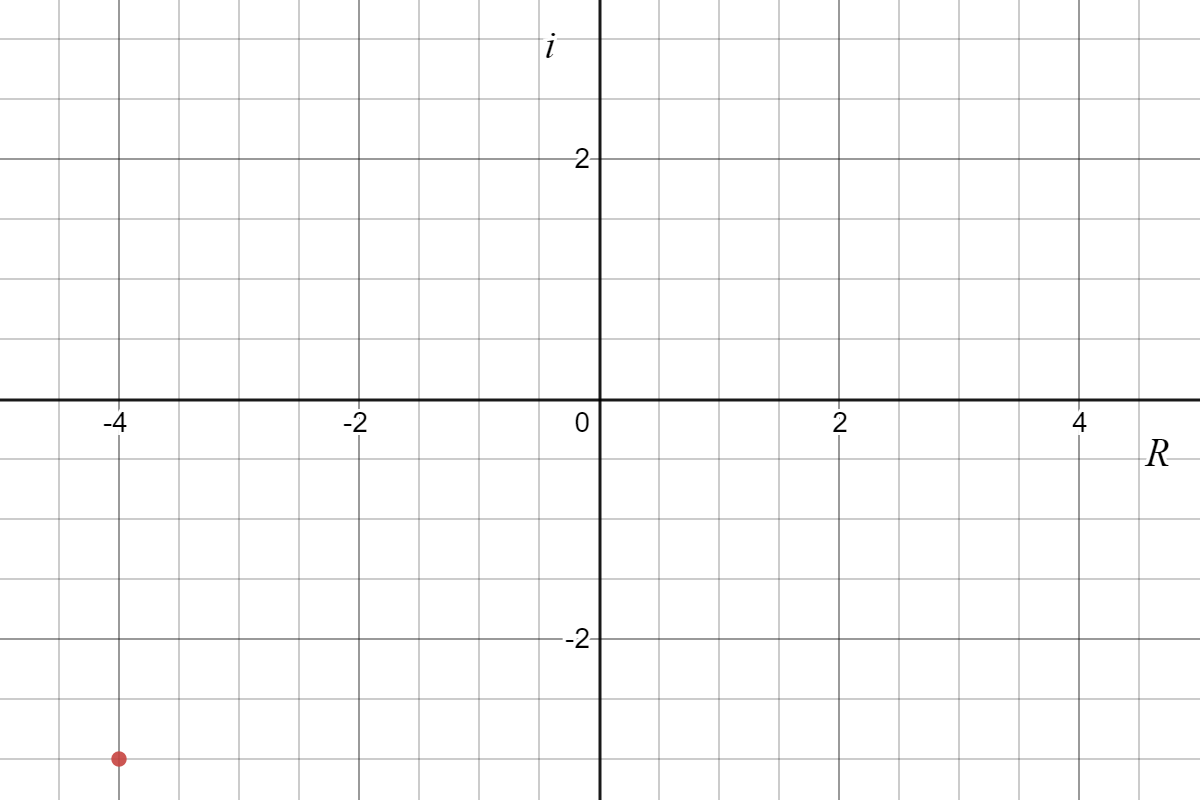
Here's a problem for practice:

What is the magnitude of −4−3i-4-3i?

Choose one answer

Learn a clever approach

Every problem comes with a worked solution, so even one you cannot crack shows you a new way to think. These are real problems from the AMC 12 and AIME, the national math competitions for middle and high school students, each with a worked solution on LIVE by Po-Shen Loh.

Interactive · 3 questions

The Magnitude of a Complex Number

Earlier, we related complex numbers to vectors on the complex plane. We saw how adding complex numbers is essentially equivalent to adding vectors.

Now, vectors have magnitudes. The magnitude of a vector is the length of the vector; the vector (ab)\binom ab has magnitude a2+b2\sqrt{a^2+b^2}. We wish to extend this to complex numbers.

However, it's not trivial how to find the "length" of a complex number. We need a segment to find the length of. So we draw a diagram with z=a+biz=a+bi and consider the possible cases.

The only natural segment to draw is the one from zz to the origin, so we draw that.

Aha! Now we have something. We can use the Pythagorean Theorem to find that the length of the segment from zz to the origin is a2+b2\sqrt{a^2+b^2} (just like in vectors)! We call this the magnitude of zz, and we denote it by ∣z∣|z|.

What is ∣5+12i∣|5+12i|?

Video

(Video) The Magnitude of a Complex Number

by James Hilburn

In this video by James Hilburn, you can see an example of how to find the magnitude of a complex number by graphing.

Summary

The complex plane looks a lot like the cartesian plane with real numbers that we are more familiar with. The horizontal access is the xx axis (the real axis), and the vertical axis is the yy axis (the imaginary axis). We know this because in a complex number, x+yix+yi, the xx term is the real part, and the yiyi part is the imaginary part.

Say we want to graph the complex number, 1+3i1+3i. We know the first term is the real part, and the second term is the imaginary part. On our complex plane, we will move 11 unit to the right and 33 units up.

Watch a couple more of the examples to fully understand!

Illustrated · 2 min

Graphing a Complex Number and Finding the Magnitude

In our previous lessons, we learned the basics of complex numbers and how to multiply them. In this lesson, we’re going to dive into two important concepts: graphing complex numbers and finding their magnitude.

By the end of this lesson, you'll be able to plot complex numbers on a graph and calculate their magnitudes!

Graphing Complex Numbers

Image source: by Anusha Rahman

You may remember that a complex number has two parts: a real part (like 22 or 0.50.5) and an imaginary part (involving the imaginary unit ii, where i=−1i=\sqrt{-1}).

In general, a complex number looks like: z=a+biz=a+bi

, where aa is the real part, bb is the imaginary part (with ii), and ii is the square root of −1-1.

For example, 3+4i3+4i is a complex number, where the real part is 33 and the imaginary part 4i4i.

#####Graphing Complex Numbers

To better understand complex numbers, we can graph them on a special kind of coordinate plane called the complex plane.

  • The horizontal axis represents the real part of the complex number.
  • The vertical axis represents the imaginary part of the complex number.

When you graph a complex number like 3+4i3+4i, you're plotting a point on this plane.

  • The real part is 33, so move 33 units to the right along the real (horizontal) axis.
  • The imaginary part is 4i4i, so move 44 units up along the imaginary (vertical) axis.

The point where these two lines meet is the location of the complex number on the complex plane.

Graph of 3+4i

Image source: by Anusha Rahman

Magnitude of a Complex Number

The magnitude of a complex number tells us how far the number is from the origin on the complex plane. We can think of it as the distance from the origin to the point representing the complex number.

The find the magnitude of a complex number, we can use the Pythagorean Theorem.

∣z∣=a2+b2|z| = \sqrt{a^2+b^2}

In our previous example, to calculate the magnitude of 3+4i3+4i:

∣z∣=32+42=9+16=25=5|z| = \sqrt{3^2+4^2}=\sqrt{9+16}=\sqrt{25}=5

So, the magnitude of 3+4i3+4i is 55.

Conclusion

In this lesson, you learned:

  • A complex number is written as a+bia+bi, where aa is the real part and bb is the imaginary part.
  • The complex plane helps us graph complex numbers, with the real part on the horizontal axis and the imaginary part on the vertical axis.
  • The magnitude of a complex number is the distance from the origin and is calculated using the formula ∣z∣=a2+b2|z| = \sqrt{a^2+b^2}

In the next lessons, you will learn about the complex conjugate and dividing complex numbers.

Type a concept, like “slope” or “photosynthesis”.

↑ ↓ to choose · Enter to openSearch explanations and problems