Interactive · 1 question
+4 contributors




Representing Horizontal and Vertical Lines with Standard Form
First, take a look at the Cartesian Coordinate system and think about this:
How do we specify a horizontal or vertical line? They are less complex than the other lines we would have, since we already know they are either parallel to the -axis or the -axis.
These rules are for straight lines.

Made using Desmos
Horizontal Lines
All horizontal lines are parallel to the -axis. They cross (or intersect with) the -axis.
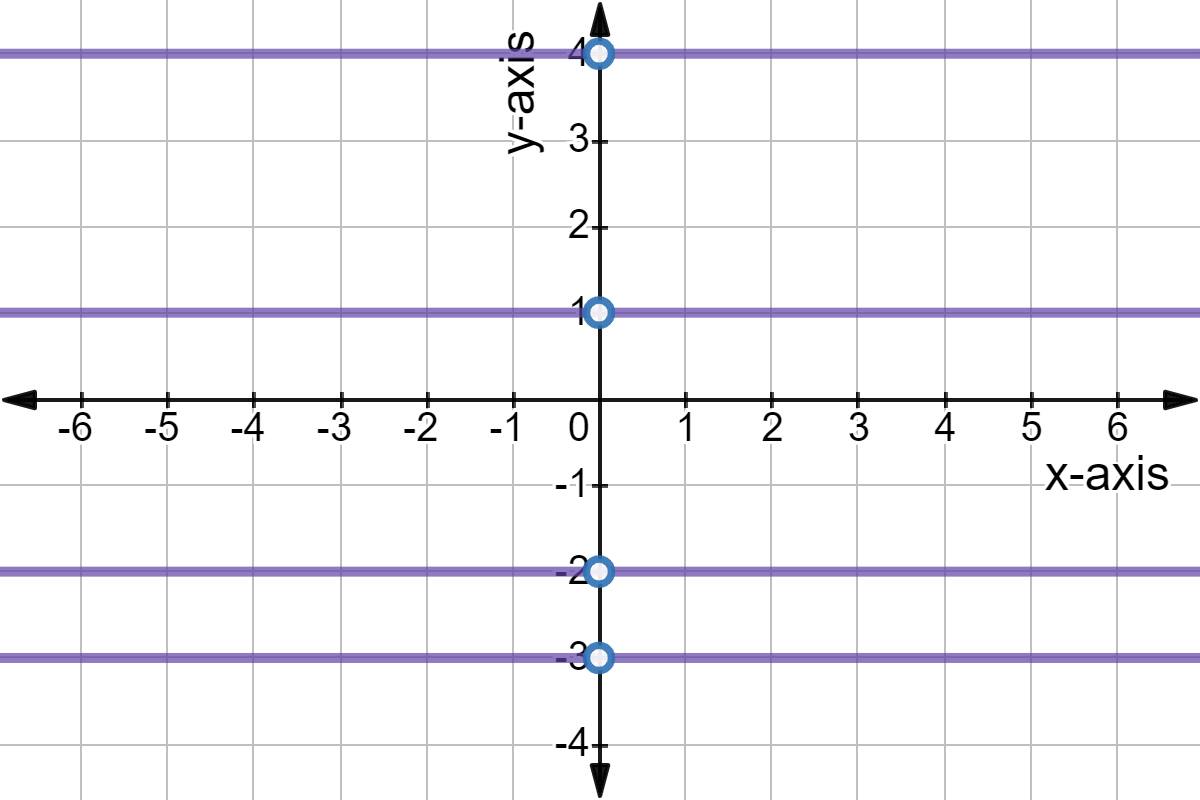
All of these are horizontal lines.
Made using Desmos
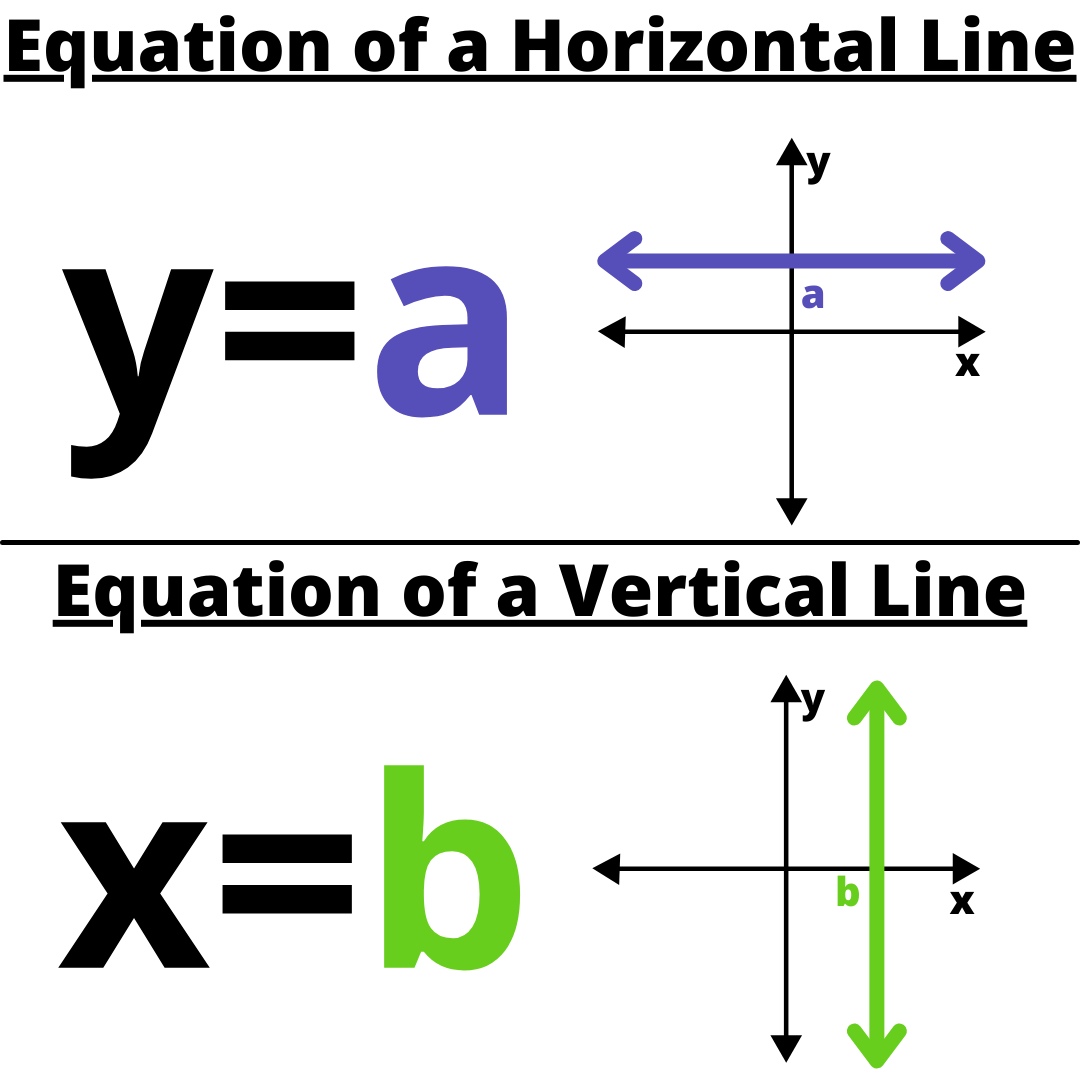
To write the equation of a horizontal line, we only need to specify where it intersects with the -axis. This will look like where is where the line crosses the -axis.

=== Made using Desmos
Can we reach this conclusion from the standard form of linear equations? The answer is yes. A line is horizontal when in the equation .
When , we can rearrange the standard from equation to be: We can further gather that the -intercept, , is the same as .
Vertical Lines
All vertical lines are parallel to the -axis. They all cross (or intersect with) the -axis.

All of these are vertical lines.
Made using Desmos
To write the equation of a vertical line, we only need to specify where it intersects with the -axis. This will look like where is where the line crosses the -axis.

=== Made using Desmos
We can reach this conclusion from the standard form of linear equations by letting .
When , we can rearrange the standard from equation to be: We can further gather that the -intercept, , is the same as .
Recap
When using the standard form of an equation
- the line will be horizontal when .
- the line will be vertical when .
Practice Problem
Select all the equations below that are for vertical lines.
Solution
Vertical lines, in standard form, will have their term equal to . We can see that the second answer choice, , is of this form.
Whenever we simplify this form, we get: The third answer, , is of this form. Here the fraction .