Interactive · 1 question

Type I errors

A Type I error is a measurement error caused when a negative result accidentally returns positive, or a false positive.

Example: You are figuring out whether or not you still have salt. You quickly glance into the pantry and see the pepper shaker, but you think it is a salt shaker. In fact, you have no salt at all.

Which of the choices below is an example of a Type I error?

Assume that a non-spam is a "positive test."

Choose one answer

Illustrated · 1 min

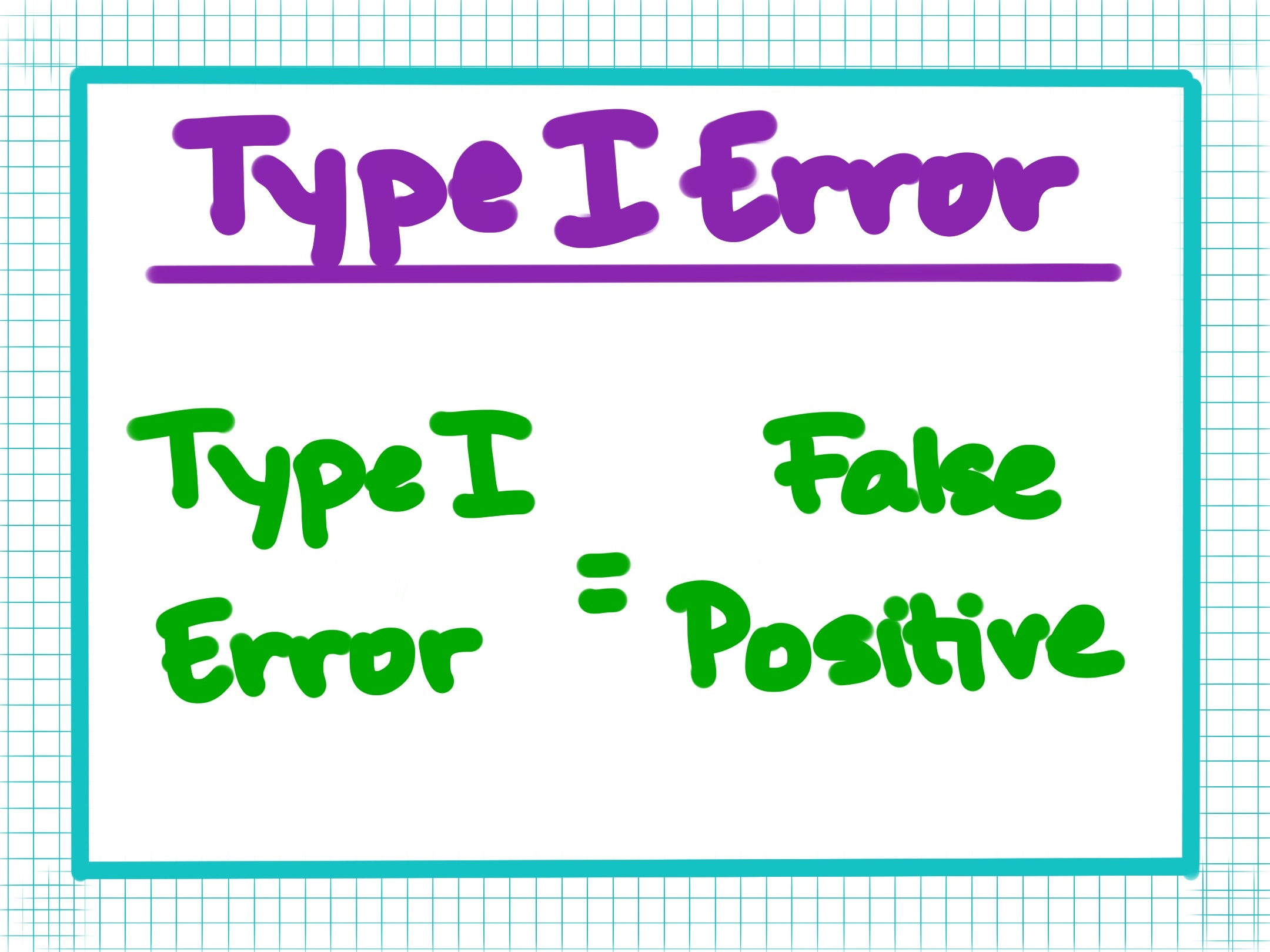
Type I Error

Now that we've covered hypothesis testing, we can move deeper in the topic. The first type of hypothesis testing and statistical significance we will talk about is Type I Error, which is an incorrect solution.

Type I Error
Type I Error = False Positive

Image source: by Anusha Rahman

Type I Error is the probability of finding a false positive result. That means that you found a result that showed statistical significance, even though there wasn't any. We can also think of it as rejecting the null hypothesis that is actually true. If you have a 95%95\% confidence interval, that means that there is a 5%5\% chance that your test results are the result of a Type I error.

Changing the sample size has no effect on Type I error.

In the next lesson, you will learn about Type II error, which is easy to mix up with Type I error. Now that you've mastered Type I error, you're ready to tackle Type II error! Type II error is a false negative.

Video

(Video) Type I vs. Type II Error

by 365 Data Science

In this video by 365 Data Science, you will learn about Type I and Type II error.

Type a concept, like “slope” or “photosynthesis”.

↑ ↓ to choose · Enter to openSearch explanations and problems