乘以1

Video

(Video) Multiplication Properties of 0 and 1

by mathman1024

Here's a video by mathman1024 explaining the multiplication property of zero and the multiplication property of one.

Summary\large{\text{Summary}}

The Multiplication Property of One (also known as the Multiplicative Identity) states: a⋅1=aa\cdot1=a This means that any number times one will just stay that number. Multiplying by 11 doesn't change anything.

For example, 1(−959)=−9591(-959)=-959

The commutative property of multiplication says the 11 can be on the left or the right. As an example,

−959(1)=−959-959(1) = -959

This means exactly the same thing as the previous equation!

Illustrated · 1 min

Numbers stay the same when you multiply them by 11

When you multiply a number by 11, that number stays the same. That is because when you multiply, you're essentially saying that you want to add a number to itself a bunch of times.

For example, in the expression 2×52 \times 5, we're basically just adding 22 to itself five times. Take a look at the number line below to get a visualization of how that works:

Starting at 0, add 2 five times. This gets us to 10.

This image is equivalent to 2×52 \times 5 or 2+2+2+2+22+2+2+2+2

If we had the equation 2×12 \times 1, we would stop after we added 22 once:

Add 2 once to get to 2.

This image is equivalent to 2×12 \times 1 or just 22

We could also interpret 2×12 \times 1 as adding 11 to itself twice, but if you look at the image you can see that that just gets us the same answer:

Add 1 twice to also get to 2.

This image is equivalent to 2×12 \times 1, or 1+11+1

No matter what, if you multiply 22 by 11, the answer is still 22. The same goes for any other real number—if you multiply something by 11, it will stay the same.

Illustrated · 1 min

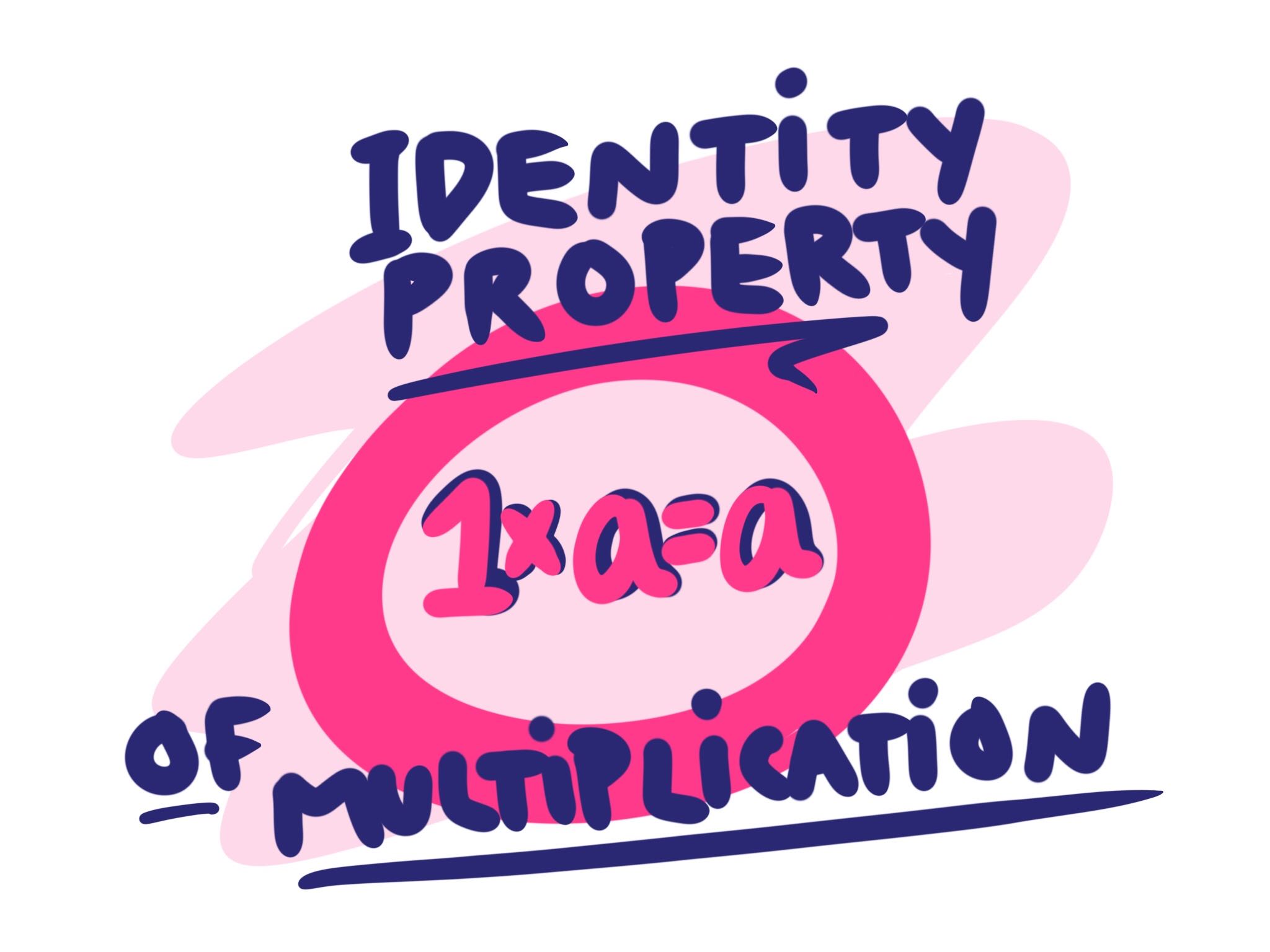
Identity Property of Multiplication

The Identity Property of Multiplication states that if you multiply any number by 1,1, the result will be that number.

Identity Property of Multiplication: 1 x a = a

Image by Caroline Kulczycky

Think about it: if you multiply a number by 1,1, it will retain its identity...it will stay the same! Thus we call 11 the multiplicative identity.

Examples:

1⋅4=4123⋅1=123(x+y+z)⋅1=x+y+z\begin{align} 1 \cdot 4 &=4\\ 123 \cdot 1 &= 123\\ (x+y+z) \cdot 1 &= x+y+z \end{align}

As a bonus, we can multiply the 11 first or second. This is because multiplication is commutative.

Bonus

Interested in mathematical properties? Check out some other cool properties, like the reflexive, symmetric, and transitive properties!

Type a concept, like “slope” or “photosynthesis”.

↑ ↓ to choose · Enter to openSearch explanations and problems