阻抗:几何学问题

Before this, know电动势

Interactive · 1 question

You're probably wondering about the direction of induced current. This is explained by Lenz's Law, which states that the direction of induced current is such that its magnetic field opposes the change in magnetic flux. Let me break this down. The fundamental thing to understand is that SYSTEMS DO NOT WANT CHANGE. Whenever there is a change in magnetic flux, the current induced serves to reverse it. So, when you're trying to figure out what direction the induced current is going in, ask yourself this question:

What is causing the change in magnetic flux? Was the magnetic field through the loop getting stronger or weaker and in what direction?

Once you figure that out, think of the exact opposite situation. For example if the change in flux was caused by a stronger magnetic field into the page, then the current induced would produce a field out of the page to counter that change. In contrast, if the change was caused by a weakening magnetic field into the page, the induced current would produce a magnetic field into the page to counter the reduced magnitude of magnetic field. You can then use the right-hand rule for a current-carrying wire to figure out the direction of the current.

Let's do an example.
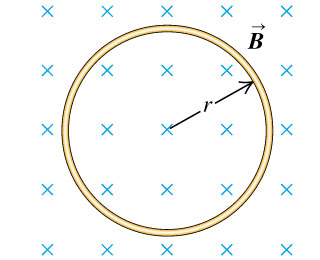
If the field is initially pointed into the screen away from you and then it gets stronger, what will be the direction of induced current? The current will produce a magnetic field pointing out of the screen towards you to oppose the strengthening magnetic field into the screen. Using the right-hand rule, if the magnetic field inside the loop is coming towards you, the current will be in the counter-clockwise direction.

Now do this one yourself.
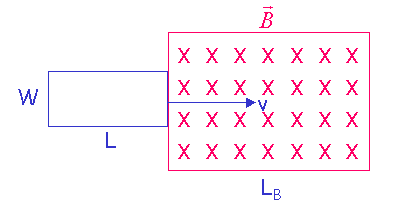
A loop of wire is moving into a magnetic field that is pointed into the screen away from you. What is the direction of the current induced in the wire as it is entering?
Choose one answer

Illustrated · 1 min

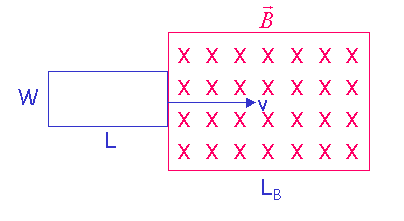
I'll show you a lil' trick. Let's say there's a loop of wire moving at velocity v into or out of a magnetic field that is perpendicular to the surface.

When the loop is entering the field, it will have an induced current and emf as a result of the changing flux from changing area.

First of all, v can be rewritten as the change in length inside the field per second:

v= Δl/Δt

Recall:

ε=|(ΔBA)/Δt|

In this case, only area is changing. The change in area is wΔlwΔl.

So,

ε=|BΔA/Δt|=|BwΔl/Δt|=Bwv

**Note: this can also be written as Blv rather than Bwv depending on how you are labeling **

Interactive · 1 question

Michael Faraday, undoubteldly one of the most influential men in physics, discovered a fundamental phenomenon in electromagnetism. His experiments showed that a changing magnetic flux/ magnetic field induces a current in a loop of wire. In this lesson, I will work to describe this concept both qualitatively and quantitatively, but first we must recap on a few important definitions.


Okay backtrack, what is magnetic flux? Essentially, it is the measure of the total magnetic field that passes through a given area. In other words, it is the surface integral of magnetic field passing through a surface and can be visualized as the number of B field lines passing through a two-dimensional plane of area. Therefore, magnetic flux is proportional to the product of the magnetic field strength and the area it's passing through.

It would be nice to say that magnetic flux is also equal to this product, but that's not always correct. As you would expect from the title of this explanation, inductance is a matter of geometry. In more specific terms, magnetic flux is the surface integral of the normal component of the magnetic field to the 'surface' or the open face of the loop. Figuring out the normal/perpendicular component requires basic trigonometry.

source: etkina college physics

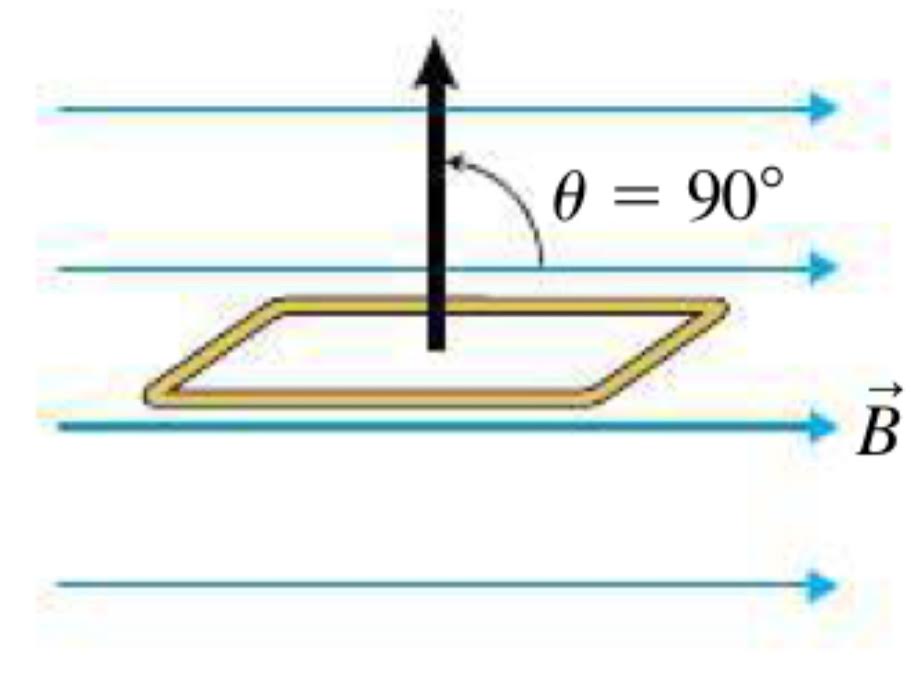
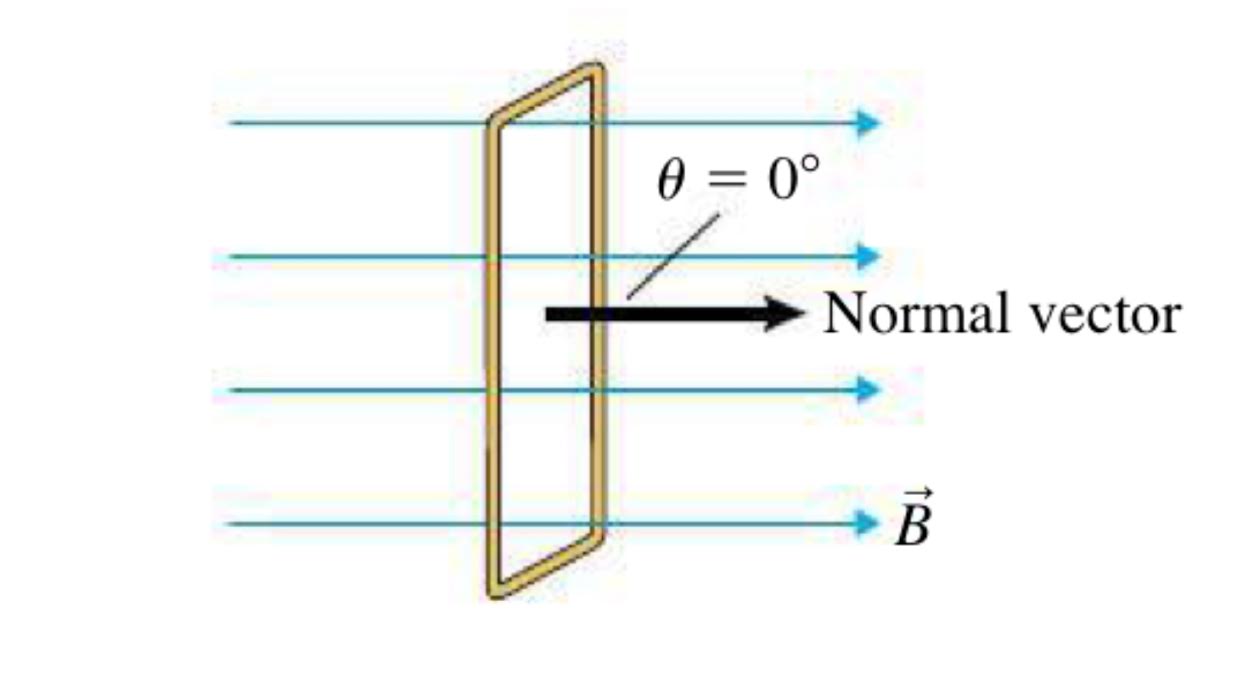
In this image, the direction of the magnetic field into the wire is perpendicular to the 'surface.' So when calculating the magnetic flux, all you need to do is multiply the magnetic field strength by the area of the loop.

source: etkina college physics

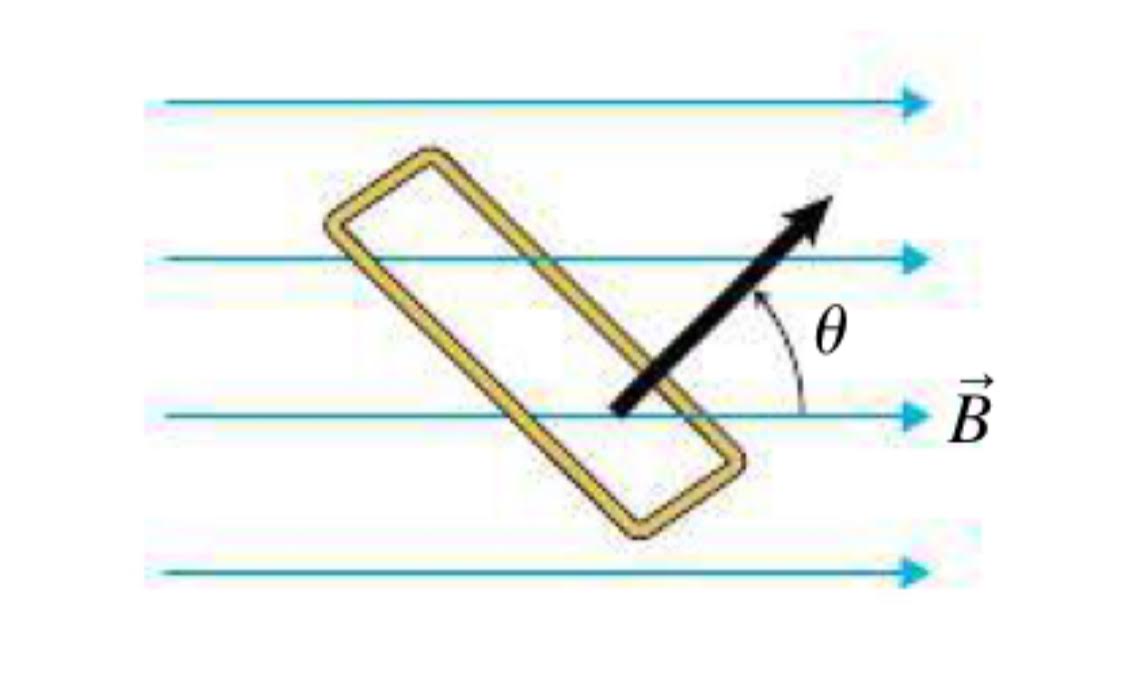
In this image, the magnetic field is not perpendicular to the surface so we have to find its perpendicular component which is indicated by the black, bolded line. To do this, we use right triangle trigonometry. The B vector is the hypotenuse and the bold line we will call a.

a=BcosΘ

This is the perpendicular component of the magnetic field so

Φ=BAcosΘ

**This is the commonly accepted formula for magnetic flux but don't get too dependent on it. Know your trig!!

In summary, to find the magnetic flux through a loop of wire, find the normal or perpendicular component of the magnetic field and multiply that by the area of the loop.

source: etkina college physics

What is the magnetic flux through this loop of wire?

Choose one answer

Type a concept, like “slope” or “photosynthesis”.

↑ ↓ to choose · Enter to openSearch explanations and problems