
Interactive · 4 questions
+7 contributors





As with equalities, it's possible for inequalities to have no solution. And, just to make your life a little more fun, it's also possible that the solution to an inequality can include all real numbers.
Here are a couple graphics to get you thinking before looking at some more complex examples.

Image source: By Caroline Kulczycky

Image source: By Caroline Kulczycky
Inequalities with no solution
What you're looking for in this case is nonsense. Yes, that's right: you are looking for nonsense. If you come across an inequality that indicates information that is not true, then the inequality has no solution.
Let's look at a few examples.
This inequality is nonsense. Why?
There is no way that an absolute value can be less than or equal to a negative number. By definition, absolute values are greater than or equal to (i.e., or positive integers). This inequality violates that definition, making it nonsense. We can say that this inequality has no solution.
Keep in mind that sometimes you may need to isolate the absolute value in order to solve for it.
Simplify this inequality. Is there a solution or not?
When we simplify this inequality to get the terms on one side, here's what we get:
is definitely not greater than . This is also nonsense, which means that the inequality has no solution.
What is the solution to this inequality?
Nope, this isn't true either. This inequality violates another definition: no squared values can be negative unless they are multiplied by negative numbers. This is also nonsense, which means that this inequality has no solution.
There is one more possibility of when inequality have no solutions. Look at the example below. The shaded regions never touch, so there is no solution. This is known as an OR compound inequality.
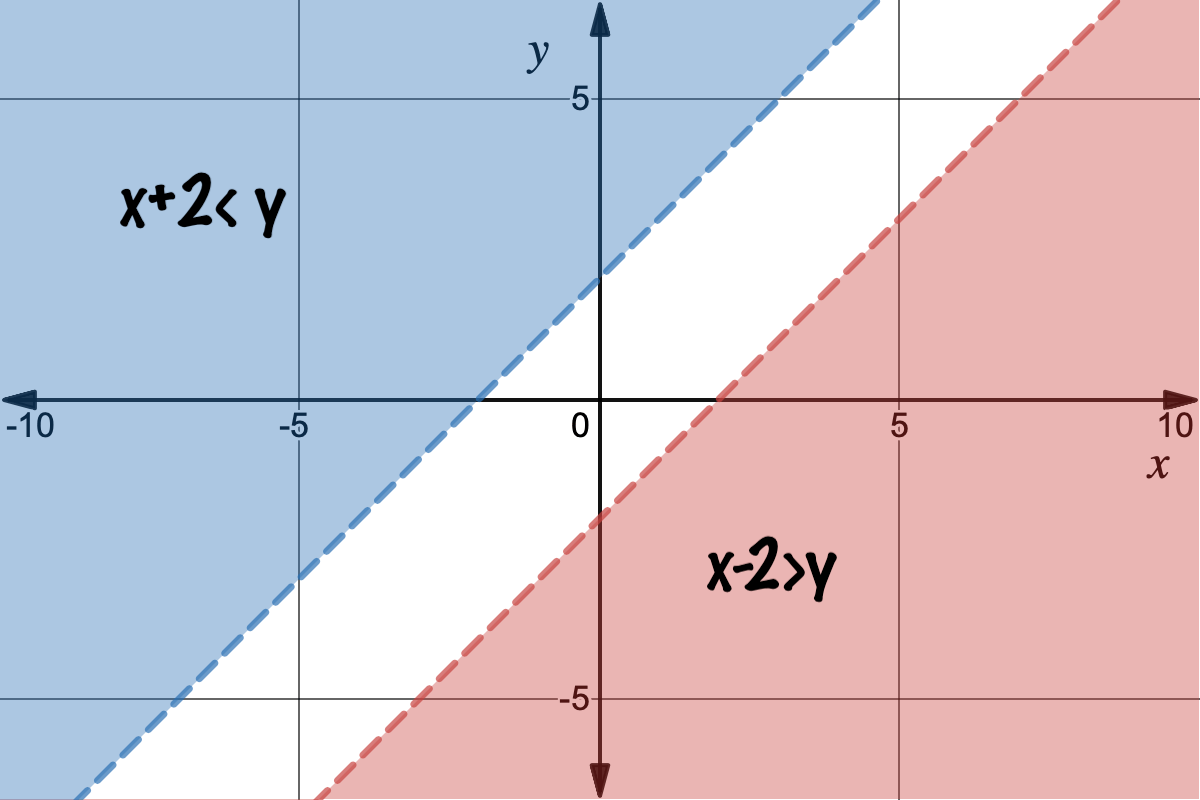
made using Desmos
Inequalities with "all real numbers" solutions
In this situation, we are looking for inequalities that give us information that is ALWAYS true. Let's look at an example:
This statement will always be true. It doesn't matter if is a positive or negative number. Adding will always produce a greater number than adding . Because this is always true, we can say that this inequality's solution is all real numbers.
How can we represent "all real numbers" in interval notation?
We can write it in interval notation as: . We can't fully reach infinity, so we have to use an exclusive interval. You could further simplify this inequality by putting the terms on one side. Let's try that and see if our answer changes:
Nope! Our answer stays the same because this expression is always true. will always be greater than . This confirms that the inequality's solution is all real numbers.
