指数增长

Before this, know指数函数

Video · + 1 min read

(Video) Exponential Growth

by mathman1024

Here's a video by mathman1024 talking about growth and decay.

Summary\large{\text{Summary}}

Both growth and decay can be represented with an exponential function: y=y0ekty=y_0e^{kt} Where,

  • y0=y_0= the initial value or amount
  • k=k= the rate (constant)
  • t=t= time

You might have noticed that this formula looks similar to the formula for continuous compounding interest, A=PertA=Pe^{rt}. Well that's because they're pretty much the same. Continuous compounding interest is a type of exponential growth.

Let's see if you are understanding exponential growth.

How long would it take to double an investment at 8%8\% interest rate compounded continuously? No starting amount has been given though but we know that at the end we want our final value to be double the starting value. So if we use our continuous compounding interest formula we get

  • A=2PA=2P since we want it to be doubled
  • PP is unknown
  • r=0.08r=0.08
  • tt is what we're solving for A=Pert2P=Pe0.08t2PP=Pe0.08tP2=e0.08tln⁡2=ln⁡e0.08tln⁡2=0.08tln⁡20.08=0.08t0.08ln⁡20.08=tt≈8.664 years\begin{align} &A=Pe^{rt}\\ &\color{#8925AE}{2P}=Pe^{\color{#8925AE}{0.08}t}\\ &\frac{2P}{\color{#8925AE}{P}}=\frac{Pe^{0.08t}}{\color{#8925AE}{P}}\\ &2=e^{0.08t}\\ &\color{#8925AE}{\ln}2=\color{#8925AE}{\ln}e^{0.08t}\\ &\ln2=0.08t\\ &\frac{\ln2}{\color{#8925AE}{0.08}}=\frac{0.08t}{\color{#8925AE}{0.08}}\\ &\frac{\ln2}{0.08}=t\\ &t\approx8.664\text{ years} \end{align}

You go to the beach and start collecting shells on the first day. The first day, you only collect four shells. After the first day, it gets quadrupled, so you have 16 shells. On the second day you get 4 dollars, and so on. If we make a table we see: shellsday411626432564\begin{array}{c|c} \text{shells}&\text{day}\\ \hline 4&1\\ 16&2\\ 64&3\\ 256&4 \end{array} You might notice that pattern to be 4n4^n.

Video

(Video) Exponential Growth and Decay

by ThinkwellVids

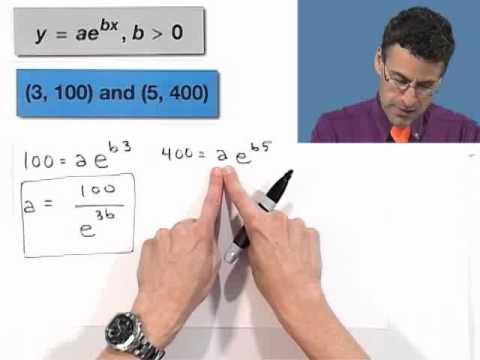
Here's a great video by ThinkwellVids showing you how to solve a problem involving exponential growth.

Summary\large{\text{Summary}}

The equation for exponential growth is y=axbxy=ax^{bx}. You're usually given two different sets of points. With those you make two equations and use them to find any unknowns. Then once you have a formula you can plug in any value you want and find its solution.

Test Yourself: Bacteria grows at an exponential rate. When Jasmine checks the population after a day there's 150150. After 44 days it grew to 10001000. How many were there after 55 days. Answer to the nearest whole number.

Choose one answer

Video

(Video) Exponential Growth Application

by GVSUmath

In this video by GVSUmath the concept of exponential growth is explained.

Read · 1 min

Exponential Growth

Bacteria are one of the most common ways to look at exponential growth. If your population is larger, then the rate of increase or growth should be increasingly larger. This concept is modeled by the function y=aebx with b>0y=ae^{bx} \text{ with } b>0

So, let's look at an example.

A student measures bacteria at two different times. After 22 hours, there are 100100 bacteria. After 44 hours, there are 400400 bacteria. How many bacteria are present at 55 hours?

We have the following information:

  • (2,100)(2, 100)

  • (4,400)(4, 400)

When x=2x=2 and y=100y=100 the equation is correct. So, 100=ae(2x)100=ae^{(2x)}. This means, a=100e2ba=\frac{100}{e^{2b}}.

Now, we see when x=4x=4 and y=400y=400 the equation is correct. So, 400=ae(4b)400=ae^{(4b)}. We can plug in a=100e2ba=\frac{100}{e^{2b}}. We see,

400=ae(4b)400=100×e(4b)e2b400=100×e(2b)4=e(2b)ln⁡4=ln⁡e2bln⁡4=2bb=12ln⁡4\begin{align} 400&=ae^{(4b)}\\ 400&=\frac{100\times{e^{(4b)}}}{e^{2b}}\\ 400&=100\times{e^{(2b)}}\\ 4&=e^{(2b)}\\ \ln{4}&=\ln{e^{2b}}\\ \ln{4}&=2b\\ b&=\frac{1}{2}\ln{4} \end{align}

We can now plug bb in to the other equation to find aa. We see, 400=ae(4b)400=ae4×12ln⁡4400=aeln⁡42400=16aa=25\begin{align} 400&=ae^{(4b)}\\ 400&=ae^{4\times{\frac{1}{2}\ln{4}}}\\ 400&=ae^{\ln{4}^2}\\ 400&=16a\\ a&=25 \end{align}

Finally, we can plug in aa and bb. y=25ex2ln⁡4y=25e^{\frac{x}{2}\ln{4}}

Now, we can find any size of the bacteria population given any time!

Illustrated · 1 min

Exponential Growth

We see exponential growth in a lot of different industries, including biology, economics, and math!

Exponential Growth
y=a(1+r)^x
a: initial amount
r: growth rate
x: time

Image source: by Anusha Rahman

We use the following formula to calculate exponential growth:

y=a(1+r)xy=a(1+r)^x

, where aa represents the initial amount, rr represents the growth rate, and xx represents the time.

Type a concept, like “slope” or “photosynthesis”.

↑ ↓ to choose · Enter to openSearch explanations and problems