什么是无理数?

Before this, know例子

Interactive · 1 question

What is an Irrational Number?

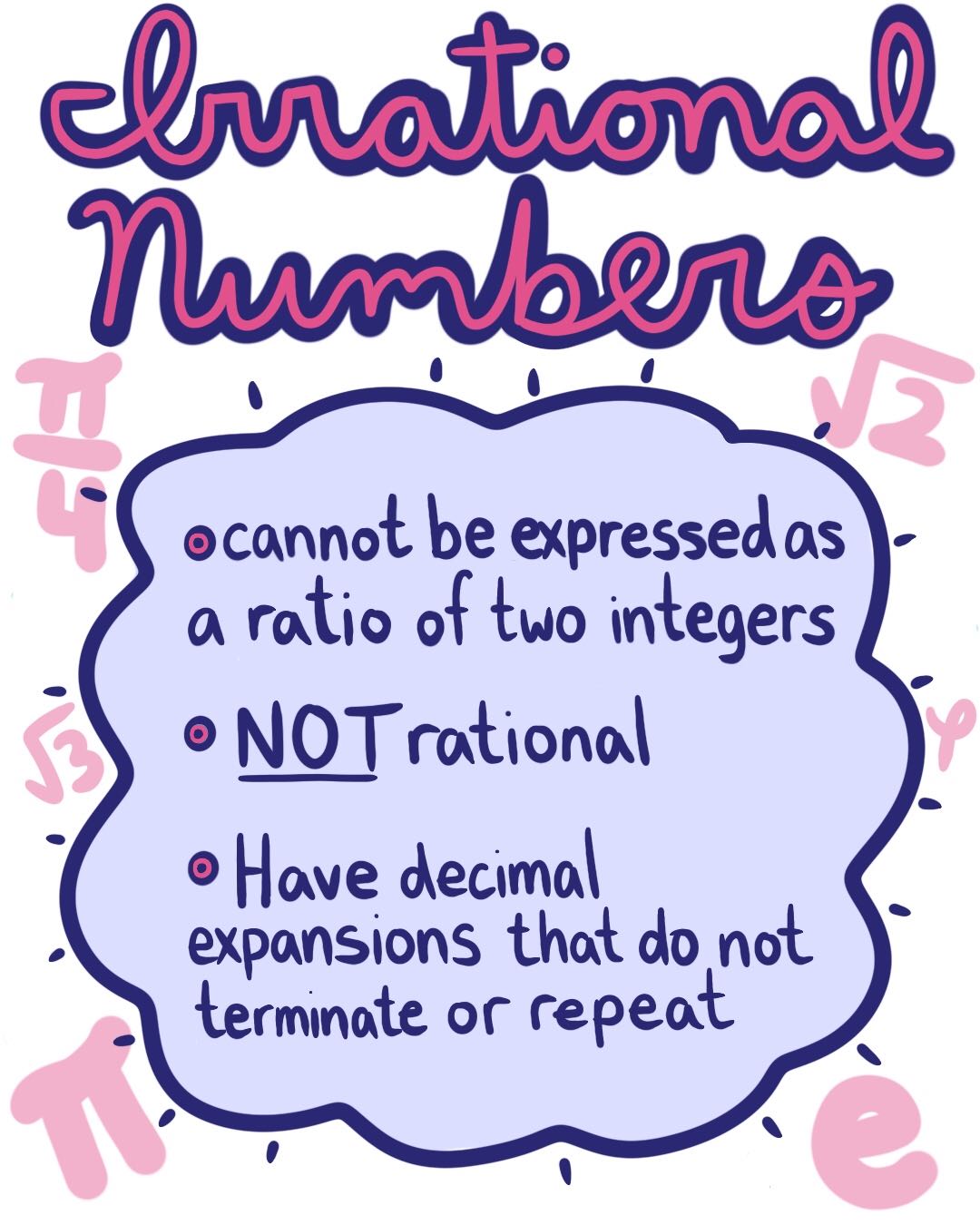
Irrational numbers: cannot be expressed as a ratio of two integers, not rational, have decimal expansions that do not terminate or repeat.

Image by Caroline Kulczycky

Irrational numbers are not rational—they are real numbers that we cannot write as a ratio pq\frac{p}{q} (where pp and qq are integers, with q≠0q\neq 0). The reason we don't allow q=0q = 0 is because we cannot divide by zero. Also, irrational numbers can be positive or negative.

Is π2\frac{\pi}{2} irrational?

Choose one answer

Interactive · 2 questions

What is an Irrational Number?

Irrational numbers are kind of the opposite of rational. They are [real] (https://www.expii.com/t/what-are-real-numbers-9010) numbers that we can't write as a ratio pq\frac{p}{q} where pp and qq are integers, with q≠0q\neq 0. In fact, every real number is either a rational number or an irrational number. No number can possibly be both rational and irrational!

For example, 2.62.6 is rational because it can be expressed as a fraction 135\frac{13}{5}. This is an example of a terminating decimal. Every terminating decimal has a finite number of digits, and all such numbers are rational.

As another example, 2\sqrt{2} = 1.414213….1.414213…. is irrational because we can't write that as a fraction of integers. The decimal expansion of 2\sqrt{2} has no patterns whatsoever. In particular, it is not a repeating decimal.

Some examples of irrational numbers are π,e,ϕ\pi, e, \phi, and many roots. However, keep in mind that not all roots are irrational, ex: 9=3\sqrt{9}=3. Always check to see if the root can be simplified.

Examples

Let’s take a look at some examples.

Are these numbers rational or irrational?

  1. 0.6666660.666666…..(66 repeating)
  2. 3\sqrt{3}
  3. 7127^{\frac{1}{2}}
  4. 1+52\frac{1 + \sqrt{5}}{2}

Solutions to the Examples

  1. 0.6666660.666666…..(66 repeating) is a rational number because we can write it as a fraction 23\frac{2}{3}. Both the numerator and denominator are integers! Repeating decimals are rational numbers because they can be rewritten into fractions. They are indicated by a repeating pattern in the decimal representation.

This is despite there being countless place values after the decimal.

  1. 3\sqrt{3} is irrational because we are unable to write it as a fraction. Its decimal expansion is 3=1.73205…\sqrt{3} = 1.73205…

There are infinitely many digits after the decimal point. However, these digits exhibit no pattern or repetition.

  1. Write the fractional exponent as a square root: 7\sqrt{7}. Then, just like in Example 2, write out the decimal expansion: 7=2.64575...\sqrt{7} = 2.64575... This has no fraction representation, so it is also irrational.

  2. This number has a square root inside of a fraction. The square root 5\sqrt{5} cannot be simplified, so it is irrational. That makes the entire expression irrational. It may look like that number came out of nowhere, but it's actually quite famous. It's so well-known it was given the name golden ratio{\color{ffaa3d}{\text{golden ratio}}}.

Now, we will take a look at some of the types of problems you might encounter about irrational numbers. The main goal is to classify numbers as either rational or irrational. Remember, every number is one or the other, not both.

Example 1

Select each irrational number on this list.

Choose all correct answers

Video · + 1 min read

(Video) Examples of Irrational Numbers

by Derek Rouch

This video by Derek Rouch goes over the differences between rational and irrational numbers. Every number is either rational or irrational. No number can be both rational and irrational.

Summary\large{\text{Summary}}

Rational Number — Any number that can be written as a ratio ab\frac{a}{b} (where a,ba,b are integers and b≠0b \ne 0); this includes all repeating decimals.

Irrational Number — Any real number that cannot be expressed as such a ratio. In other words, a real number that is not rational. Most numbers out there are irrational. However, we prefer to use rational numbers in problems whenever possible.

Famous Irrational Numbers

Constants: π,e\pi, e

The symbol π\pi refers to the area of a circle with radius 11. The symbol ee refers to Euler's number. We won't get into what ee means right now, but trust me, it appears everywhere!

Imperfect Squares: Any square root that we can't simplify into a whole number (ex. 17,24\sqrt{17}, \sqrt{24}); this means it's important to try to simplify square roots first.

Decimals that never terminate and never repeat (ex. 0.482164320.48216432…)

There are lots of other irrational numbers. In fact, most numbers out there are irrational. Despite this, if we were to cram all numbers onto a number line, there'd be a rational number between any two irrational numbers! This is called a density property.

We are now going to take a look at some of the types of problems you might encounter about examples of irrationals.

Example 1

Is 16\sqrt{16} an irrational number?

Choose one answer

Type a concept, like “slope” or “photosynthesis”.

↑ ↓ to choose · Enter to openSearch explanations and problems