
Interactive · 1 question
Before reading this post, please read this [post][https://www.expii.com/e/640/]. (Just for fun: I had just proved the Trig Ceva in a different way.)
Given a triangle and cevians each from different vertex, given that the cevians are concurrent at . Reflect each cevian from their respective angle bisectors. Then the new lines are also concurrent at a point , which we call it the isogonal conjugate of .
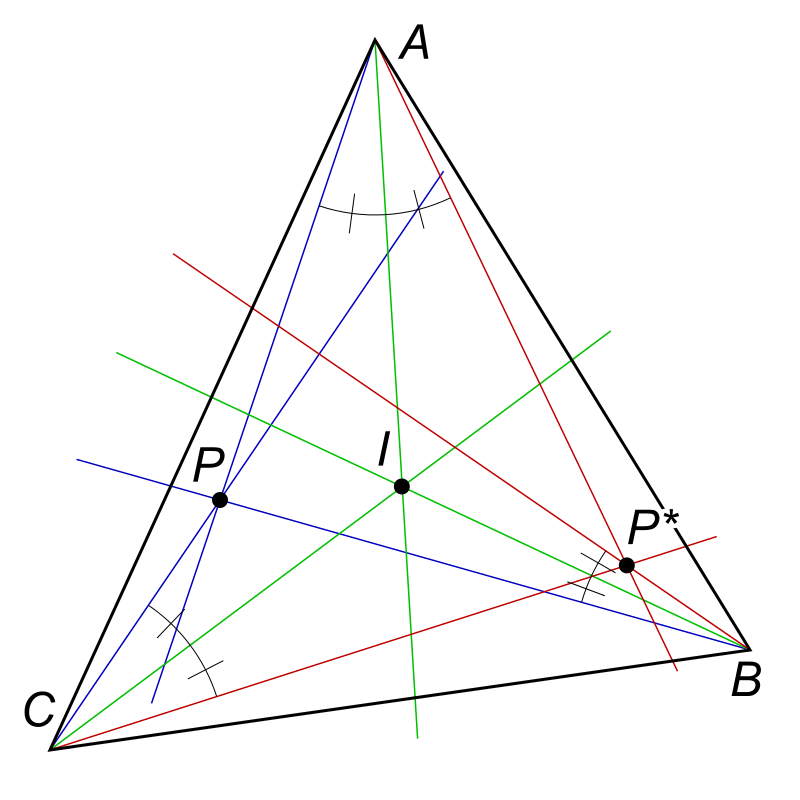
P' is the isogonal conjugate of P.
So you have know what is Trigonometric Ceva Theorem. How should you apply them into the proof of the theorem?
Solution: Note that , , and . So, by Trig Ceva theorem, we have and we are done by the converse of the Trig Ceva theorem. Yay.
Interesting Facts: The isogonal conjugate of the incentre is itself. The isogonal conjugate of the orthocentre is the circumcentre . The isogonal conjugate of the centroid is (by definition) the symmedian point . The isogonal conjugates of the Fermat points are the isodynamic points. The Brocard points are isogonal conjugates of each other. Try to prove each of them!
Challenge: Let a triangle has side lengths . Prove that the barycentric coordinates of the isogonal conjugate of the point with barycentric coordinates is