Interactive · 2 questions
+4 contributors

Kinetic energy is the energy of motion.
We would like to express the kinetic energy of an object in terms of properties like mass and velocity, .
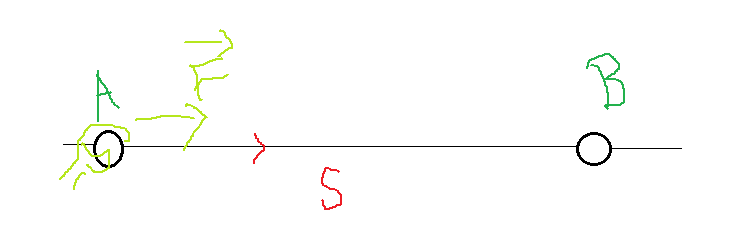
Let's start by accelerating from rest by a constant force acting over a distance .
The work that we did on the object is .
The Work-Energy Theorem tells us that the work we did is equal to the change in kinetic energy.
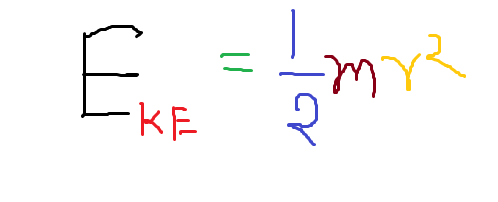
Therefore the kinetic energy which we call , .
But how can we relate this to the motion of the object ? It would be nice to have an expression for the kinetic energy purely from the parameters of the object itself.
How do we relate the force to changes in motion?
We use Newton's Second Law! This says that , where is the mass of the object and is the acceleration of the object. Note that when and are constant, will be constant.
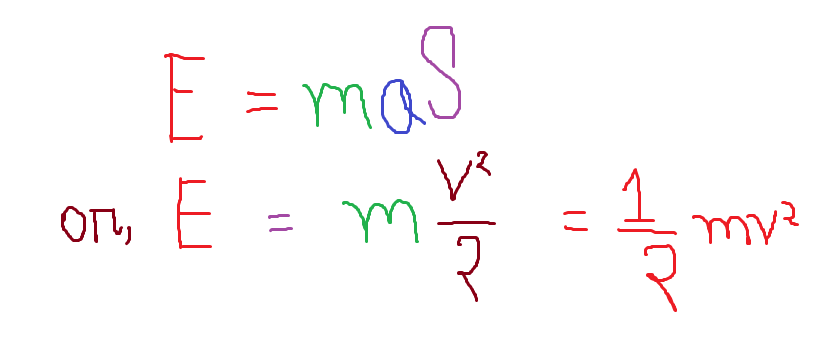
Using this law to substitute for the force, , although we are certainly not mad with this result.
When we started out, we wanted to figure out the kinetic energy in terms of the mass of the object and its speed. Now the constant force leads to a constant acceleration, so let's try to use our familiar friends, the kinematics equations to help!
Which kinematics equation should we use?
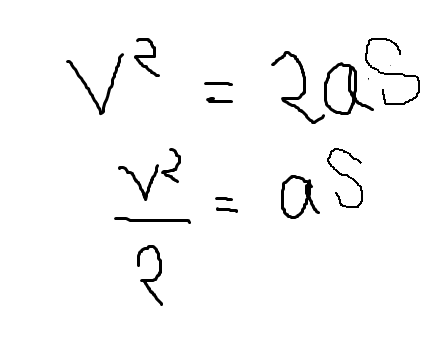
Technically, there was no wrong answer to the above question. We could have used any combination of the formulas to get the answer. However, the nicest answer comes from the equation .
We already know some of these values! Since we are accelerating the object from rest, . Also, , since that is the distance the object moves!
Thus, letting , we have the following: Plugging this into our equation, , we have: So there you have it! The kinetic energy of an object is one half of the product of the object's mass and the square of the object's velocity.
You can check that the equation is dimensionally correct. The units on both sides are [kg] [M] /[s].
Now, we derived this formula for an object accelerated from rest with a constant force, but this formula is true regardless of how an object is accelerates. I'd you know calculus, try repeating this derivation for an object accelerated by a time dependant force .