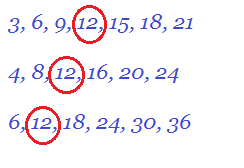
最小公倍数

Before this, know公倍数

Interactive · 1 question

Before discussing Least Common Multiples, let's begin with the term multiples. What does it mean for a number to be a multiple of another number?

If we multiply a number xx by an integer, we get the multiples of xx. For example, 66 is a multiple of 22 because we can multiply 22 by an integer to get 66. In this case that integer is 33. We can tell it's 33 because 2×3=62 \times 3 = 6. However, sometimes you have to deal with larger numbers. In this case you might need to solve an equation to figure out what number to multiply by.

We can also list the multiples of a number by "counting by" that number. For example, when we "count by 22" we are listing the multiples of 22 {2,4,6,8,10,12,14,16...}.\{2,4,6,8,10,12,14,16...\}. These lists technically never end. However, we usually only write out a few numbers from the lists. Each number in that list is the result of multiplying 22 by another whole number. That's why we call these numbers multiples of 22.

Similarly, if we were to count by 77 i.e. {7,14,21,28,35...}\{7,14,21,28,35...\}, we are listing multiples of seven. If we are listing multiples of a positive number, the numbers increase as we go further along the list. If we are listing multiples of a negative number, the numbers decrease as we go further along the list.

Select all of the multiples of 99.

Choose all correct answers

Learn a clever approach

Every problem comes with a worked solution, so even one you cannot crack shows you a new way to think. These are real problems from the AMC 8, AMC 10, AMC 12 and AIME, the national math competitions for middle and high school students, each with a worked solution on LIVE by Po-Shen Loh.

Interactive · 1 question

Least Common Multiple (LCM)

To understand what a LCM is, you must first understand what a multiple is. As a refresher, a multiple of an integer is the product of that integer and another integer. For example, some multiples of 1010 are ⋯ ,−30,−20,−10,0,10,20,30,⋯\cdots , -30, -20, -10, 0, 10, 20, 30, \cdots

The letters LCM are an acronym for the phrase "least common multiple". Written another way,

L\textbf{L}east (or smallest)

C\textbf{C}ommon (or shared)

M\textbf{M}ultiple

So, the LCM of two (or more) integers is the smallest [positive] multiple they share. It's important to note that the LCM is always a positive number. Otherwise, you can always find a smaller multiple, since multiples can be negative! The LCM also stands for lowest common multiple. However, using "least" is more common. That's the phrase we'll use in this explanation.

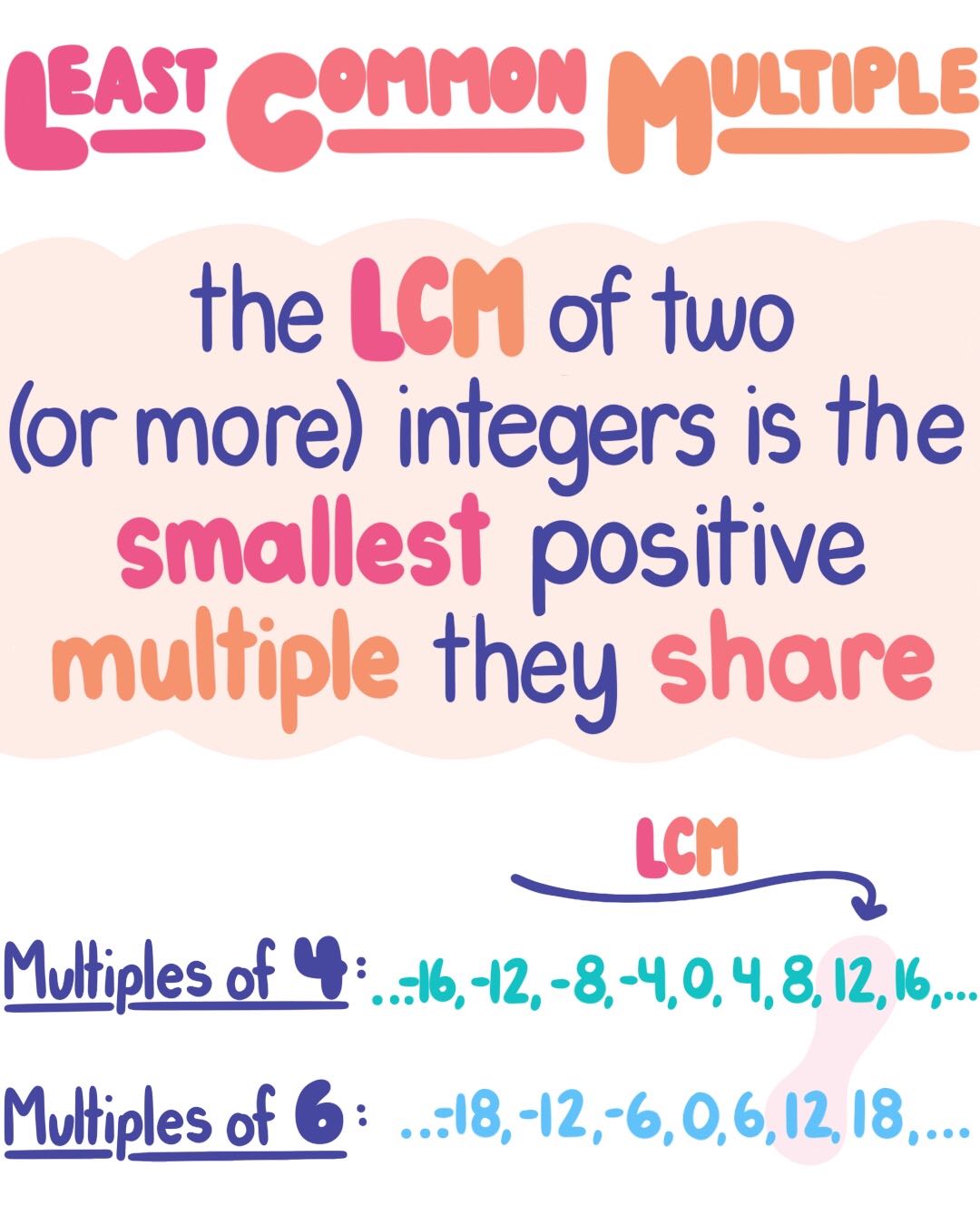
Here's a graphic to recap what we've learned:

Least Common Multiple: the LCM of two (or more) integers is the smallest positive multiple they share. For example, some multiples of 4 are .....,-16, -12, -8, -4, 0, 4, 8, 12, 16, ..... and some multiples of 6 are .....,-18, -12, -6, 0, 6, 12, 18, ..... Thus, the LCM of 4 and 6 is 12, since it is the smallest positive multiple they both share.

Image by Caroline Kulczycky

Let's do an example to practice what we've learned!

Practice Problem

What is the LCM of 2,4,2, 4, and 8?8?

Choose one answer

Video · + 4 min read

(Video) Finding the LCM

by Mathademics!

This video by Mathademics! shows you how to find the Least Common Multiple (also called the Lowest Common Multiple) of two or three numbers.

Summary\large{\text{Summary}}

They go over three different methods to finding the LCM of two numbers. We'll explain each method. Then you're free to use whichever one you like the most.

Method 1

The first method is to list out multiples of each number. Then we choose the first one that appears in all of the lists. It might take a lot of listing out numbers. However, if you like skip counting you'll probably enjoy this method.

For example, if we want to find LCM(12,16):\text{LCM}(12,16): 1212,24,36,48,60,...1616,32,48,64,80,...\begin{array}{c|l} 12&12,24,36,{\color{#29A603}{48}},60,...\\ 16&16,32,{\color{#29A603}{48}},64,80,... \end{array} As you can see, 4848 is the LCM\text{LCM}. We had to list out less multiples of 1616 than of 1212. It doesn't matter where the 4848 appears in the two lists. It just has to be the first number appearing somewhere in both lists.

Also, you can keep writing these lists forever. However, once you find the LCM you can stop. There's no need to continue listing out numbers after this point.

Method 2

Another way to find the LCM\text{LCM} is by using prime factorization. Write out the prime number factors of each number. Then, select the prime factors that they have in common. Multiply these by the remaining prime factors that they don't have in common.

For example, if we want to find the LCM(12,16)\text{LCM}(12,16) we first write out the prime factorizations of each. 122⋅2⋅3162⋅2⋅2⋅2\begin{array}{c|l} 12&2\cdot2\cdot3\\ 16&2\cdot2\cdot2\cdot2 \end{array}

Select the prime factors that the 1212 and 1616 have in common. 122⋅2⋅3162⋅2⋅2⋅2\begin{array}{c|l} 12&{\color{#29A603}{2}}\cdot{\color{#29A603}{2}}\cdot3\\ 16&{\color{#29A603}{2}}\cdot{\color{#29A603}{2}}\cdot2\cdot2 \end{array} They each have two 2s. Let's write these down: 2⋅2{\color{#29A603}{2}}\cdot{\color{#29A603}{2}}

In practice this is often written with exponent notation, 2⋅2=222 \cdot 2 = 2^2. This is just shorter to write.

Now, multiply the factors that 1212 and 1616 don't share: 2,2,2, 2, and 3:3: 2⋅2⋅2⋅2⋅3=48{\color{#29A603}{2}}\cdot{\color{#29A603}{2}}\cdot2\cdot2\cdot3=48

The product of all the green numbers is the greatest common factor. It's the smallest positive integer which divides both numbers we want the LCM of. It is a product of prime numbers, but we won't use all of the numbers listed. If there are no green numbers, then the greatest common factor is 11. We say the greatest common factor is 11 because it's the multiplicative identity. In this case we're multiplying nothing together at all! Note that the greatest common factor is also called the greatest common divisor.

Two numbers with greatest common factor 11 are called relatively prime numbers.

Method 3

This can also be found by using the ladder method. Write down both numbers and divide by the smallest prime factor that goes into both until there aren't anymore. Surely, you will run out of prime factors eventually.

For example, let's find the LCM\text{LCM} of 1212 and 16.16.

2 goes into 12 and 16. This gives us 6 and 8. 2 also goes into these. It gives us 3 and 4.

Since there aren't any prime numbers that go into both 33 and 44 we're done. In other words, no prime number divides both 33 and 44. We say these two numbers are relatively prime. Remember that 11 is not a prime number, so it doesn't count. We take the outer numbers, 22 and 2,2, and multiply them by the bottom numbers, 33 and 44. 2⋅2⋅3⋅4=482\cdot2\cdot3\cdot4=\boxed{48}

A More Involved Example

It might surprise you that we can find the LCM of more than 22 numbers. In this case we can use either Method 1 or Method 2, but not Method 3. Let's walk through what that looks like.

Let's find the LCM of 66, 77, and 2121. That is, we try to find LCM(6,7,21)\text{LCM}(6, 7, 21). We'll use Method 1 highlighted above for this example. List out a bunch of multiples of 66, 77, and 2121, each in separate rows.

612,18,24,30,36,42,48,...714,21,28,35,42,49,56,...2142,63,84,...\begin{array}{c|l} 6&12,18,24,30,36,{\color{#29A603}{42}},48,...\\ 7&14,21,28,35,{\color{#29A603}{42}},49,56,...\\ 21&{\color{#29A603}{42}}, 63, 84,... \end{array}

We highlighted 4242 in green in each row. This is the first multiple to appear in all three rows. We could keep writing these lists to find more common multiples. However, we were only asked for the least common multiple, so we'll stop here.

If you want more practice, try doing this problem again, but using Method 2. Then make sure you get the same answer as we did with Method 1.

Knowing multiple ways to solve a problem can help you check your work.

A Quick Check

Aside from doing the same problem multiple ways, there's one other option for checking your work. The acronym LCM has the word "multiple" in it. That's what the "M" stands for. Thus the LCM should be a multiple of all the numbers we started with.

How do we check that? Divide the LCM by the numbers we were looking for the LCM of. Each time we should get an integer answer. Let's use our last example to check this. We want to divide the LCM, 4242, by each number we started with. These numbers were 6,6, 77, and 2121. The division is shown below:

42÷6=742 \div 6 = 7 42÷7=642 \div 7 = 6 42÷21=242 \div 21 = 2

Each of our answers on the right is an integer, so we passed the test. Good job!

Why Do We Care?

Finding the LCM of numbers might look like this isolated skill you'll never use again. It is actually very useful for a problem about fractions you may have seen before. When we look to add or subtract fractions with unlike denominators, we're really trying to find an LCM. Specifically, we want the LCM of the denominators of the fractions.

The LCM will become the new denominator of the fractions. Once the fractions have the same denominator, we can add or subtract them together.

Type a concept, like “slope” or “photosynthesis”.

↑ ↓ to choose · Enter to openSearch explanations and problems