Video · + 3 min read
+5 contributors



(Video) Slope-Intercept Word Problems
by cpfaffinator

This video by cpfaffinator explains how to translate word problems into variables while working through a couple of examples.
(Note: the answer at 3:34 should be instead of .)
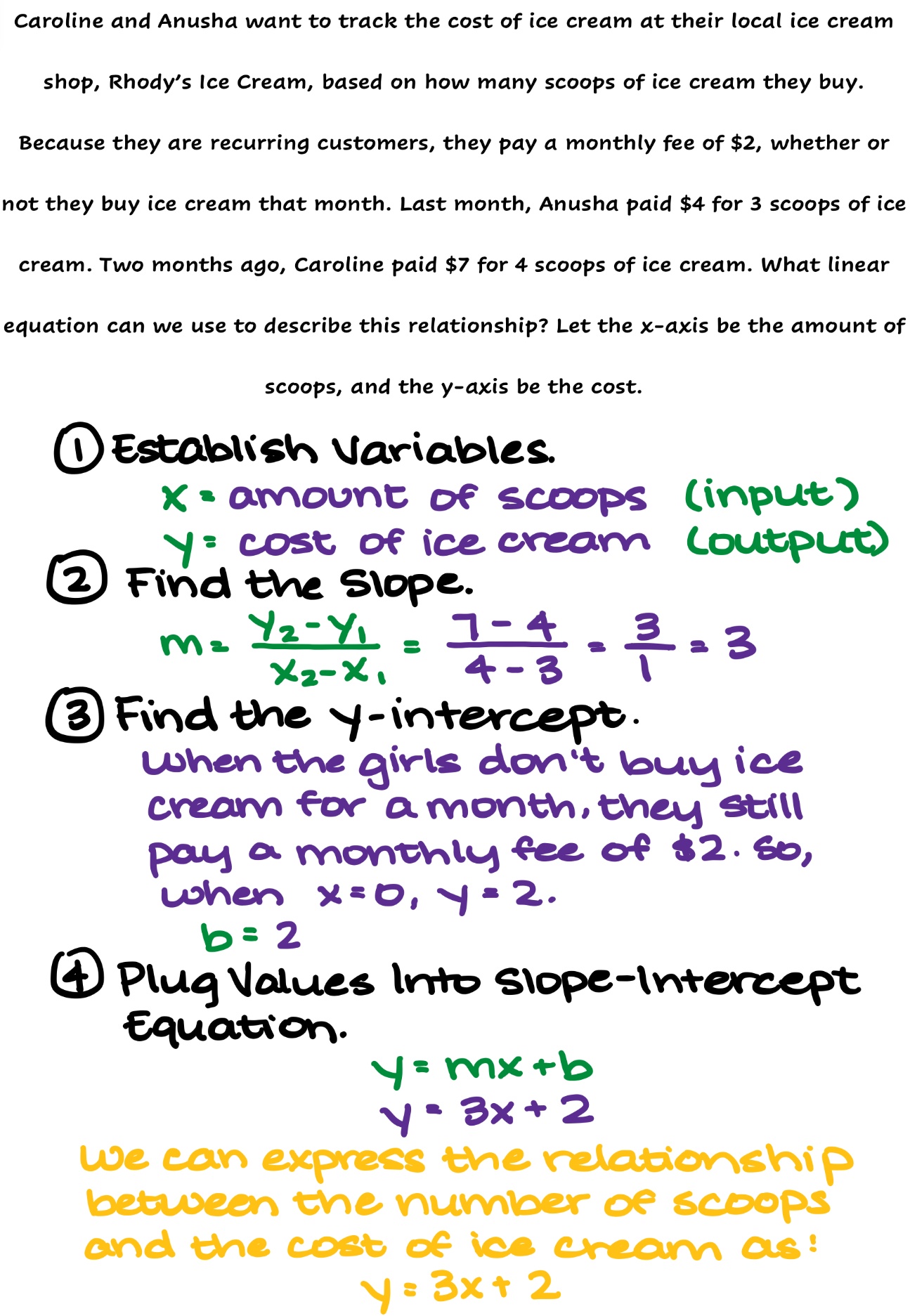
When writing linear equations (also called linear models) from word problems, you need to know what the and variables refer to, as well as what the slope and -intercept are. Here are some tricks to help translate:
- The variable. Usually, you'll be asked to find an equation in terms of some factor. This will usually be whatever affects the output of the equation.
- The variable. The variable is usually whatever you're trying to find in the problem. It'll depend on the variable.
- The slope (). The slope will be some sort of rate or other change over time.
- The -intercept (). Look for a starting point or extra fees—something that will be added (or subtracted) on, no matter what the variable is.
Using these parts, we can write the word problem in slope intercept form, , and solve.
Example 1
A city parking garage charges a flat rate of for parking hours or less, and per hour for each additional hour. Write a linear model that gives the total charge in terms of additional hours parked.
First up, we want the equation, or model, to give us the total charge. This will be what the variable represents. The total charge depends on how many additional hours you've parked. This is the variables.
Next, we need to find the slope, . If we look at the slope-intercept equation, , the slope is multiplied with the input . So, we want to find some rate in our problem that goes with the number of additional hours parked. In the problem, we have per hour for each additional hour. The number of hours is being multiplied by the price of every hour.
The -intercept is the starting point. In other words, if we parked our car in the garage for hours, what would the price be? The problem says the garage *charges a flat rate of . A flat rate means that no matter what we're being charged .
Plugging these into the slope-intercept equation will give us our model.
Example 2
Six tall pine trees were planted during the school's observation of Earth Awareness Week in . The trees have grown at an average rate of . Write a linear model that gives the height of the trees in terms of the number of years since they were planted.
Practice 1
What does the variable represent in our equation?
Since the trees grow a certain amount every year, the height of the trees depends on how many years it has been since the trees were planted. The variable depends on the variable.
Practice 2
What does the variable represent in our equation?
The variable will affect the variable. So, the height of the trees is affected by how many years they've been growing.
Practice 3
What is the slope of our equation?
Slope is the rate or change over time. The trees literally change, or grow, every year. So the rate is .
Practice 4
What is the -intercept of our equation?
The -intercept will be the value at the start, or when . So it's asking what is the height of the tree at the start, or when have gone by? When the trees were first planted, they were tall.
Practice 5
What is the linear model for the trees' height?
Plugging in and into the slope-intercept equation gives us: