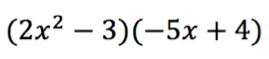
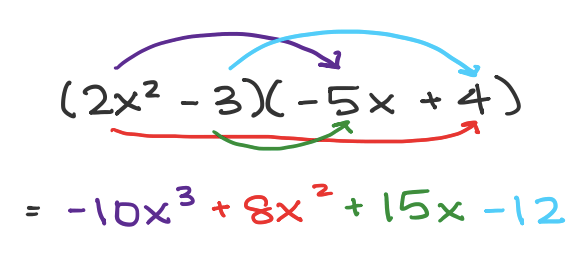
先外后内

Interactive · 1 question

Using FOIL to Multiply Binomials

In an earlier lesson, we saw how to multiply binomials using tables. Here, we're going to use the FOIL method!

When multiplying binomials (expressions with two terms joined by addition or subtraction), we can use the distributive property.

A few pages back, we have a general explanation of how to use the distributive property when working with polynomials. You can access that here. Throughout all of these examples, make sure you remember your exponent rules!

The most common application of the distributive property when multiplying binomials is called FOIL.

Aluminum foil

By Lewis Ronald (Own work) CC BY-SA 3.0, via Wikimedia Commons

No, not this kind of foil. But, hopefully thinking of this picture will help you remember to use the FOIL approach!

FOIL

We're going to use a simple example involving two binomials to help explain what FOIL is.

Suppose that we have the expression (x−2)(x+6)(x-2)(x+6), which is composed of the binomials x−2x-2 and x+6x+6. The FOIL method reminds us which of these binomials' terms we need to multiply together:

  • F: First two terms (in red below)
  • O: Outside two terms (in orange below)
  • I: Inside two terms (in yellow below)
  • L: Last two terms (in green below)
Using 0=(x-2)(x+6), we can foil by multiplying x by x, x by 6, -2 by x, and -2 by 6.

Image source: by Hannah Bonville

Then, after all that multiplication is done, all we need to do is add up the resulting terms and simplify the expression!

We're going to FOIL as shown in the last picture and then simplify. 0=(x-2)(x+6) will multiply into 0=x^2+6x-2x-12. This can be simplified by combining like terms 6x and 4x. The simplified answer is 0=x^2+4x-12.

Image source: by Hannah Bonville

Use FOIL to multiply these binomials: (x−5)(x+2)\left(x-5\right)\left(x+2\right)

What is the product?

Choose one answer

Video

(Video) The FOIL Method

by mathman1024

This video by mathman1024 goes over some examples of polynomial multiplication. He goes over a few methods including the FOIL method.

Summary\large{\text{Summary}}

The FOIL method stands for First Outer Inner Last. You multiply the first terms of each binomial, then the outer terms, then the inner, and finally the last terms.

The first example he does is: (5x+2)(x+8)(5x+2)(x+8).

(5x+2)(x+8)5x⋅x+5x⋅8+2⋅x+2⋅85x2+40x+2x+165x2+42x+16\begin{gather}(5x+2)(x+8)\\ \color{purple}{5x\cdot x+5x\cdot8}\color{green}{+2\cdot x+2\cdot8}\\ \color{purple}{5x^2+40x}\color{green}{+2x+16}\\ 5x^2+42x+16 \end{gather}

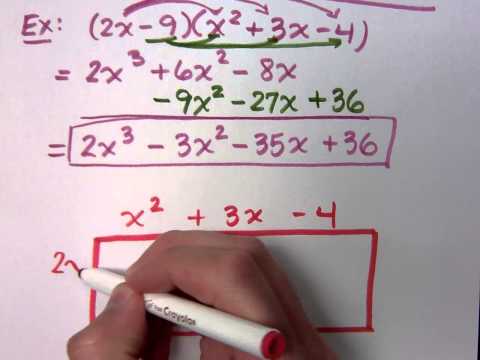
He then does an example with a binomial multiplied by a trinomial. While the FOIL method isn't made for this you still do the general steps which is multiply each term in the first by each term in the second.

The example is: (2x−9)(x2+3x−4)(2x-9)(x^2+3x-4).

(2x−9)(x2+3x−4)2x⋅x2+2x⋅3x+2x⋅−4−9⋅x2+−9⋅3x+−9⋅−42x3+6x2−8x−9x2−27x+362x3−3x2−35x+36\begin{align} &(2x-9)(x^2+3x-4)\\ \color{purple}{2x\cdot x^2}&\color{purple}{+2x\cdot3x+2x\cdot-4}\\ &\color{green}{-9\cdot x^2+-9\cdot3x+-9\cdot-4}\\ \hline \color{purple}{2x^3}&\color{purple}{+6x^2-8x}\\ &\color{green}{-9x^2-27x+36}\\ \hline 2x^3&-3x^2-35x+36 \end{align}

Interactive · 5 questions

FOIL

What a strange title. Aluminum foil, tin foil, what do those things have to do with mathematics?

Well, FOIL is a nice way to remember how to multiply binomials. It will also help us when multiplying other kinds of polynomials.

Now, reader, I know what you're thinking now: how does FOIL help us remember how to multiply binomials?

FOIL is an acronym for First Outer Inner Last.

FOIL for (a + b)(c + d)

F: a * c

O: a * d

I: b * c

L: b * d

Image source: By Alex Federspiel

Okay good, you got it! Now, let's try using FOIL on the expression (x+1)(2x+3)(x+1)(2x+3) together.

Remember, F stands for First. So, let's multiply our First terms first.

What is the first term in the binomial on the left?

Choose one answer

Type a concept, like “slope” or “photosynthesis”.

↑ ↓ to choose · Enter to openSearch explanations and problems