乘积:奇数个负数

Before this, know负数除负数负数除正数

Video · + 1 min read

(Video) Integer Multiplication and Division

by Math Antics
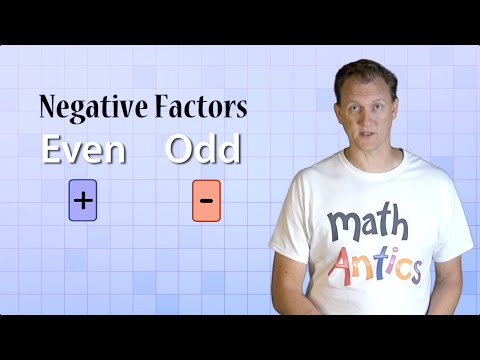
Summary\large{\text{Summary}}

The hardest part of any integer multiplication problem is deciding the sign of the final answer. Remember that negatives change the sign of a problem. For instance, a single negative in a problem will change the answer from a positive to a negative. He uses an example with 3×−13 \times -1 multiple times.

3×−1=−33×−1×−1=33×−1×−1×−1=−33×−1×−1×−1×−1=33×−1×−1×−1×−1×−1=−3\begin{align} 3 \times -1 &= -3\\ 3 \times -1 \times -1 &=3 \\ 3 \times -1 \times -1 \times -1 &=-3\\ 3 \times -1 \times -1 \times -1 \times -1 &= 3\\ 3 \times -1 \times -1 \times -1 \times -1 \times -1 &=-3 \end{align}

Notice that all of the lines with an odd number of negatives have a negative answer. An odd amount of negatives in a multiplication or division problem will always yield a negative number.

However, the product a positive number and a positive number will always be positive. In fact, it doesn't matter how many you multiply together. For instance, the product of fifty positive numbers will be positive! This is the main difference from multiplying negative numbers together.

Test Yourself: What is −3×−4×−6-3\times -4\times -6? Suggestion: determine the sign of the answer first. It's important to keep track of all the negative signs!

Choose one answer

Illustrated · 1 min

The product will always be negative.

Every time you multiply something by a negative number, you "flip" the sign of that number. For example, if you multiply a positive number by a negative number, the answer will be a negative number. If you multiply a negative number by a negative number, the answer will be a positive number.

You can think of this like flipping a light switch. The light always starts out on, and every time you see a negative number as you read an expression, you flip the switch (even if it's the very first number). If the light ends up on when you've gotten to the end of the expression, the result should be positive. If it's off, it should be negative.

-6 x -2 x 12 x 34 x -8. Each negative value switches the switch from on to off. Since there's 3 negatives, it ends on the off setting. This means the product will be negative.

Above, the switch starts out ON. At −6-6, we switch it to OFF. At -2, we switch it back to ON. Since 1212 and 3434 aren't negative, we don't touch the switch when we read those terms. Then, at −8-8, we switch it to OFF again, which means that it's OFF when we get to the end of the expression. Notice that there were 33 negative numbers--an odd number.

Whenever there's an odd number of negatives, the switch will end up in a different position than it started in—off—so the answer will be negative.

Interactive · 2 questions

Let's say you have −1×−1-1\times-1 what does that equal? It equals 11. Now what if you have −1×−1×−1-1\times-1\times-1? Well that's essentially just a 1×−11\times-1 which equals −1-1.

So two −1-1's gave us a positive one, 11

And three −1-1's gave us a negative one, −1-1

And four −1-1's will give us a positive one, 11

And five −1-1's will give us a negative one, −1-1

Do you see the pattern? An even number of −1-1's gives us a positive one, 11. This can be applied to any set of products. The product of an even number of negatives give us a positive number.

An odd number of −1-1's gives us a negative one, −1-1. This can be applied to any set of products. The product of an odd number of negatives give us a negative number.

Example 2×−3×−1×−4×−1×−52\times-3\times-1\times-4\times-1\times-5\\

The product of an odd number of negatives gives us a negative result. The product of an even number of negatives gives us a positive result

Image by Caroline Kulczycky

How many negative signs are in this problem?

Choose one answer

Type a concept, like “slope” or “photosynthesis”.

↑ ↓ to choose · Enter to openSearch explanations and problems