有理式乘除法

Before this, know什么是有理式?

Read · 1 min

In the previous lesson, we looked at adding and subtracting rational expressions. This lesson will look at the other two operations - multiplying and dividing expressions. Both of these lessons will help in simplifying rational expressions.

Multiplying and Dividing Fractions

It's helpful to review how to multiply and divide fractions.

To multiply fractions, we multiply straight across the numerators and denominators. That means we multiply the numerator by the numerator, and we multiply the denominator by the denominator.

ab⋅cd=a⋅cb⋅d=acbd\frac{a}{b} \cdot \frac{c}{d} = \frac{a \cdot c}{b \cdot d} = \frac{ac}{bd}

Dividing fractions has just one extra step. We multiply the first fraction by the reciprocal of the second fraction.

ab÷cd=ab⋅dc=a⋅db⋅c=adbc\frac{a}{b} \div \frac{c}{d} = \frac{a}{b} \cdot \frac{d}{c}=\frac{a \cdot d}{b \cdot c} = \frac{ad}{bc}

Multiplying Rational Expressions

We use this same concept when we are evaluating rational expressions! Since rational expressions are essentially a ratio of two expressions, we set up the expressions like a fraction.

x+2x+3\frac{x+2}{x+3}

Let's think about what happens if we want to multiply two rational expressions together! Then we're multiplying two fractions together!

x+2x+3⋅x−1x−4\frac{x+2}{x+3} \cdot \frac{x-1}{x-4}

Now, we'll multiply the two numerators together for the new numerator of the product. Then, we'll multiply the two denominators together for the new denominator of the product.

x+2x+3⋅x−1x−4=(x+2)(x−1)(x+3)(x−4)=x2−x+2x−2x2−4x+3x−12=x2+x−2x2−x−12\begin{align} \frac{x+2}{x+3} \cdot \frac{x-1}{x-4} \\ &= \frac{(x+2)(x-1)}{(x+3)(x-4)} \\ &= \frac{x^2-x+2x-2}{x^2-4x+3x-12} \\ &= \frac{x^2+x-2}{x^2-x-12} \\ \end{align}

Dividing Rational Expressions

When we divide rational expressions, we use the same steps we'd use when dividing fractions! We multiply the first rational expression by the reciprocal of the second rational expression.

Let's say we want to divide the following rational expressions:

3x+12x−1÷x−33x−1\frac{3x+1}{2x-1} \div \frac{x-3}{3x-1}

We're going to flip the second the fraction, i.e., find the reciprocal!

3x+12x−1⋅3x−1x−3\frac{3x+1}{2x-1} \cdot \frac{3x-1}{x-3}

Now, we can multiply the numerators together, and then multiply the denominators together!

3x+12x−1⋅3x−1x−3(3x+1)⋅(3x−1)(2x−1)(x−3)9x2−3x+3x−12x2−6x−x+39x2−12x2−7x+3\begin{align} \frac{3x+1}{2x-1} \cdot \frac{3x-1}{x-3} \\ \frac{(3x+1) \cdot (3x-1)}{(2x-1)(x-3)} \\ \frac{9x^2-3x+3x-1}{2x^2-6x-x+3} \\ \frac{9x^2-1}{2x^2-7x+3} \\ \end{align}

Video · + 1 min read

(Video) How to Multiply and Divide Rational Expressions

by Brian McLogan

In this video by Brian McLogan, you will learn the three simple steps to multiply and divide rational expressions.

Summary

Just like with fractions, you don't need to have the same denominator to multiply or divide the fractions. Two key rules to keep in mind:

  • Always try to simplify as much as possible! Factoring will be really important here.

  • Make sure you can apply your multiplication, by using FOIL or the distributive property.

Example: Multiply the following rational expression: (x+1)(x−2)(x−2)(x+4)⋅5(x+4)(x+1)\frac{(x+1)(x-2)}{(x-2)(x+4)} \cdot \frac{5(x+4)}{(x+1)}

Your first instinct may be to multiply out all of the factors, but then you will be left with many different terms, and that is not meaningful. Instead, go back to one of the two key rules we mentioned earlier: simplify as much as possible! You'll notice that you can immediately cancel out the (x−2)(x-2) factors in the numerator and denominator of the first fraction! We can then rewrite the expression as:

5(x+1)(x+4)(x+4)(x+1)\frac{5(x+1)(x+4)}{(x+4)(x+1)}

There is one more simplification we can do! We can cancel out the (x+1)(x+1) terms and the (x+4)(x+4) terms. That leaves us with 55 as our simplified answer.

Try the next example on your own before watching the video!

Example: Simplify the following rational expression:

x2−5x+6x÷x2−x−12x\frac{x^2-5x+6}{x} \div \frac{x^2 -x-12}{x}

Illustrated · 1 min

Multiplying and Dividing Rational Expressions

In this next lesson on evaluating rational functions, we are going to learn how to multiply and divide rational expressions. As we've learned before, a rational expression is like a fraction, but the top and bottom are polynomials.

You've already learned how to add and subtract rational expressions! This is one step further.

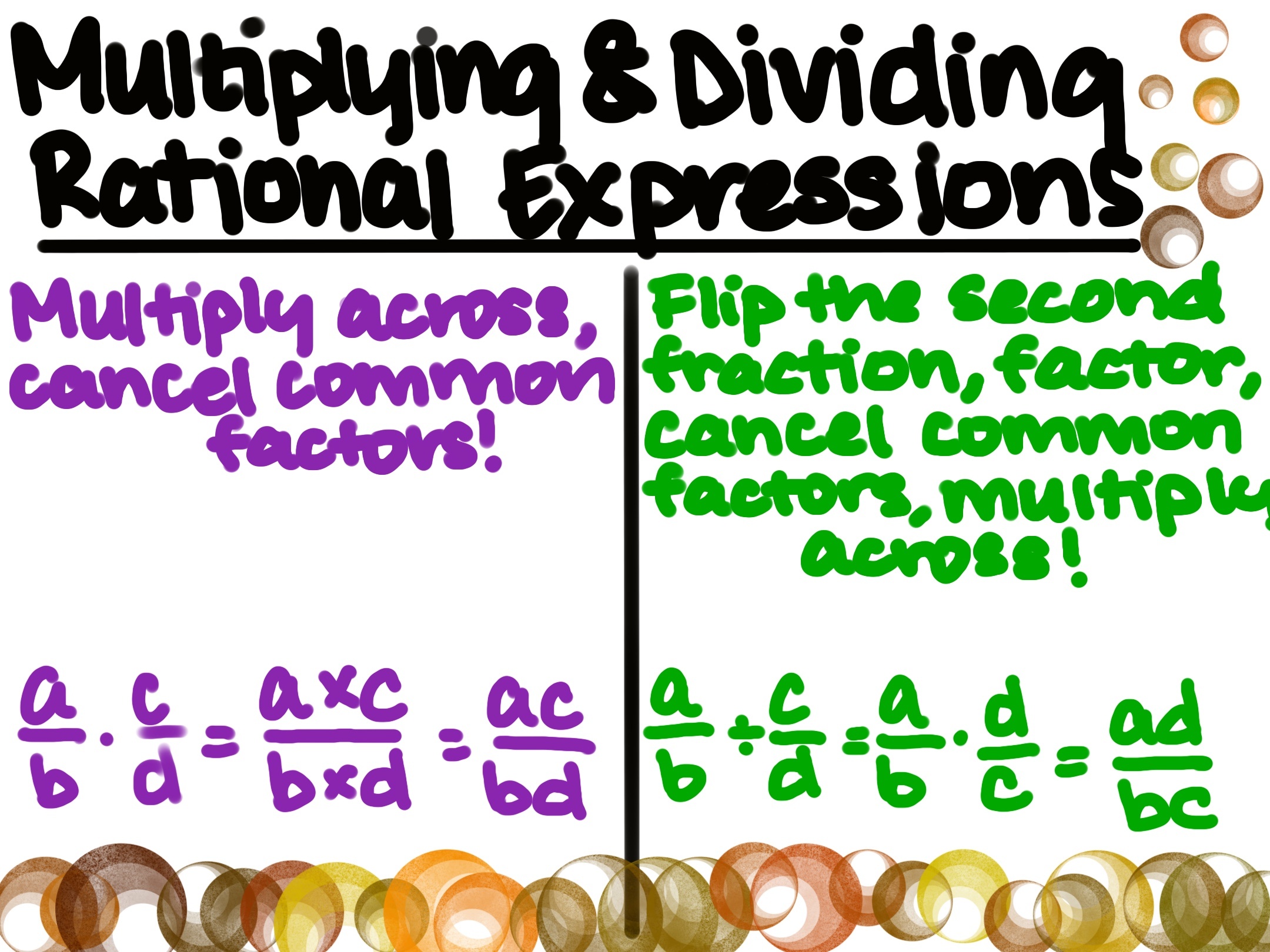
Multiplying and Dividing Rational Expressions
Multiply across, cancel common factors!
Flip the second fraction, factor, cancel common factors, multiply across!

Image source: by Anusha Rahman

Multiplying

Like regular fractions, when you multiply rational expressions, you multiply the numerators together and the denominators together. Before you do that, it's smart to factor everything first to see if anything cancels out.

Let's look at an example:

2x3⋅5x=2x⋅53⋅x=10x3x=103\frac{2x}{3} \cdot \frac{5}{x} = \frac{2x \cdot 5}{3 \cdot x} = \frac{10x}{3x} = \frac{10}{3}
Dividing

Dividing rational expressions is like what we did when multiplying. Except there's one extra step: you are going to flip the second fraction before multiplying. We call this multiplying by the reciprocal.

Let's look at an example:

4y5÷2y=4y5⋅y2=4y⋅y5⋅2=4y210=2y25\frac{4y}{5} \div \frac{2}{y} = \frac{4y}{5} \cdot \frac{y}{2} = \frac{4y \cdot y}{5 \cdot 2} = \frac{4y^2}{10} = \frac{2y^2}{5}

In general, always look for common factors before multiplying and dividing - that will help stop you from making mistakes with complicated numbers and fractions!

In the next lesson, you will learn how to simplify complex rational expressions.

Type a concept, like “slope” or “photosynthesis”.

↑ ↓ to choose · Enter to openSearch explanations and problems