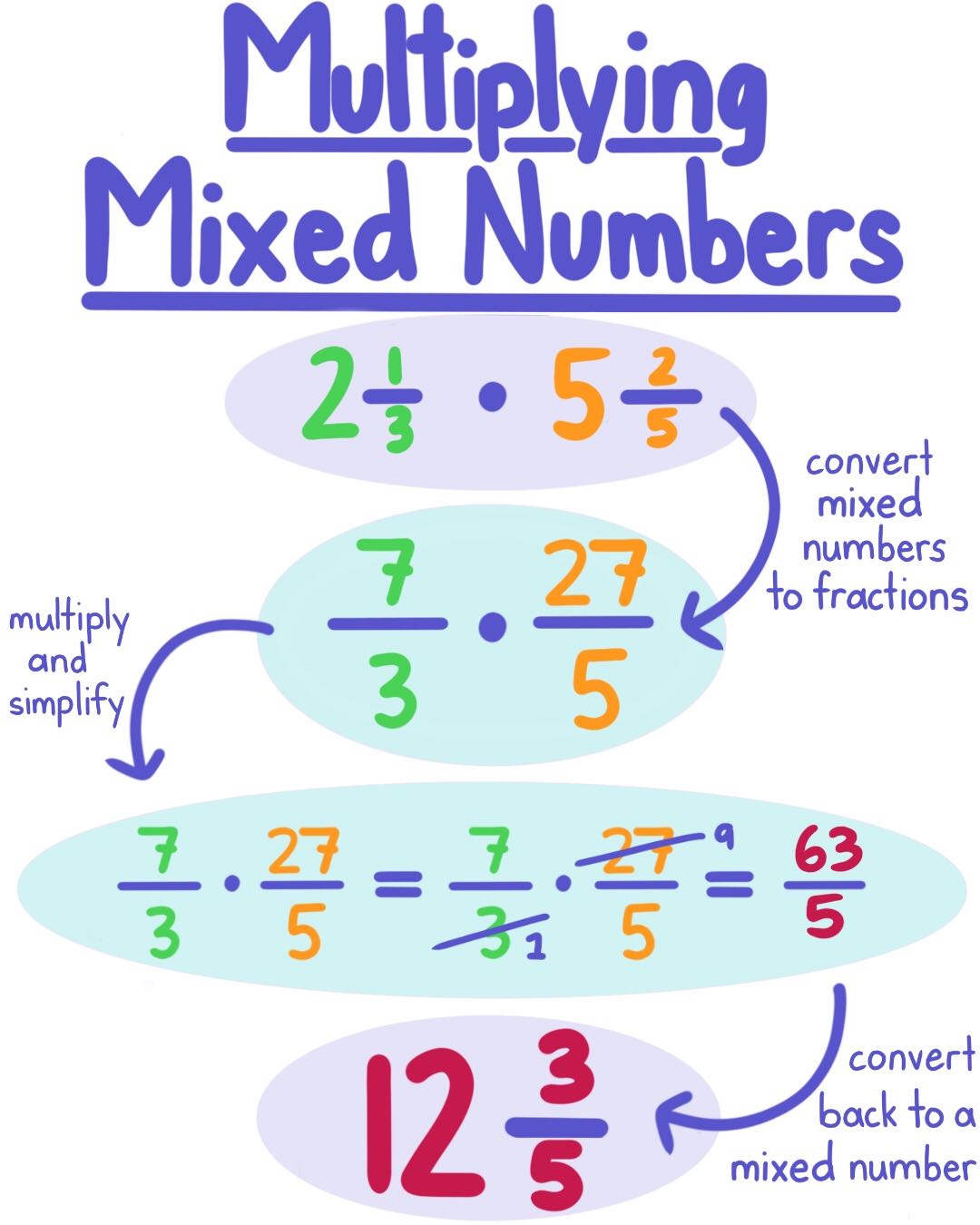
To multiply mixed numbers, we need a few steps. The most important thing to remember is that we cannot multiply these numbers as written. The first step is to convert the mixed numbers to improper fractions.
We can find this by multiplying the numerators and denominators separately and placing the products in the same positions:
11×20=2202×7=14
The fraction 14220 can be simplified to 7110. Now, we're very close to our answer! We don't have it in quite the format we want it in, though, so let's move on to Step 3.
A mixed number is a combination of an integer and a fraction. The integer is called the integer part. The fraction is called the fraction part. Hence they are sometimes called mixed fractions. Some examples are
465,732,381
We usually write the mixed number so that the fraction is a proper fraction. These mixed fractions are equivalent to
4+65,7+32,3+81
respectively. The difference is we don't write the plus sign anymore.
We can add or subtract two mixed numbers. The next question that arises is, can we multiply mixed numbers? The answer is a resounding yes, but it takes a bit of work.
Before multiplying, we must convert both mixed numbers to improper fractions. Then we multiply the improper fractions together directly. In some cases we will need to reduce the fraction to lowest terms. Finally, we can convert back to a mixed number. This procedure assumes we know how to multiply regular fractions. You should review that first if you need to.
Since our problem was given with mixed numbers, we aim to have our final answer be a mixed number too.
Multiplying two mixed numbers might be harder than adding or subtracting them. However, multiplication lets us avoid one painful step. We don't have to worry about common denominators. You might remember adding and subtracting fractions with unlike denominators. For those problems you had to find the greatest common denominator. It's the same for adding or subtracting mixed numbers. No need to worry about that when multiplying them together!
Let's work some examples.
First Example
We're going to multiply
151×131
The first step is to convert the mixed numbers to improper fractions. To calculate the new numerators, we use order of operations.
151=55×1+1=56131=33×1+1=34
Now we multiply these fractions. Multiplying the numerators and denominators together gives
56×34=1524
This is an improper fraction. That's a good sign because we want to convert back to a mixed number. First, however, we ask if we can reduce this fraction. We look for common factors of the numerator and denominator. That leads to the conclusion that 3 is a common factor. Let's get rid of it:
1524=5×38×3=5×38×3=58
And finally, let's turn this back into a mixed number.
58=153
In summary, we've shown that
151×131=153
Second Example
Let's work out another example. This time we're going to multiply
531×131
The fractions are slightly different, but the procedure is the same. Let's convert the mixed numbers to improper fractions. One of these fractions is repeated from the first example.
531=35×3+1=316131=31×3+1=34
Now, let's multiply these two fractions together. Multiply the numerators. Then multiply the denominators.
316×34=964
In the last example we reduced the fraction. Can we do that again here? It turns out the answer to this question is no. The numerator and denominator are relatively prime. That means they share no common prime factors. In other words, the greatest common factor is 1. More thoroughly, we write the prime factorization for each number.
64=2×2×2×2×2×2=269=3×3=32
So we see 64 and 9 share no common factors besides 1. That means we can't reduce the fraction 964. All that's left is to convert back to a mixed number.
964=791
In summary, we've shown
531×131=791
Third Example
We're going to mix it up a bit now (no pun intended). Let's throw in a negative sign. We're going to multiply
−353×252
Once again we convert from mixed number back to improper fraction. We can just carry around the negative sign in front. It won't mess with anything else.
−353=−53×5+3=−518252=52×5+2=512
Now let's multiply the fractions. The negative sign in front will act as multiplying by −1.
−518×512=−25216
This fraction does not need to be reduced. The numerator and denominator don't share factors besides 1. If you want, you can check this with the prime factorizations of 216 and 25. Anyway,
−25216=−82516
Just like in the other examples, we wrote our final answer as a mixed number.
A Word Problem
To wrap things up we're going to do a word problem.
Question Statement: Filip works part-time at a factory. He works three shifts in a week. Each shift is 521 hours long. How many hours does he work in a week? Write your answer as a mixed number.
Only the first number is a mixed number. The second number is an integer. So we convert 521 to an improper fraction:
521=25×2+1=211
We will also write the 3 as 13. This will make multiplying easier. Then
521×3=211×13
Now multiply the numerators and denominators:
211×13=233
Finally, let's turn this back into a mixed number:
233=1621
Hence our final answer is 1621hours.
The Most Common Mistake
Let's conclude by discussing the most common mistake students make. Don't multiply the integer parts and the fraction parts. This doesn't work because of the invisible plus sign present in any mixed number. In other words, doing this violates the order of operations.
Moving Forward
In this explanation we skipped over one of the big operations. What about division? Well, we can divide ordinary fractions. This includes those improper fractions.
As a result we're also able to divide mixed numbers. The procedure is similar to multiplying mixed numbers.