What is "Order of Operations"?
Let's first talk about what an "operation" is. An operation in math is any action that involves adding, subtracting, multiplying, dividing, raising to a power, taking a square root, etcetera. If you see it in an equation, and it's not a number or variable, it's probably an operation.
Now, when we see an expression, such as (3+9)×2−10÷5, how do we know what to do first? Do we read it left to right? Right to left? Should we pay attention to what is in the parentheses?
The math wizards of the world sat down at a meeting to discuss how to solve problems like this. They then made the "Order of Operations", that they engraved into a stone tablet, which stated that math problems should be solved in this order:
- Parentheses
- Exponents
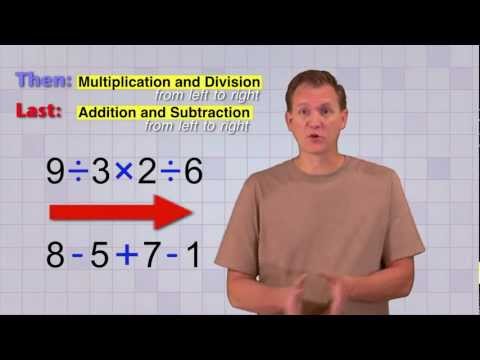
- Multiplication/Division
- Addition/Subtraction
Alright, this is a lot to remember, so we can create an acronym to remember it!
P.E.M.D.A.S (Parentheses, Exponents, Multiplication, Division, Addition, Subtraction) will help you remember in what order to perform the operations. You can use the phrase Please Excuse My Dear Aunt Sally to help you memorize. Let's look at an example.
Example
What is 4+(3×2)−2+10÷5?
How do we start this? Let's think back to P.E.M.D.A.S. The P is for parentheses, so let's look at what is in our parentheses. We have (3×2). We perform this operation first, which we know equals 6, so our equation will now become:
4+6−2+10÷5
What next? Well, we don't have any exponents, so we will skip the E. We will move on to M.D., which stands for multiplication and division. We notice that we have division in our equation. Therefore, we will perform that operation next. We will do 10÷5, which we know to be 2. Our equation will now become:
4+6−2+2
Now that we have our equation containing only addition and subtraction! We can now perform the operations from left to right, since we can do addition and subtraction in whatever order they appear. So now, we will do:
4+6−2+2
10−2+2
10−2+2
8+2
=10
And there we have it! Just follow the P.E.M.D.A.S., and you'll always be successful! Let's look at an example containing exponents.
5×3+23−6÷3+(9−6)
We still have a pair of parentheses in this equation, so we will do this first:
5×3+23−6÷3+(9−6)
5×3+23−6÷3+3
Now, we will look for our E, exponents. We notice 23 in our equation. Perfect! So now we will perform 23, which is 2×2×2, equal to 8. So now we will have:
5×3+8−6÷3+3
Our next move is to look for multiplication and division, M.D. in our equation. We have 5×3 and 6÷3. We will do 5×3 first, since it comes first in the equation. We know that 5×3=15, so we can change our equation to:
15+8−6÷3+3
Now, we can do 6÷3, which equals 2, so our equation is:
15+8−2+3
Great! Now we have our equation containing only addition and subtraction, so we can just perform the operations from left to right!
15+8−2+3
15+8−2+3
23−2+3
=21+3
=24
and there you have it!