什么是百分数?

Video

(Video) What are Percentages?

by Math Antics

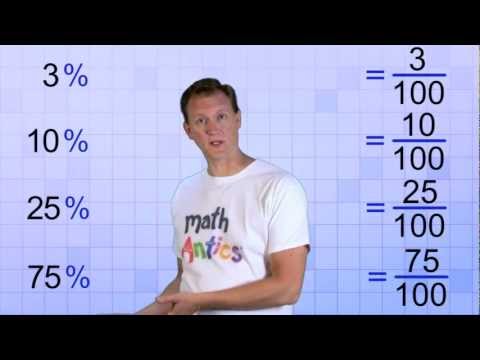
Here's a video by mathantics that explains percents.

Summary\large{\text{Summary}}

A percent is a fraction that always has 100100 as its denominator. #100\frac{\#}{100} But instead of writing the number over 100100 every time, we use the percent symbol %\%. # %\#\,\%

For example, if we saw 15%15\% we would read it as "fifteen percent". But it's the same as 15100\frac{15}{100}. 15%=1510015\%=\frac{15}{100}

To go from the fraction to the percent, multiply by 100. Then add the percent sign at the end.

100%100\%

One-hundred percent, 100%100\%, is just the fraction 100100\frac{100}{100}, which is just 11. 100%=100100=1100\%=\frac{100}{100}=1 100%100\% is just all of something, or one whole. Thus it makes sense it equals 11.

Over 100100

So what about percent over 100100? What is 126%126\%? Well, it works the exact same way. Just place the number over 100100 in a fraction. 126%=126100=126100126\%=\frac{126}{100} = 1 \frac{26}{100} The 126100\frac{126}{100} is an improper fraction, and 1261001 \frac{26}{100} is a mixed number; they mean the same thing. Thus these fractions and the percent are all bigger than 11.

Convert 1.011.01 into a percent.

Choose one answer

Illustrated · 1 min

A Percent Is a Fraction of 100100!

The word "percent" means "per hundred." So, whenever you see a number with a percent sign (%),(\%), you can imagine it as a fraction, with the number before the %\% as the numerator (the top number) and 100100 as the denominator (the bottom number).

For example, if you have a container that holds 100100 mL total, but there is only 60 mL60\text{ mL} of water in it, you could say that it was 60%,60\%, or 60100\frac{60}{100}, full.

60% full is also 60/100 full, 3/5 full, 6/10 full, and 0.6 full.

We can also write percents as fractions or as decimals. Sometimes those are easier to work with.

Read · 1 min

If a percent is just a fraction, with 100100 as the denominator, why make a special thing of it? Why not just have fractions?

Fractions can be hard to compare, but percents make comparison at a glance much easier.

Suppose the pupils at two different schools voted on whether to abolish school holidays, and the votes in favor were like this:

At School A, 457457 pupils out of a total of 985985 voted to abolish holidays. At School B, 518518 out of 11371137 voted to abolish holidays.

Which school had the larger proportion of pupils voting against school holidays? And was there a majority against holidays in either school?

The problem here is that the denominators of the two fractions are different. It's not so easy to compare 457985\frac{457}{985} (School A) to 5181137\frac{518}{1137} (School B).

But, when we translate those fractions into percentages—we see this:

At School A, 46.4%46.4\% voted to abolish holidays. At School B, 45.6%45.6\% voted to abolish holidays.

We have forced those two awkward fractions into forms which are easy to compare—and we can see that a slightly higher proportion of pupils at School A are against them, than at School B.

We were also asked if a majority of students voted to abolish holidays at either school. Both percentages are less than 50%50\%. So, the answer to this question is no.

The price we pay for this convenience is a loss of information. These results are rounded, and we don't know how many students were in each school.

But it's much easier to compare the opinions of the two schools when we put things in percentages. If we were comparing more than two schools, we would appreciate the convenience of percentages even more.


Type a concept, like “slope” or “photosynthesis”.

↑ ↓ to choose · Enter to openSearch explanations and problems