
Read · 1 min
The Phase is the number of times 1 phase length fits inside of the entire wave. Phases are used both to describe the number of waves that have passed and the position of a point in a wave.
Read · 1 min
The Phase is the number of times 1 phase length fits inside of the entire wave. Phases are used both to describe the number of waves that have passed and the position of a point in a wave.
Illustrated · 1 min
Phase is a very important conception of wave. If we look at the general wave equation , (kx-wt) is the phase of any particle on the wave. Here x indicates the co-ordinate and t indicates the time depending phase of that particle.(w=omega=angular frequency)
As (kx-wt) is in the cosine function, we can claim that (kx-wt) must be an angle. Now the most important question will arise. What is the definition of this angle? At first, let's talk about a single one-dimensional oscillating particle under such a potential filed where K is a constant. The position of this particle along with the Y axis can be written as Y=Acos(wt). For a simple particle we consider x=0 and that's why the wave equation comes down to only Y=Acos(wt) . This omega is considered as a constant angular velocity of a rotating particle with constant radius.
If we plot the y position of this rotating particle we will end up something like Y=Acos(wt) where A is the radius of the circular orbit and this is also the same A of the amplitude of oscillating particle.
If we add more and more such oscillating particles in our situation where the oscillation of any particle influences the oscillation of adjacent particles and obey the equation like this - , we can get the phase of any particle (kx-wt) which depends on x (the distance from the origin point of the wave).
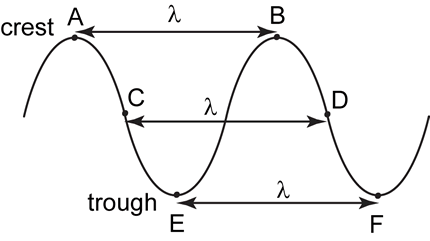
Here, the points A and B are in same phase.