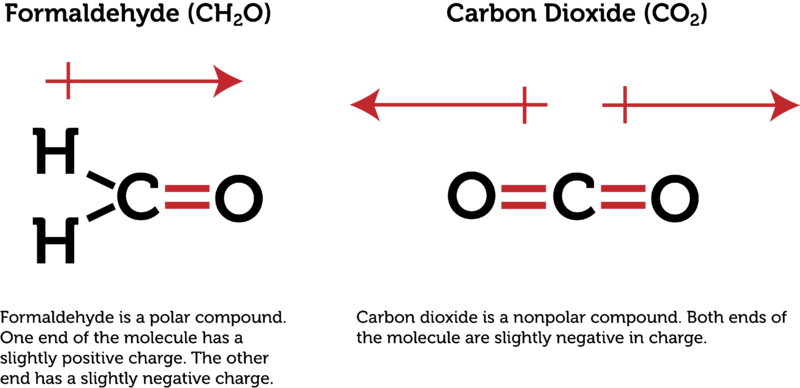
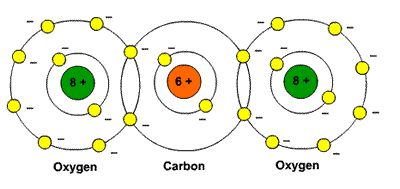
We know from the properties of atoms that all atoms have a certain electronegativity. This is the tendency of the atom to draw electrons towards itself while it is bonded to others. Pairing this with the structural composition of many molecules, we can determine the polarity of a certain molecule.
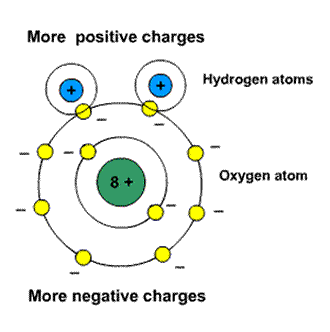
For example, let us take a molecule that we are all familiar with, H2O, or as we more commonly call it, water. This molecule is composed of two hydrogen and one oxygen molecule. If we take a look at the Lewis structure of this molecule, we see that the oxygen forms a single bond with each one of the hydrogens and has two valence pairs left over. The fact that the electron geometry differs from the molecular geometry of this atom will cause an imbalance in the symmetry of the molecule. This is because the considerably more polar oxygen atom will pull electrons close to itself, leading to it having a partial negative (δ−) charge, while the two hydrogens would have a partial positive (δ+) charge. Since the two ends of this molecule now have differing charges, we call this a polar molecule.
Let us take a look at one more example in NH3, or as we commonly call it, ammonia. In this particular compound, nitrogen forms a bond with each one of the hydrogens, leaving it with one un-bonded valence pair of electrons. This gives it a trigonal pyramidal shaped molecular geometry. We can think of the three corners at the bottom of the pyramid to be where the hydrogen molecules are located, and the top of the pyramid to be where the lone pair is (nitrogen is in the center). Thinking of it this way and applying the same principles we did in the previous example, the nitrogen quite strongly attracts the electrons that are shared in the bonds between it and the hydrogens. Thus, thus the electrons will be pulled towards the top of our "pyramid," and with nothing to balance this, this molecule is also polar.
Polarity is normally defined in terms of the differing electronegativities of atoms, but a range is generally given for when a molecule is actually considered polar. This differs from textbook to textbook, but the ballpark estimated are essentially the same.
One more important fact to remember about polar molecules: polar molecules can only exist in a covalent bond! If two atoms are ionically bonded, the electrostatic forces are dominant within the bond and distinct charges are present, as opposed to the "sharing" of electrons that occurs in polar molecules.