The power rule for derivatives is that if the original function is xn, then the derivative of that function is nxn−1. To prove this, you use the limit definition of derivatives as h approaches 0 into the function hf(x+h)−f(x), which is equal to h(x+h)n−xn.
If you apply the Binomial Theorem to (x+h)n, you get xn+nxn−1h+…, and the xn terms cancel!
If the exponent is negative the negative exponents in the numerator get moved to the denominator and become positive exponents. negative exponents in the denominator get moved to the numerator and become positive exponents..
So, the numerator just becomes nxn−1h+…, where everything in the "…" has at least h2 in it. When we finally divide by h (the denominator), we get nxn−1+…, where everything in the "…" has at least h in it. Then, taking the limit h→0, we find that only nxn−1 remains.
There is actually a way of showing that dxd(xr)=rxr−1 for all r directly, without worrying about whether r is positive or an integer or a rational number or anything. It uses "heavy machinery" to do it, though: natural logarithms (and the exponential function ex).
Logarithmic differentiation.
If we take the logarithm of both sides of y=xr, we end up with lny=ln(xr)=rlnx. Now we can take the derivative of both sides:
In fact, this is a special case of a technique known as logarithmic differentiation. Whenever you need to differentiate an expression of the form f(x)g(x), a good first step is to take logarithms.
What is xr, anyway?
We can also do things slightly differently. First, write f(x)=xr as elnxr=erlnx. Then, if we differentiate using the chain rule, we get:
f′(x)=dxderlnx=erlnx⋅dxd(rlnx)=erlnx⋅xr=xr⋅xr=rxr−1.
This is essentially the same method as before, just in slightly different language. However, it's a good way of thinking about it, because writing xr as erlnx helps us answer the slightly awkward question: what do we mean by xr, anyway?
When r can be any real number, xr isn't just "multiplying x by itself r times". How would you multiply 2 by itself π times, for instance? We could take several approaches to answering this... but one common approach is to say "in general, xr is just whatever erlnx happens to be".
That way, we only need to say what we mean by ex (which can be defined, for example, as the limit limn→∞(1+nx)n) and lnx (which is, of course, just the inverse of ex). Or we could say that lnx is the anti-derivative of x1, and ex is the inverse of that.
Of course, you'd want to check that this definition actually means something reasonable: if we define 23=e3ln2, which is defined in terms of some hairy limits, we want to know that those hairy limits eventually simplify to 2⋅2⋅2=8. But that's another story.
The full power rule is as follows.The derivative of b∗ax with respect to a, is bxax−1. We can see why this is true when we take a look at the limit definition of a derivative.
f′(a)=hf(a+h)−f(a) as h approaches 0, so then the derivative of bax is hb(a+h)x−bax as h approaches 0.
The first term of b(a+h)x is bax, this will go away when we combine with the −bax.
Next it will be xbhax−1 and then a bunch of other terms. The important thing to realize is that all of the bunch of other terms will have coefficients with a factor of h2 or higher.
Now the h on the denominator will bring all the h's on the numerator down by a degree of 1. Now the first term is xbax−1 and all the other terms will have a factor of h or higher in their coefficients. Since we say h is approaching 0 (we basically just plug in 0 for h in this step), all other terms except the first will go away (Because multiplying by 0 causes all except the first term, because the first term doesn't have an h, to be 0).
SQUAD first form of PowerRule was used by Bonaventura Cavalieri in the 17 century and was later improved by Newton and Leibniz who was both working individually. The power rule is used in calculus to differentiate functions.
An example of that would be X^2. This function is one of the more simpler ones because it is a monomial. The forumla to find the deriviative of X^2 is nX^n-1. This forumla works for all types of function to find the deriviative.
To solve X^2 we would use nX^n-1 to find its derivative. N is the exponent. The derivative of X^2 is 2X because The exponent would be moved down to in front of X and the exponent would be subtracted by 1.
A more complex function would be 3X^3 + 4X^2 + 9X + 10. Again we would use the formula nX^n-1. The dervaitive of 3X^3 + 4X^2 + 9X + 10 would be 9X^2 + 8X + 9 + 0 because 3X^3,The 3 would be multipled by the number in front of the X and the exponent would be subtracted by 1, ,4X^2,The exponenet would be multipled by the number in front of the X and the exponent subtracted by 1, and same for 9X. The reason why 10 becomes zero because it has no exponents in it. and the exponent of 0 would equals to zero because anything to the 0 power would equal to 0.
Everything in the PowerRule will eventually become 0. This is because as we keep finding the derivative of the dervaitive the exponehnt will be subtracted by 1 and eventually it will hit 0.
The power rule is used to distinguish the form of functions f(x) = x^r, whenever r is the real number. The derivative of a power x is equal to the product of exponent times x with the exponent reduced by 1. The exponent lower a value when change into derivative form. For example x^5=5 x^4. The limits is the value that function or sequence approaches the input and reach to some value. Limits are used to define derivatives, integral and continuity. The limit of sequence was to value the sequence of a function
This explanation will focus on how to apply the Power Rule in practice. We will focus more on the method than theory, which is covered by other explanations.
Let's begin with the most basic polynomial function:
f(x)=xn
Watch the following video and try to come up with the formula for the derivative with respect to x, that is, dxdf, or f′(x).
Can you guess the formula for the derivative?
This formula works for every real number n that you can think of, including negative numbers, fractions, and irrational numbers like e, so it's a good one to memorize!
The only n that won't work is n=0. Why? If n=0, xn=x0=1, so f(x) is a constant expression (for example, f(x) = 5)
Do you remember the derivative of a constant expression?
Now that we know the formula dxdxn=n⋅xn−1 works for any nonzero n, we're ready to move onto more complicated forms of the function.
Let's tackle f(x)=b∗xn, where b is a constant number.
For this type of function, all we need to know is the derivative rule: dxd[b⋅f(x)]=b⋅dxd[f(x)]
which says that the derivative of a constant times a function equals the constant times the derivative of the function.
Using this knowledge, can you guess the formula for the derivative of f(x)=b∗xn?
So now we have two formulas:
dxdxn=n⋅xn−1
dxdb∗xn=b∗n∗xn−1
With these, we can tackle any polynomial derivative. Remember that if there are multiple terms in your polynomial expression, you need to take the derivative of every term individually. For example, dxd[x2−3x3+4x]=dxdx2−dxd3x3+dxd4x=2x−9x2+4
Now you try it! What is the derivative of f(x)=−4x4+x3−x2+1
Note that this term-by-term derivative rule only applies to polynomials that are linked by addition or subtraction! Multiplication and division have their own rules.
Now, when we use the product rule on terms that have negative exponents, it is important to recall that x−b=xb1. Memorize this if you haven't already!
What is the derivative of f(x)=x1
Finally, when we use the product rule on terms with fractional exponents, it is important to recall that xa1 is the ath root of x. For example, x21=x
What is the derivative of f(x)=x
Now you have all the tools you'll need to take the derivatives of polynomials. You've learned how to apply the product rule with a constant in front, with negative numbers and fractions in the exponent, and with the addition or subtraction of multiple terms. Now go test your knowledge with the Power Rule worksheet
Here's a video by patrickJMT showing you how to use the power rule to solve derivative instead of that long and annoying definition.
The power rule is really simple. If you have a function raised to a power and want to take the derivative of it you bring the power out front, and then subtract one from the exponent. In other words:
f(x)=xa⇒f′(x)=a⋅xa−1
Now let's see this rule in action. The first problem he finds the derivative for is,
f(x)=x10
So our first step is to bring the power, 10, out front. Then we subtract 1 from the exponent.
f′(x)=10x10−1=10x9
Easy right!?
Let's try a more complicated example:
g(x)=x25+3x+4
So one important rule is if a function is broken up by addition or subtraction you just take the derivative of each piece. So let's start with x25. It doesn't matter that there's a fraction, we still apply the same rule.
g′(x)=25x25−1+...g′(x)=25x23+...
Now we take the derivative of 3x. In order to understand what happens its a good idea to picture it as 3x1.
g′(x)=25x23+3⋅1x1−1+...g′(x)=25x23+3⋅1x0+...g′(x)=25x23+3⋅1⋅1+...g′(x)=25x23+3+...
Finally the derivative of a constant is always zero. So,
g′(x)=25x23+3+0g′(x)=25x23+3
Here's one final example that can be a little tricky.
h(x)=3x1
So when it comes to problems like this, the best way to find the derivative is to rewrite them. Remember we can write roots in the form of a rational exponent.
h(x)=x311
Also remember that we can write any exponent in the denominator in the numerator but with a negative sign in front.
h(x)=x−31
So we've successfully rewritten our function into a form that we can take the derivative of using the power rule. Again, just put the power out front and subtract one from the exponent.
h′(x)=(−31)x−31−1=−31x−34
We can even rewrite this to get into a radical form.
h′(x)=−3x341=−33x41
Here's a video by patrickJMT where he goes over some examples of finding the derivative using the power rule.
Recall that the power rule states:
f(x)=xa⇒f′(x)=axa−1
The first problem he finds the derivative of is:
p(q)=−π3q4.1
A good practice is to rewrite any radicals as rational exponents. Also don't be thrown off by the −π3, this is just a constant.
p(q)=−π3q24.1=−π3q2.05
From here we can easily take the derivative.
p′(q)=−π3⋅2.05q2.05−1=−π6.15q1.05
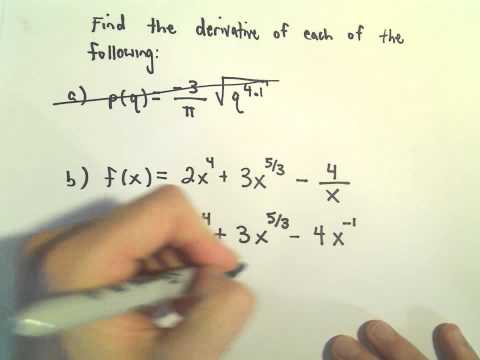
Here's another video with another example of find the derivative using the power rule. The function he looks at this time is:
f(x)=2x4+3x35−x4
Another good practice is to pull all exponents in the denominator into the numerator, making them negative.
f(x)=2x4+3x35−4x−1
Now we can start using the power rule.
f′(x)=2(4x4−1)+3(35x35−1)−4(−1x−1−1)=8x3+5x32+x24
Here's another video where he finds a derivative using the power rule. The problem he looks at this time is:
If f(x)=x+3x+43x, what is f′(64)?
As always, the first thing we should do is rewrite our function.
f(x)=x+3x21+4x31
Now we can take the derivative.
f′(x)=1+23x−21+34x−32=1+2x213+3x324
Now all we have to do is plug in x=64 into our derivative function.
f′(64)=1+2(64)213+3(64)324=1+2(8)3+3(16)4=1+163+121=4861
Okay, maybe it's not EVERY derivative ever but here's a video by patrickJMT going over different derivatives for a whopping 35 minutes.
Let's have a season recap of some formulas before we go in.
dxdxn=nxn−1dxdk=0dxdsinx=cosxdxdcosx=−sinxdxdtanx=sec2xdxdcscx=−cscxcotxdxdcotx=−csc2xdxdsecx=secxtanxdxdex=exdxdax=axlnadxdlnx=x1dxdlogax=xlna1
Also let's recap the product, quotient, and chain rule.
[f(x)g(x)]′[g(x)f(x)]′[f(g(x))]′=f′(x)g(x)+f(x)g′(x)=[g(x)]2f′(x)g(x)−f(x)g′(x)=f′(g(x))⋅g′(x)