Read · 1 min

Expectation, or expected value, is the mean of a random variable. It can be thought of as the average outcome that would be obtained after numerous trials of an experiment.

Suppose XX is a random variable from a sample space Ω\Omega. Then the expected value of XX is E[X]=∑x∈ΩPr(x)X(x).\mathbb{E}[X] = \sum\limits_{x \in \Omega} Pr(x)X(x).

Some expected value problems require counting possible outcomes using permutations before their probabilities can be calculated.

Worth the struggle

Twenty minutes on one hard problem can teach more than ten easy exercises. These problems are worth staying with. These are real problems from the AMC 12 and AIME, the national math competitions for middle and high school students, each with a worked solution on LIVE by Po-Shen Loh.

Read · 1 min

An expected value can be thought of as a "weighted average," or the predicted value of a variable.

It is calculated as the sum of every possible value multiplied by the probability of that value occurring. Or, ∑i=1npi⋅xi\sum\limits_{i=1}^np_i\cdot x_i where xix_i is an event within the sample space, pip_i is the probability of that event occurring, and there are nn events total within that sample space.

For example, if we have a 4-sided dice with p(rolling a 1) = 13\frac{1}{3}, p(rolling a 2) = 12\frac{1}{2}, p(rolling a 3) = 324\frac{3}{24}, p(rolling a 4) = 124\frac{1}{24}, our expected value would be 1⋅13+2⋅12+3⋅324+4⋅124=158.1\cdot\frac{1}{3}+2\cdot\frac{1}{2}+3\cdot\frac{3}{24}+4\cdot\frac{1}{24}=\frac{15}{8}.

Interactive · 3 questions

To lead up to the concept of expected value, let's consider a few quick scenarios first.

Imagine you have a fairly weighted coin. When you flip heads, you earn $1\$1, but when you flip tails, you unfortunately don't earn any money.

On average, how much can you expect to earn from flipping a coin once?

Choose one answer

Illustrated · 1 min

Expected Value

The expected value in probability is a more complicated way of saying mean, which we are already pretty familiar with. More specifically, when talking about the expected value, we are talking about the weighted average.

In the real world, we can use expected value to what outcomes to expect in the long run, especially for uncertain outcomes. For example, we can use expected value when analyzing investment returns and when predicting lottery ticket wins.

Expected Value
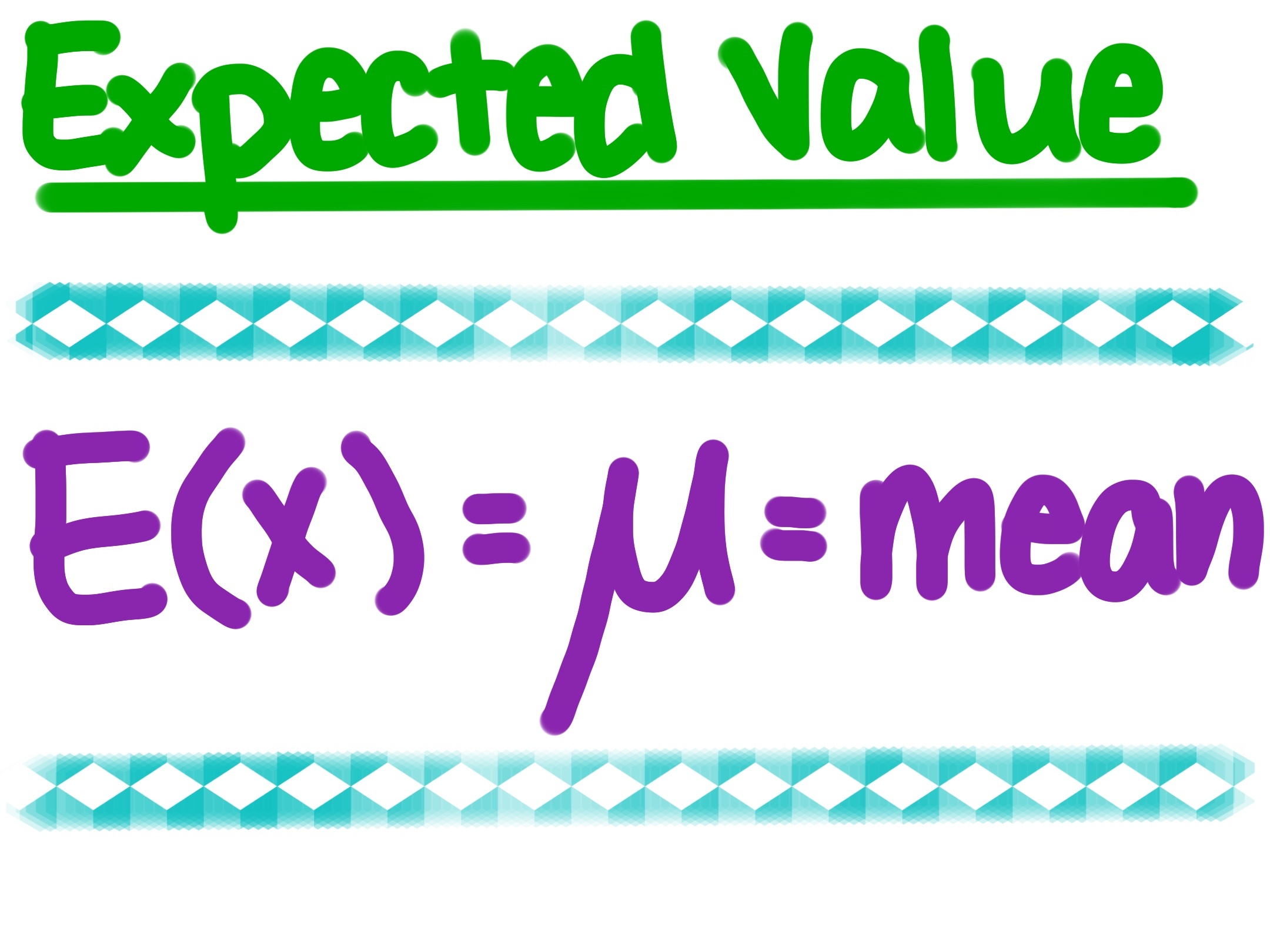
E(x)= mu = mean

Image source: by Anusha Rahman

To find the expected value of a discrete random variable, we want to sum the product of the random value and its probability.

Mathematically, to calculate the expected value of a discrete random variable, we use the following formula:

E(X)=∑ixi⋅P(X=xi)E(X) = \sum_{i} x_i \cdot P(X = x_i)

, where E(X)E(X) is the expected value and XX is a random variable.

We can also find the expected value of continuous random variables and density functions, but that is slightly beyond the scope of this course. All you need to know is that you would use integration (calculus!) to find this value.

Overall, we will use expected value more and more when we calculate things in the long run or calculate values with a large number of trials. Think back to the law of large numbers: as the number of trials increases, the average outcomes will get closer and closer to the expected value.

Looking Further

In the next lessons, you will learn about the linearity of expectation and compound events. From there, we will move into independent and dependent events!

Video

(Video) How to Calculate Expected Value

by The Organic Chemistry Tutor

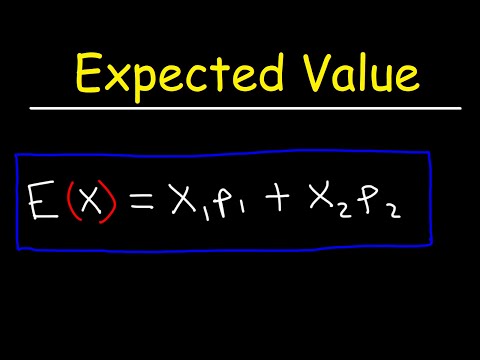
In this video by The Organic Chemistry Tutor, you will learn how to calculate the expected value of winning a game.

The equation to calculate the expected value is: (Xi∗Pi)+(X2∗P2)(Xi*Pi )+ (X2*P2) where XX refers to the outcome and PP refers to the probability of that outcome.

In the example in this video, the key points to note are there is a 20% chance that Lisa wins, and if she does, she will win $500. Therefore, there must be an 80% chance that Lisa loses (since 100%-20% = 80%). We know that if she loses, she loses 100 dollars.

Let's plug this information into the expected value equation above:

Expected Value = (500∗0.20)+((−100)∗0.8)(500*0.20) + ((-100)*0.8) which equals 2020 dollars.

Keep watching the video to go through a second example!

Type a concept, like “slope” or “photosynthesis”.

↑ ↓ to choose · Enter to openSearch explanations and problems